2026-06-05 - Tense, procedural, and credibility-focused
Zelenskyy calls for direct Ukraine war negotiations with
One closed daily edition: image, reading, signals, sources, and provenance for this date.
AI-generated content. No prior human review.
Editorial Reading
The day’s strongest signal is a politics of accountability under strain: Ukraine’s Volodymyr Zelenskyy publicly urged Vladimir Putin to meet face to face in a neutral country, framing negotiation as urgent while the war’s diplomatic path remains uncertain. In Australia, ASIC opened an investigation into KPMG following whistleblower claims, while parliamentary argument continued over the scrutiny and timing of major tax reforms due to take effect in 2028.
Australian politics also saw confusion around One Nation’s housing policy after senior figures struggled to explain its details in broadcast interviews. In the United States, legal and electoral pressure remained visible, with reports that John Bolton is expected to plead guilty in a classified-documents case and Maine Senate candidate Graham Platner denying newly reported allegations about past conduct.
Why this mattered
These developments are tied less by geography than by a shared editorial thread: institutions, candidates, and wartime leaders are being tested in public view. The Ukraine signal is the clearest geopolitical flashpoint, but the surrounding stories all concern trust, scrutiny, and the consequences of contested narratives—whether in corporate governance, parliamentary procedure, campaign vetting, or national-security law.
Elsewhere in the world
Beyond the top diplomatic and legal headlines, Australia’s domestic debate reflected a wider concern about whether complex policy is being developed and scrutinized transparently, from tax reform to housing proposals. Court-process reforms for victim-survivors also remained part of the Australian public agenda, showing how legal systems continue to adjust around dignity, language, and procedural harm.
Climate and technology signals were comparatively muted in this set, leaving governance, war diplomacy, and political credibility as the dominant lenses.
What moved the day
- Zelenskyy calls for direct Ukraine war negotiations with Putin in a neutral third country
- Zelenskyy publishes open letter saying the time to end the war is now
- ASIC launches investigation into KPMG after whistleblower claims
- Australian opposition criticizes limited parliamentary scrutiny of major tax reforms
- One Nation figures struggle to explain housing policy in broadcast interviews
- Reports say John Bolton is expected to plead guilty in a classified-documents case
- Maine Senate candidate Graham Platner denies newly reported allegations about past conduct
- Australian court-process reforms for victim-survivors remain in focus
Still moving
- Ukraine-Russia diplomacy and the prospects for any direct leader-level talks
- Scrutiny of Australian tax reforms scheduled for 2028
- Corporate-governance questions around KPMG following whistleblower claims
- Australian housing policy debate and party-policy coherence
World Signals
- conflict 92
- innovation 18
- resilience 83
- fragility economic 77
- pressure climate 16
- cultural pulse 56
Why the image looks like this
Visual frame
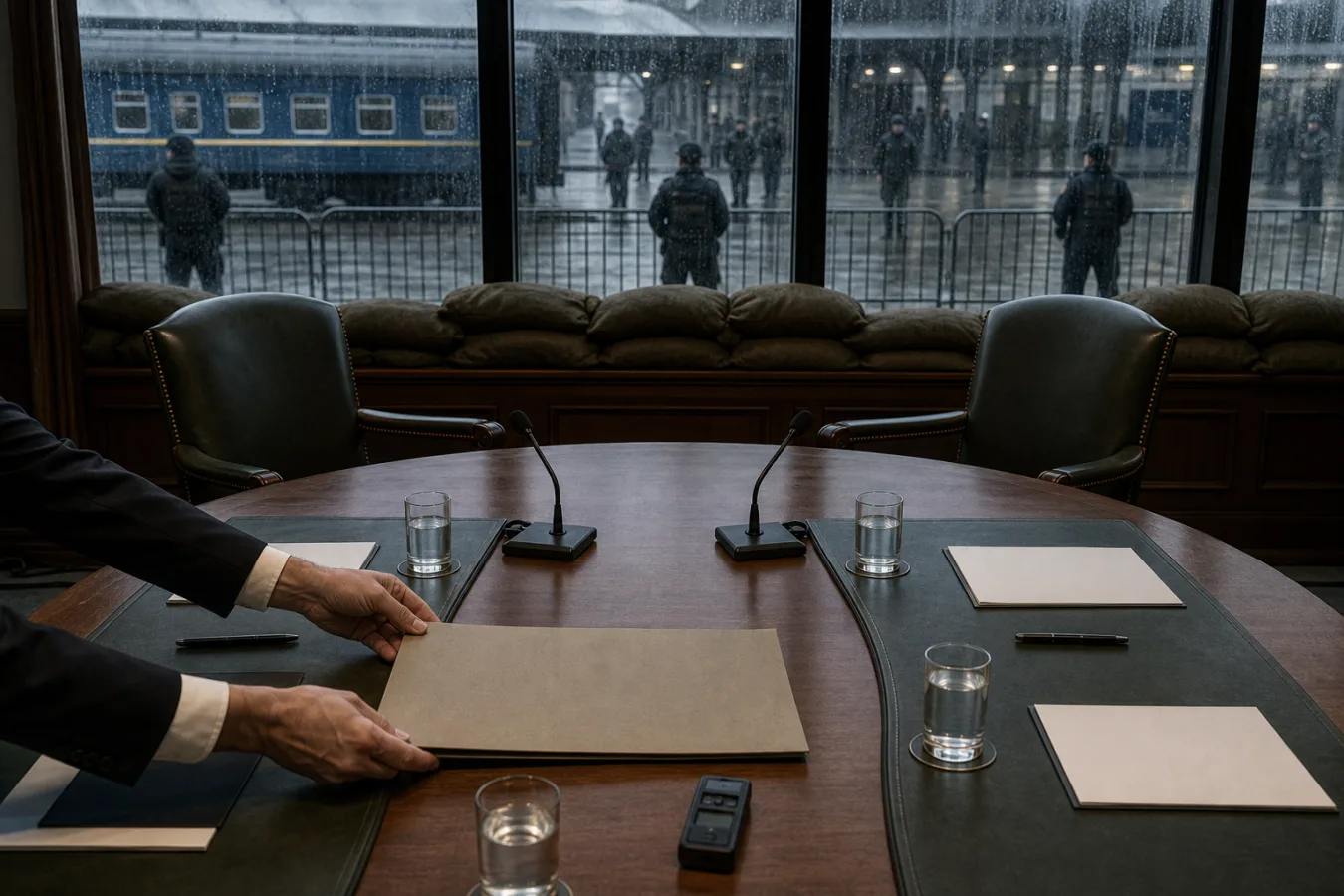
Tense, procedural, and credibility-focused An anonymous mediator’s hands slide an unsigned folder across an empty diplomatic table while rain and security barriers press against the conference room window.
Visual logic
The image translates the day into one readable scene, choosing spatial depth, environmental pressure, and tactile detail over a generic symbolic collage so the editorial reading remains legible.
Concept
Tense, procedural, and credibility-focused editorial composition anchored on zelenskyy calls for direct ukraine war negotiations with putin in a neutral third country.
How it was framed
Composition focuses on single dominant focal mass, foreground anchor with a readable midground transition and decisive background counterforce, human-scale depth cues across foreground and midground, and full-bleed coverage to the edges of the frame.
Visual direction leans on Full-bleed, edge-to-edge diplomatic table seen from above, with no white margins, Layered newsprint collage of legal documents, parliamentary benches, and campaign microphones, and Muted portrait grid suggesting public accountability without caricature.
Material treatment uses editorial paper grain, soft matte ink, atmospheric glaze, and high-contrast material edges to keep the image tactile rather than generic.
Color language is built around Diplomatic Slate, Courtroom Umber, Parliament Green, and War-Room Blue.
Sources
Australia news live: ASIC launches investigation into KPMG after whistleblower claims
Open sourceBarnaby Joyce and One Nation colleague bungle details of key housing policy in ‘trainwreck’ interviews
Open sourceZelenskyy calls for face-to-face Ukraine war negotiations in letter to Putin
Open sourceGraham Platner says allegations of physical abuse of former partner ‘are simply not true’ – as it happened
Open source‘You can stop your war’: Zelenskyy’s open letter to Putin – in full
Open sourceMaine Senate candidate Graham Platner rejects new allegations of abusive behavior
Open sourceRelated editions
The World Canvas for 2026-06-06
The day’s world-state is shaped by renewed military danger in the Gulf, unsettled electoral politics across several democratic arenas, and institutional scrutiny over failures of care and public safety. The sharpest signal comes from the Middle East, where the US and Iran exchanged strikes after drones were launched toward the Strait of Hormuz, prompting Kuwait and Bahrain to issue air-raid alerts and again testing a fragile ceasefire. In parallel, California’s governor’s race and Los Angeles municipal politics point to a volatile US electoral cycle, while Victoria’s leadership speculation underscores how integrity reform and campaign pressure can destabilize incumbents before voters are heard. Beyond geopolitics, a Tasmanian coroner’s finding that irresponsible prescribing directly contributed to two deaths places medical oversight and addiction care back in focus, while the killing of actor James Handy adds a localized but culturally resonant public-safety story.
The World Canvas for 2026-06-04
The day’s world-state is defined by overlapping attempts to contain political and security pressure before it widens: in the Middle East, a reported Iranian missile and drone attack on Kuwait’s international airport killed one person and injured dozens even as US-led ceasefire and Iran-related talks continued, while Israel and Lebanon agreed to renew a ceasefire under conditions aimed at halting Hezbollah fire in the south. In domestic politics, Australia’s Labor government pushed a tax package through the lower house after contested amendments, framing the vote around worker tax cuts and housing affordability, while US political attention stayed fixed on candidate selection, intelligence leadership scrutiny, and unsettled mayoral and midterm contests. The common thread is institutional stress management: parliaments, courts, campaigns, and diplomatic channels are all trying to absorb conflict without letting it spill into broader disorder.
The World Canvas for 2026-06-07
The day’s signals point to societies trying to manage pressure at several levels at once: household finances are thinning, social housing shortages remain structurally severe, and industrial policy is struggling to keep pace with the electric-vehicle transition. Technology’s consumer-facing promise is also under scrutiny, with reports of AI-assisted shopping journeys leading users toward fraudulent retail sites. Public safety and social cohesion remain prominent concerns, from arrests after an alleged machete brawl in Melbourne to legal proceedings in the US examining alleged attacks on Jewish communities in Europe. Alongside these strains, cultural life still asserts itself through debates over how loud, open and civic public spaces such as the Sydney Opera House should be.
The World Canvas for 2026-06-03
The day’s signal is dominated by democratic process and institutional trust: US midterm primaries are sharpening the November landscape, while a Supreme Court order allowing Alabama to use a congressional map that removes a majority-Black district adds a major voting-rights flashpoint to the cycle. In Australia, domestic politics is turning on tax fairness and the public meaning of complex financial structures, while a separate controversy over an academic’s AI-assisted opinion piece has widened the debate over authorship, integrity, and how institutions should govern generative tools. Around the edges, political memory and personal narrative remain part of the public record, with Jill Biden’s memoir event revisiting the pressures that led Joe Biden to leave the 2024 race.
Method and provenance
Image prompt
Full-bleed editorial realism: a high oblique view across a neutral alpine conference room table, dominant subject an empty oval diplomatic table with two vacant chairs facing each other and a mediator’s anonymous hands carefully sliding a plain unsigned folder toward the center, anatomically correct hands with one clear gesture and natural wrists. Foreground shows matte paper, capped pens, water glasses, and a small recorder with no labels; midground transitions through paired microphones and a narrow gap between the chairs; background counterforce is a rain-streaked window with sandbags at the sill, police barriers, and a dim railway platform beyond, suggesting war pressure outside the procedural room. Muted Diplomatic Slate, Courtroom Umber, Parliament Green, and War-Room Blue palette, natural overcast light, crisp material edges, documentary scale, no readable text, no recognizable leaders or flags.
Full Source Layer for This News Digest
Australia news live: ASIC launches investigation into KPMG after whistleblower claims
Open sourceBarnaby Joyce and One Nation colleague bungle details of key housing policy in ‘trainwreck’ interviews
Open sourceZelenskyy calls for face-to-face Ukraine war negotiations in letter to Putin
Open sourceGraham Platner says allegations of physical abuse of former partner ‘are simply not true’ – as it happened
Open source‘You can stop your war’: Zelenskyy’s open letter to Putin – in full
Open sourceMaine Senate candidate Graham Platner rejects new allegations of abusive behavior
Open source