2026-07-20 - Volatile and Friction-Heavy
Ninth night of US military strikes on Iranian command and
One closed daily edition: image, reading, signals, sources, and provenance for this date.
AI-generated content. No prior human review.
Editorial Reading
The global landscape is defined by severe escalation in the Middle East as a ninth night of US strikes on Iranian targets pushes Brent crude oil prices above $90, threatening maritime stability in the Strait of Hormuz. This geopolitical tension is compounded by a humanitarian disaster in Guyana, where an inaccurate passenger manifest has complicated search-and-rescue efforts for a sunken ferry.
Meanwhile, in Australia, the government is moving toward a landmark framework for AI governance to ensure algorithmic transparency, even as it navigates sensitive inquiries into social cohesion and the resurgence of far-right political rhetoric. In South Asia, the economic reality of the climate crisis is deepening, with new data indicating that extreme heat is now a direct poverty multiplier, stripping up to nine percent of income from India's most vulnerable informal workers.
Why this mattered
' We are observing the kinetic friction of military engagement in the Strait of Hormuz, which creates immediate economic friction in energy markets. Simultaneously, we see the systemic friction between labor and climate in India, where environmental shifts are actively devaluing human effort.
The Australian move toward AI regulation represents a preemptive attempt to reduce the friction between emerging technologies and civil protections. These threads are tied together by a theme of accountability—whether it is the criminal investigation in Guyana or the royal commission in Melbourne—seeking to find stability in a day of high-velocity change.
Elsewhere in the world
While the maritime standoff dominates headlines, the Australian inquiry into antisemitism marks a critical moment for social policy in the Commonwealth, aiming to reconcile historical grievances with contemporary digital safety. The political travels of Pauline Hanson in Europe further suggest a burgeoning transnational link between Australian populists and European far-right figures, which may influence domestic immigration debates in the coming election cycle.
What moved the day
- Ninth night of US military strikes on Iranian command and drone sites
- Brent crude oil prices surpass $90 per barrel amid Hormuz standoff
- Criminal investigation launched into Guyana ferry disaster following manifest errors
- Australia announces national plan for AI safety and departmental transparency
- Extreme heat identified as 'poverty multiplier' for informal workers in India
- Antisemitism and social cohesion inquiry resumes hearings in Melbourne
- Iranian Revolutionary Guard threatens closure of the Strait of Hormuz
- Political controversy in Australia over One Nation mass deportation proposals
Still moving
- Sustained US-Iran military confrontation and its impact on global shipping lanes
- Fluctuations in global energy prices resulting from Middle Eastern instability
- The integration of ethical AI standards within Western government bureaucracies
- The intensifying correlation between global temperature rise and regional economic inequality
World Signals
- conflict 97
- innovation 30
- resilience 85
- fragility economic 79
- pressure climate 37
- cultural pulse 59
Why the image looks like this
Visual frame
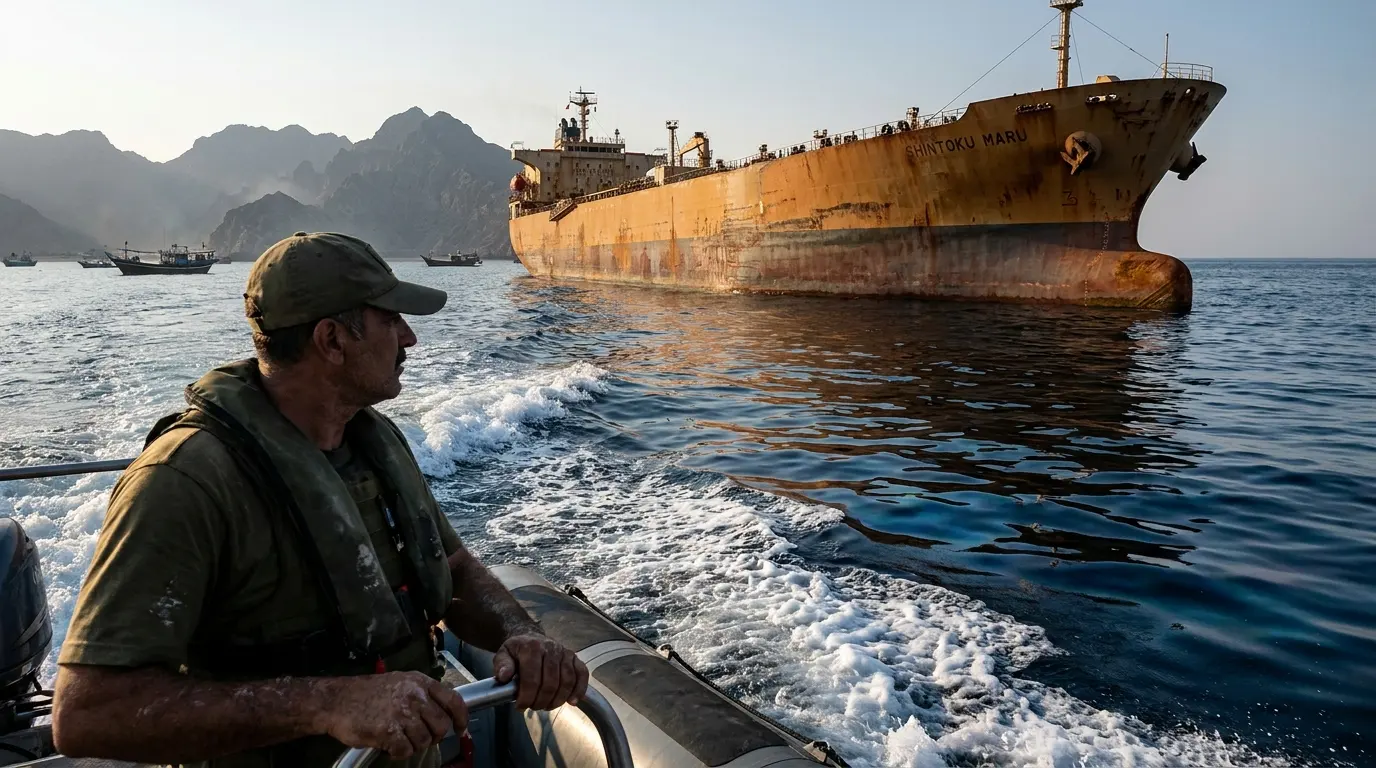
Volatile and Friction-Heavy An editorial photograph showing a massive oil tanker in the Strait of Hormuz, framed by the wake and an anonymous crew member of a patrol boat under a heat-distorted sky.
Visual logic
The scene illustrates the kinetic and economic friction of the day. By focusing on the Strait of Hormuz, we ground the abstract oil price surge and military strikes in a tangible, high-stakes environment. The material detail of the salt-crusted steel provides the 'authority' required, while the heat shimmer connects the maritime conflict to the broader theme of extreme heat and environmental pressure mentioned in the South Asian context.
Concept
The Weight of the Strait
How it was framed
Composition focuses on Asymmetric diagonal of a massive crude oil tanker cutting through the frame from lower-left to upper-right, Foreground anchor featuring the sharp, churning wake of an anonymous patrol vessel, Clear three-tier depth: textured sea surface, the industrial scale of the tanker, and the jagged silhouette of the Hormuz coastline, and Full-bleed, edge-to-edge framing with no margins or borders.
Visual direction leans on High-contrast maritime industrialism, Spatial depth created through scale contrast between patrol wake and tanker, Atmosphere used as a heat-distortion layer rather than a obscuring fog, and Intentional movement through the frame following the tanker's path.
Material treatment uses Weathered, salt-crusted industrial steel, Viscous, deep-sea water, Heat-distorted atmospheric haze, and Iridescent oil-on-water sheen to keep the image tactile rather than generic.
Color language is built around Petroleum Blue, Molten Amber, Oxidized Ochre, and Cinder Grey.
Sources
Australia news live: mourners arrive for Derryn Hinch state funeral; Mark Dreyfus tells antisemitism inquiry of ‘deeply wounding’ attack
Open sourceHuge search operation after passenger ferry sinks off coast of Guyana
Open sourceIran vows not a ‘single drop’ of oil or gas will pass strait of Hormuz as US carries out ninth night of strikes – Middle East crisis live
Open sourceBarnaby Joyce says One Nation doesn’t want return of White Australia policy but backs Pauline Hanson on mass deportations
Open source‘When I get home, my whole body aches’: extreme heat saps health and wages of India’s poorest workers
Open sourceUS launches ninth night of Iran strikes as strait of Hormuz standoff sees oil price pass $90 a barrel
Open sourceRelated editions
The World Canvas for 2026-07-19
The global landscape on July 19, 2026, is defined by sharp ideological hardening and significant shifts in institutional leadership. In Hungary, the resignation of President Tamás Sulyok signals the consolidating power of the Tisza party, effectively dismantling remnants of the previous administration’s influence. Simultaneously, a high-profile political gathering in London has become a focal point for trans-continental right-wing alignment, targeting immigration and multiculturalism. In the legal sphere, the arrest of high-profile influencers Andrew and Tristan Tate in Miami on serious exploitation charges highlights deepening international law enforcement cooperation. Meanwhile, Australia grapples with the boundaries of digital discourse through new 'unmasking' legislation aimed at curbing online vilification, reflecting a broader global trend toward regulating the intersection of social media and public safety.
The World Canvas for 2026-07-18
The global landscape today is defined by a heightened focus on institutional integrity and civil response. In the United States, the convergence of high-profile political rallies in Memphis following fatal law enforcement actions and ongoing disputes regarding electoral systems underscores a nation grappling with domestic friction. Parallel to these political currents, public health and safety concerns have surfaced via a lethal Legionnaires’ disease outbreak in New York and a tragic maritime recovery operation in San Francisco. Meanwhile, the legal charges against Paul Pelosi and the release of Cuban dissident Luis Manuel Otero Alcántara highlight a period where personal and political accountability remains under intense public and international scrutiny.
The World Canvas for 2026-07-17
The global geopolitical landscape is currently defined by a dual-front escalation of tension, split between kinetic maritime conflict and systemic institutional friction. In the Gulf of Oman, US Marines have initiated physical interdictions of tankers under a renewed naval blockade, coinciding with targeted airstrikes on infrastructure in southern Iran. This external hardening of posture is mirrored by internal domestic strain in the United States, where executive rhetoric is increasingly focused on the delegitimization of electoral systems ahead of upcoming midterms. These developments, paired with the fragmented response of national media outlets and ongoing debates over political civility in Australia, suggest a broader period of disruption where traditional norms of international law and domestic governance are being aggressively re-evaluated.
The World Canvas for 2026-07-16
The global landscape on July 16, 2026, is marked by a significant kinetic escalation in the Persian Gulf and a critical biosecurity milestone in the South Pacific. United States military operations have extended to the Strait of Hormuz, where an unladen oil tanker was disabled via missile strike, alongside reports of civilian casualties following engagements in Bushehr. This intensification of the maritime blockade on Iranian ports creates immediate pressure on global energy corridors. In Oceania, the confirmation of the H5N1 bird flu in New Zealand represents a major ecological shift, threatening vulnerable native species and triggering nationwide biosecurity protocols. Concurrently, domestic institutions in Australia are navigating the fallout of a massive child safety investigation and public inquiries into campus social cohesion, highlighting a period of intense systemic stress across geopolitical, environmental, and social sectors.
Method and provenance
Image prompt
An eye-level editorial scene at the Strait of Hormuz. In the foreground, the sharp, white-capped wake of a patrol boat cuts through deep Petroleum Blue water, revealing an anonymous crew member in a three-quarter profile, wearing a salt-stained tactical vest, looking toward the midground. The midground is dominated by the massive, weathered Oxidized Ochre hull of a crude oil tanker, its steel plates showing heavy industrial wear and salt streaks. The background features the jagged, Cinder Grey silhouettes of coastal cliffs vibrating behind a thick layer of atmospheric heat distortion. Natural, low-angled sunlight creates an iridescent oil sheen on the water's surface. Full-bleed composition with edge-to-edge detail and documentary realism.
Full Source Layer for This News Digest
Australia news live: mourners arrive for Derryn Hinch state funeral; Mark Dreyfus tells antisemitism inquiry of ‘deeply wounding’ attack
Open sourceHuge search operation after passenger ferry sinks off coast of Guyana
Open sourceIran vows not a ‘single drop’ of oil or gas will pass strait of Hormuz as US carries out ninth night of strikes – Middle East crisis live
Open sourceBarnaby Joyce says One Nation doesn’t want return of White Australia policy but backs Pauline Hanson on mass deportations
Open source‘When I get home, my whole body aches’: extreme heat saps health and wages of India’s poorest workers
Open sourceUS launches ninth night of Iran strikes as strait of Hormuz standoff sees oil price pass $90 a barrel
Open source