2026-07-14 - Escalatory and Fragmenting
US forces execute third consecutive night of strikes on
One closed daily edition: image, reading, signals, sources, and provenance for this date.
AI-generated content. No prior human review.
Editorial Reading
The geopolitical landscape is characterized by a sharp intensification of conflict as the United States enters a third night of military strikes against Iranian infrastructure, prompting a formal blockade of the Strait of Hormuz. This shift has triggered immediate retaliatory strikes from Iran against American facilities in Bahrain and commercial tankers, threatening global energy transit.
Simultaneously, the United States is signaling a significant pivot away from international legal frameworks as the Secretary of State launches a campaign to dismantle the International Criminal Court. Domestic issues elsewhere, such as the debate over artificial intelligence regulation in Australia and the infiltration of organized crime into Melbourne's hospitality sector, highlight a world struggling with both high-intensity kinetic warfare and the complex management of emerging technologies and systemic criminality.
Why this mattered
The central theme for this cycle is the erosion of established international norms and the rise of unilateral state action. The kinetic escalation in the Persian Gulf acts as a primary signal of diplomatic breakdown, which is then reinforced by the administrative push against the International Criminal Court.
This move toward absolute sovereignty over global consensus creates a feedback loop where military force and domestic isolationism become the dominant tools of statecraft. The death of cultural figure Sam Neill and the concerns over AI governance provide a counter-narrative of human heritage and the need for new ethical frameworks amidst the chaos of regional conflict.
Elsewhere in the world
While the Gulf conflict dominates headlines, the underlying tension between technological advancement and regulatory oversight is surfacing in Australia's stance on AI. Furthermore, the death of Sam Neill marks a moment of collective cultural reflection in the Southern Hemisphere, contrasting with the high-stakes political maneuvering in the United States primary elections where established endorsements are being tested against new political identities.
What moved the day
- US forces execute third consecutive night of strikes on Iranian military targets
- Formal blockade of the Strait of Hormuz announced by the US administration
- Iranian missiles and drones target American military facilities in Bahrain
- Secretary of State Marco Rubio initiates campaign to dismantle the ICC
- Australian MP Ed Husic warns against corporate self-regulation of AI
- Passing of acclaimed actor Sam Neill at age 78
- Arrest of syndicate leader linked to Melbourne hospitality arson attacks
- Fatal ICE shooting of a Colombian national in Maine draws local scrutiny
Still moving
- Sustained naval and aerial hostilities in the Persian Gulf corridor
- Global economic fallout from the closure of the Strait of Hormuz
- Strategic realignments in response to US challenges to international judicial bodies
- Continued investigation into transnational crime links within Australian hospitality
World Signals
- conflict 99
- innovation 51
- resilience 62
- fragility economic 77
- pressure climate 21
- cultural pulse 35
Why the image looks like this
Visual frame
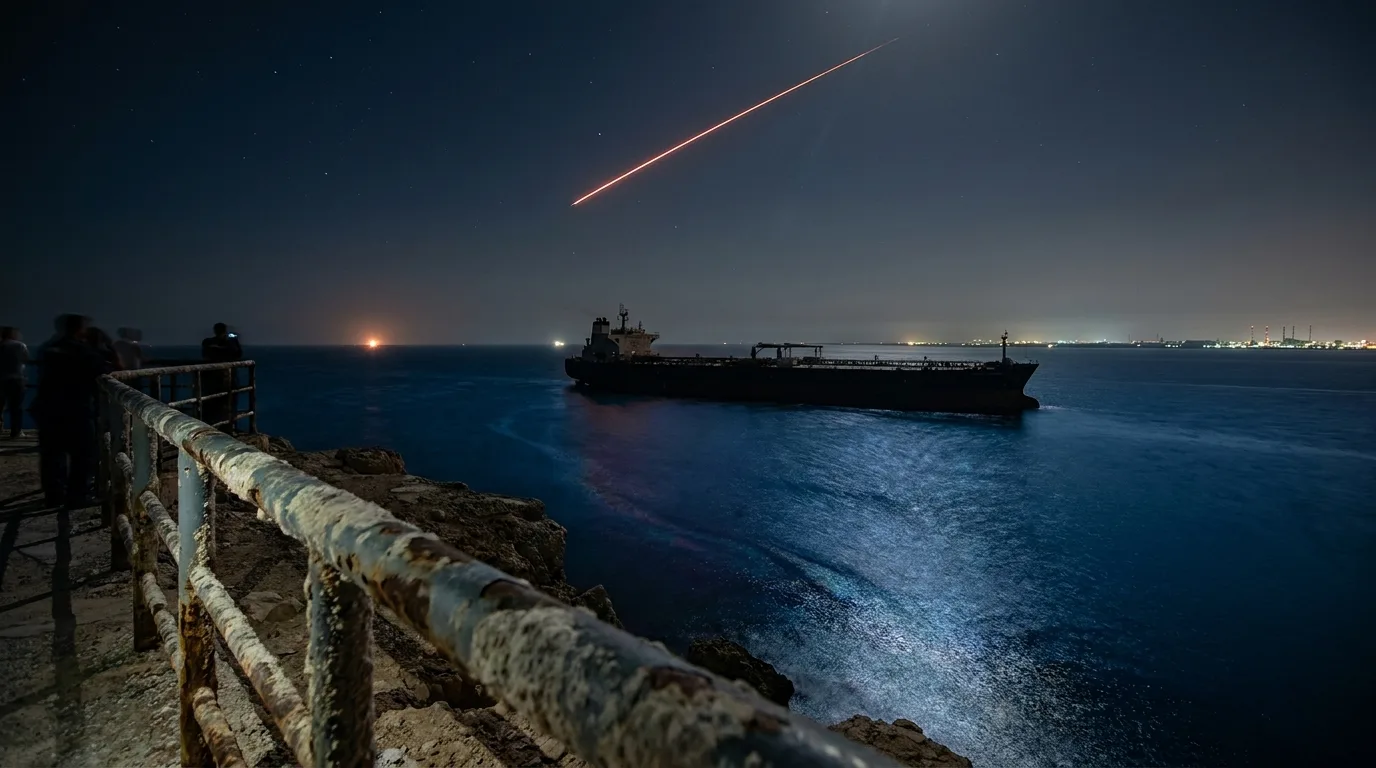
Escalatory and Fragmenting A night-time long-exposure photograph of a stalled oil tanker in the Strait of Hormuz, framed by a salt-crusted railing in the foreground and a red missile streak in the dark sky.
Visual logic
The scene grounds the geopolitical escalation in a tangible, human-scale environment. By focusing on the physical blockade and the kinetic response, the image avoids abstraction in favor of a high-stakes maritime reality. The contrast between the heavy, static tanker and the fast, light-emitting missile arc visualizes the 'Escalatory and Fragmenting' mood of the day, while the material detail of the salt-crusted railing provides the necessary authority and presence.
Concept
The Unilateral Horizon
How it was framed
Composition focuses on Asymmetric balance with a foreground anchor of a salt-crusted naval railing on the lower left, A massive, dark silhouette of a stalled oil tanker dominating the midground right, A single, sharp diagonal arc of a missile interceptor cutting through the upper third of the frame, and Deep spatial progression from the textured foreground to a distant, glowing coastal horizon.
Visual direction leans on High-contrast night photography, Long-exposure light trails with sharp structural definition, Tactile material focus on industrial surfaces, and Atmospheric depth created through light direction rather than haze.
Material treatment uses Rusted industrial steel, Iridescent crude oil sheen, Salt-crusted metal, and Ionized atmospheric glow to keep the image tactile rather than generic.
Color language is built around Persian Blue, Petroleum Black, Oxide Red, and Tactical Gray.
Sources
Middle East crisis live: US strikes Iran for third consecutive night; UAE says Tehran has hit tankers in strait of Hormuz
Open sourceAustralia news live: Ed Husic warns AI companies can’t be trusted to regulate themselves; academic tells antisemitism inquiry of ‘highly personal’ attack
Open sourceTrump says US reinstating blockade on Iranian ports – as it happened
Open sourcePolice claim breakthrough in Melbourne’s hospitality wars, alleging links to overseas crime figure
Open sourceICE fatally shoots 26-year-old Colombian man in Maine during immigration operation – as it happened
Open sourceMarco Rubio launches campaign to dismantle international criminal court
Open sourceRelated editions
The World Canvas for 2026-07-13
The global landscape on July 13, 2026, is marked by a sharp escalation in the Persian Gulf as the United States and Iran exchange heavy missile and drone strikes, threatening the critical energy artery of the Strait of Hormuz. This geopolitical crisis is mirrored by environmental volatility in Europe, where an exceptional scale wildfire in France's Fontainebleau forest has disrupted primary transit routes during an intense heatwave. Concurrently, domestic tragedies in Thailand and Australia highlight ongoing concerns regarding public safety infrastructure and social cohesion, as a devastating pub fire in Bangkok and a high-profile inquiry into antisemitism in Sydney underscore the varied pressures currently weighing on civil stability.
The World Canvas for 2026-07-12
The global state reflects a period of significant structural friction, primarily centered on the intersection of technological advancement and existing social contracts. In Australia, a pivotal divide has emerged within the Labor government over the regulation of artificial intelligence, as the push for data center investment clashes with the protection of creative intellectual property. This tension is mirrored in the political sphere by a rise in populist sentiment, fueled by a 'stagflation impulse' that ties housing scarcity to immigration. Public safety and communal rituals also face scrutiny following a fatal shooting at a Toronto street festival and a tragic death at a bonfire in Belfast. These events, alongside a crushing sporting defeat for Australia's rugby squad against France, suggest a moment where traditional systems and physical infrastructures are struggling to contain the pressures of a more volatile and economically pessimistic era.
The World Canvas for 2026-07-11
The landscape of July 11, 2026, is marked by a significant recalibration of environmental and administrative priorities alongside the resolution of long-standing international legal pursuits. In the United States, the EPA's finalization of a rule to narrow habitat protections signals a turn toward resource extraction, while at the heart of the capital, the Lincoln Memorial reflecting pool undergoes heavy maintenance amidst a broader effort to revitalize federal landmarks. Tensions remain high in Texas following a fatal encounter involving federal immigration officials, where witness accounts now directly challenge official reports. Internationally, the capture of a fugitive in South Africa and the release of historical evidence in the Peter Falconio case demonstrate the persistent reach of criminal justice across decades and borders.
The World Canvas for 2026-07-10
The current global landscape is defined by a convergence of infrastructure vulnerability and institutional accountability. In Australia, the fallout from a major telecommunications outage has escalated into a police investigation following a potential link to a fatality, highlighting the fragility of critical emergency systems. Simultaneously, the arrival of H5 bird flu in native wildlife marks a significant ecological shift for the continent. Political presence is also under the microscope as leadership commitments to cultural summits are set aside, while in the United States, a fatal error during a federal enforcement operation and unconventional primary results signal ongoing volatility in domestic policy and governance.
Method and provenance
Image prompt
A wide-angle, full-bleed long-exposure photograph of the Strait of Hormuz at night. In the lower left foreground, the sharp, tactile detail of a salt-crusted rusted steel naval railing provides a grounded anchor. The midground is dominated by the massive, dark silhouette of a stalled oil tanker floating on deep Persian Blue water with an iridescent oily sheen. A single, sharp Oxide Red diagonal arc of a missile interceptor cuts through the Petroleum Black sky in the upper third. The distant horizon shows the faint, low Tactical Gray glow of the Bahraini coastline. High-contrast lighting, sharp structural definition, edge-to-edge composition, documentary realism.
Full Source Layer for This News Digest
Middle East crisis live: US strikes Iran for third consecutive night; UAE says Tehran has hit tankers in strait of Hormuz
Open sourceAustralia news live: Ed Husic warns AI companies can’t be trusted to regulate themselves; academic tells antisemitism inquiry of ‘highly personal’ attack
Open sourceTrump says US reinstating blockade on Iranian ports – as it happened
Open sourcePolice claim breakthrough in Melbourne’s hospitality wars, alleging links to overseas crime figure
Open sourceICE fatally shoots 26-year-old Colombian man in Maine during immigration operation – as it happened
Open sourceMarco Rubio launches campaign to dismantle international criminal court
Open source