2026-07-09 - Volatile and Fractured
US military launches second day of strikes on Iranian
One closed daily edition: image, reading, signals, sources, and provenance for this date.
AI-generated content. No prior human review.
Editorial Reading
The global landscape is currently defined by the rapid disintegration of established frameworks, both diplomatic and technical. In the Middle East, the collapse of an interim agreement between the United States and Iran has catalyzed a second day of direct military strikes on Iranian port cities and infrastructure, plunging the region into a state of acute uncertainty and civilian anxiety.
Simultaneously, Australia is grappling with a crisis of domestic reliability as the nation’s primary telecommunications provider, Telstra, struggles to fully restore emergency triple-zero connectivity following a significant network failure. These geopolitical and infrastructural fractures are mirrored in the cultural sphere, where a royal commission in Australia is examining the necessity of independent oversight for public broadcasters, signaling a broader retreat from trust in the systems designed to maintain social and physical security.
Why this mattered
' The editorial logic connects the breakdown of high-level geopolitical memoranda with the granular failure of emergency communication infrastructure. Both represent a breach in the expected stability of modern life.
We are tracking how the collapse of the US-Iran agreement immediately translates into local-level fear in Tehran, while the Telstra outage demonstrates that even advanced economies are highly susceptible to sudden technical fragility. The common thread is the erosion of the 'guaranteed connection'—whether that is a diplomatic channel or an emergency phone line.
Elsewhere in the world
Beyond the headlines of military strikes and network outages, the NATO summit in Ankara is becoming a focal point for a shifting Western stance on Middle Eastern security. The withdrawal of a US Senate candidate in Maine adds a layer of domestic political turbulence to an already strained American executive branch.
In the background, the debate over media oversight in Australia reflects a growing global trend of governments and interest groups seeking greater control over public broadcaster narratives in times of high international tension.
What moved the day
- US military launches second day of strikes on Iranian coastal cities
- Telstra confirms persistent triple-zero emergency call failures after national outage
- President Trump declares US-Iran interim peace agreement is officially over
- Royal Commission hears calls for new oversight committee to vet ABC and SBS coverage
- Graham Platner withdraws from Maine Senate race following sexual assault allegations
- Explosions reported in the Iranian port city of Bandar Abbas and Bushehr province
- NATO summit in Ankara addresses shifting Middle East security dynamics
- South Australian police report ongoing failures in emergency hotline connections
Still moving
- The rapid erosion of the US-Iran interim peace framework and its impact on global oil transit.
- Technical investigation into the redundancy failures of Australia's telecommunications backbone.
- Heightened civilian anxiety and emergency preparedness in Iranian urban centers.
- The institutional response of the ABC and SBS to allegations of social division.
World Signals
- conflict 97
- innovation 51
- resilience 77
- fragility economic 64
- pressure climate 21
- cultural pulse 62
Why the image looks like this
Visual frame
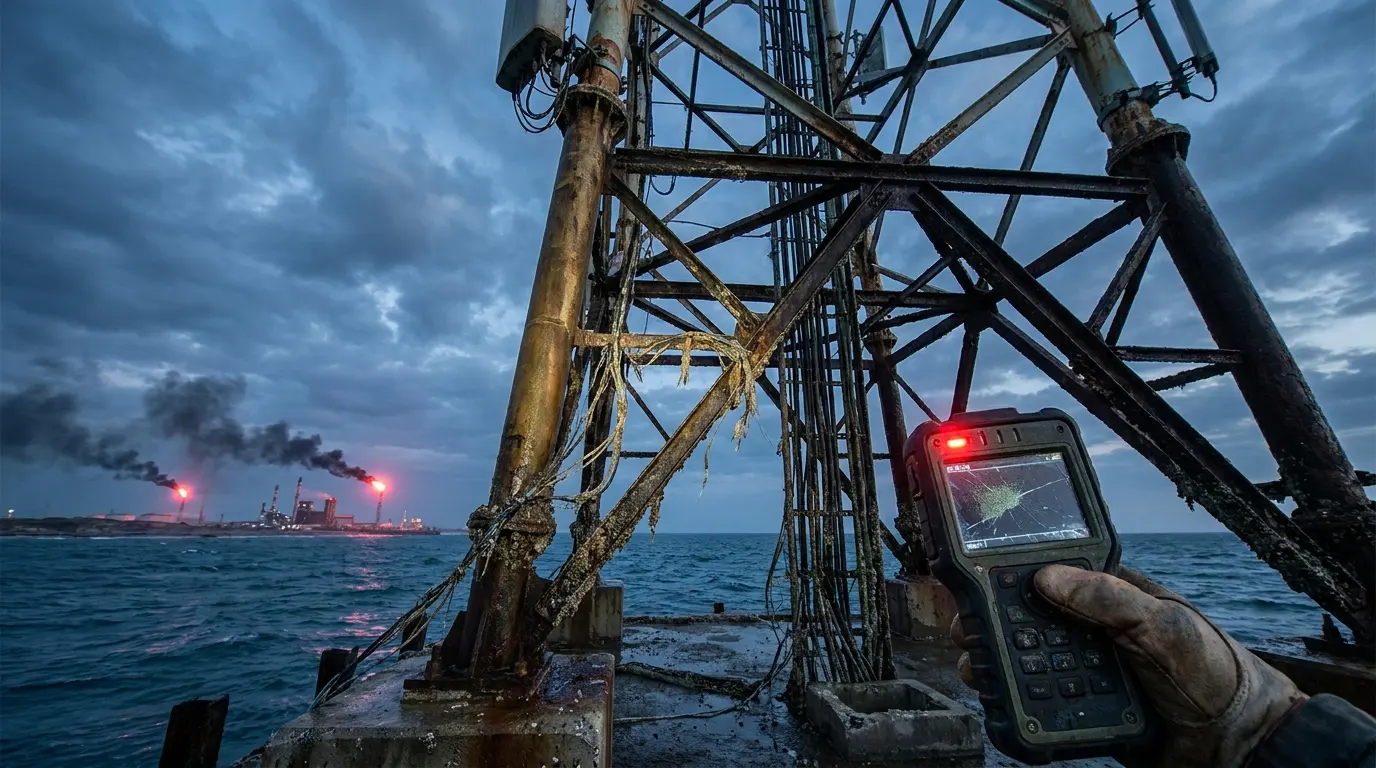
Volatile and Fractured An editorial photograph of a weathered telecommunications tower on a coastline, with a technician's hand holding a glowing diagnostic device in the foreground and smoke rising from a distant port strike across the water.
Visual logic
The scene connects the geopolitical strikes in Iran with the Australian telecommunications failure through the shared motif of broken infrastructure. By using a human-scale foreground (the technician) against a massive, failing pylon, the image emphasizes the vulnerability of the individual when systemic 'guaranteed connections' fail. The palette uses Persian Cobalt to ground the location while Emergency Red provides the focal 'event' of both the device failure and the distant conflict.
Concept
The Severed Failsafe
How it was framed
Composition focuses on Asymmetric wide-angle shot, Foreground anchor of a technician's shoulder and a handheld diagnostic device, Midground dominated by a massive, weathered telecommunications pylon, and Deep background showing a coastal horizon with rising industrial flares.
Visual direction leans on High-contrast industrial realism, Low-angle perspective to emphasize infrastructure scale, Sharp focus on material textures like rust and digital screens, and Atmospheric depth created through light sources rather than haze.
Material treatment uses Oxidized bronze plating, Frayed fiber-optic glass, Cold industrial steel, and Damp coastal concrete to keep the image tactile rather than generic.
Color language is built around Persian Cobalt, Emergency Red, Static Grey, and Oxidized Bronze.
Sources
Australia news live: Telstra says Australians can now ‘feel confident’ calling triple zero; Hanson records podcast with Tommy Robinson
Open sourceABC and SBS need ‘oversight’ committee to vet Israel coverage, Jillian Segal tells royal commission
Open sourceTelstra outage: triple-zero calls affected by network glitches as regional train services slowly resume
Open sourceUS launches strikes on Iran for a second day after Trump says agreement to end the war is ‘over’
Open sourceCeasefire plunged into greater uncertainty amid fresh US strikes in Iran – as it happened
Open sourcePlatner calls sexual assault allegations ‘all false’ as he drops out of Senate race; Maine Democrats to choose new nominee – as it happened
Open sourceRelated editions
The World Canvas for 2026-07-08
The global state is currently characterized by the stark fragility of critical infrastructure and the sharpening of transnational judicial reach. A major technical failure in Australia’s primary telecommunications network disrupted national transit and emergency services, highlighting the cascading risks of centralized digital systems. Simultaneously, the unsealing of US charges against an Indian organized crime leader in relation to a Canadian assassination marks a significant intensification of cross-border legal and diplomatic friction. These events, coupled with shifting political pressures in the United States and ongoing diplomatic maneuvers regarding the conflict in Ukraine, suggest a period of high-stakes transition where domestic stability is increasingly tied to global technical and political variables.
The World Canvas for 2026-07-07
The global landscape on July 7, 2026, is characterized by a confluence of geopolitical friction and institutional controversy. In the Indo-Pacific, regional powers are reacting to China's nuclear-capable missile tests, which Australian officials have labeled as fundamentally destabilizing to the current security architecture. Meanwhile, the FIFA World Cup has been thrust into a state of administrative turmoil after a red-card reversal for a US player sparked accusations of political interference, even as Belgium secured a decisive victory on the pitch. Domestic stability in the United States and Australia is further tested by emerging political scandals and high-profile civil disruptions, highlighting a period of heightened social and strategic volatility.
The World Canvas for 2026-07-06
The global landscape is currently marked by a sobering collision of systemic failure and physical vulnerability. In Ukraine, intensified missile strikes on Kyiv serve as a grim prelude to high-stakes diplomatic summits, while in the United Kingdom, damning reports on police leadership reveal deep-seated cultural issues of nepotism and bias. Australia grapples with a dual sense of localized tragedy and institutional scrutiny as a high-profile child protection case sparks calls for an independent review and a beloved educator faces end-of-life care following a sporting accident. Amidst these tensions, the identification of space debris in Queensland and economic projections for accessible infrastructure offer a complex counter-narrative of technological accountability and the unrealized potential of inclusive urban design.
The World Canvas for 2026-07-05
The global landscape on July 5, 2026, reflects a complex interplay between individual human endurance and the friction of systemic governance. While the successful solo row from California to Hawaii marks a milestone in maritime achievement, more grounded concerns dominate domestic spheres, notably in Australia, where energy cost debates and the physical intrusion of space debris highlight the vulnerabilities of modern infrastructure. Geopolitical tensions see a slight thaw with the release of a high-profile religious leader from China, even as archaeological discoveries in Egypt provide a sobering historical perspective on the rise and fall of urban economic centers. These disparate events underscore a world navigating the costs of progress against the enduring weight of social and economic pressures.
Method and provenance
Image prompt
A low-angle wide-angle editorial photograph of a massive, salt-corroded telecommunications tower built from oxidized bronze and static grey steel. In the lower right corner, occupying less than twenty percent of the frame, an anonymous technician’s hand—rendered with five distinct fingers and natural joints—holds a rugged diagnostic device with a sharp Emergency Red status light. The midground captures the intricate, weathered lattice of the pylon and frayed fiber-optic cables. In the deep background, across a Persian Cobalt sea, dark smoke and Emergency Red flares rise from a distant coastal industrial facility on the horizon. Harsh, natural twilight lighting emphasizes the textures of rusted metal and damp concrete. Full-bleed, edge-to-edge composition.
Full Source Layer for This News Digest
Australia news live: Telstra says Australians can now ‘feel confident’ calling triple zero; Hanson records podcast with Tommy Robinson
Open sourceABC and SBS need ‘oversight’ committee to vet Israel coverage, Jillian Segal tells royal commission
Open sourceTelstra outage: triple-zero calls affected by network glitches as regional train services slowly resume
Open sourceUS launches strikes on Iran for a second day after Trump says agreement to end the war is ‘over’
Open sourceCeasefire plunged into greater uncertainty amid fresh US strikes in Iran – as it happened
Open sourcePlatner calls sexual assault allegations ‘all false’ as he drops out of Senate race; Maine Democrats to choose new nominee – as it happened
Open source