2026-07-17 - confrontational and volatile
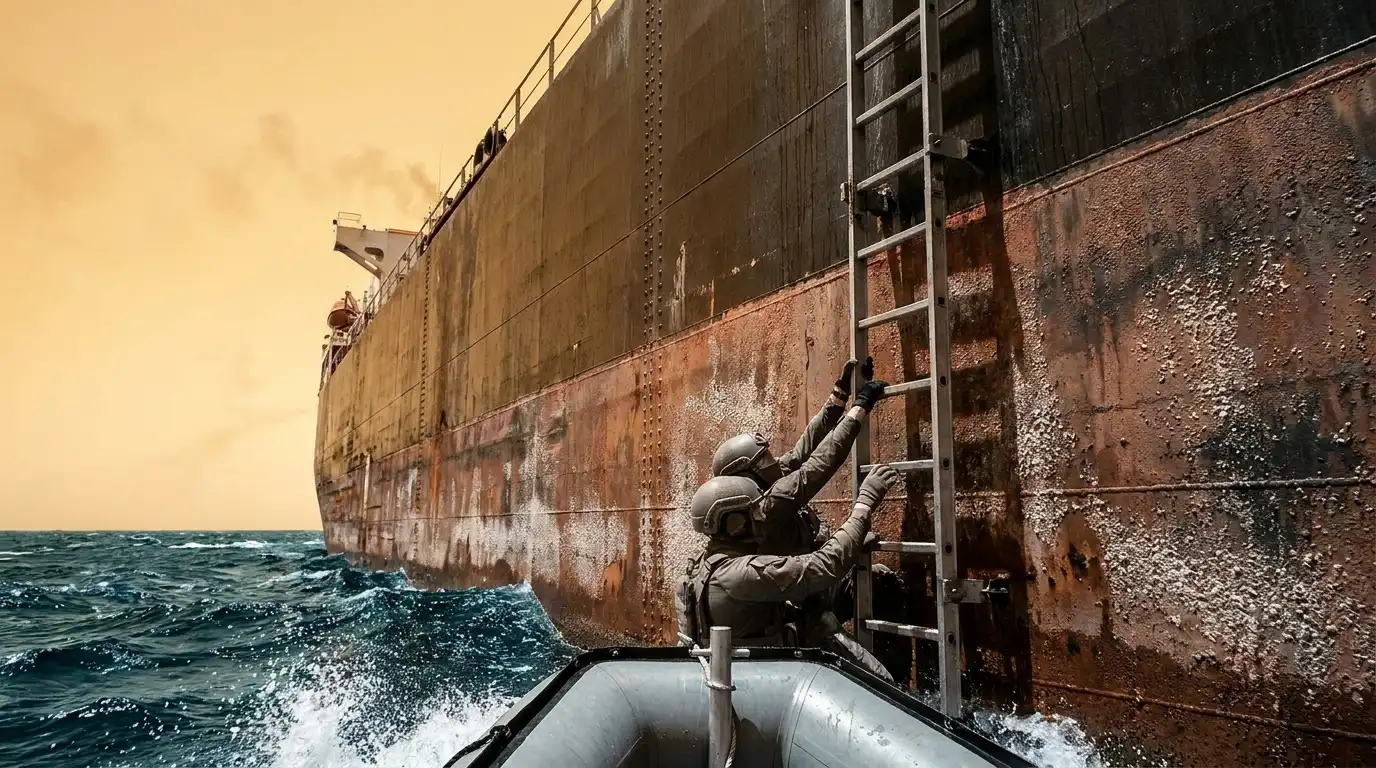
US Marines board M/T Wen Yao tanker in the Gulf of Oman
One closed daily edition: image, reading, signals, sources, and provenance for this date.
AI-generated content. No prior human review.
Editorial Reading
The global geopolitical landscape is currently defined by a dual-front escalation of tension, split between kinetic maritime conflict and systemic institutional friction. In the Gulf of Oman, US Marines have initiated physical interdictions of tankers under a renewed naval blockade, coinciding with targeted airstrikes on infrastructure in southern Iran.
This external hardening of posture is mirrored by internal domestic strain in the United States, where executive rhetoric is increasingly focused on the delegitimization of electoral systems ahead of upcoming midterms. These developments, paired with the fragmented response of national media outlets and ongoing debates over political civility in Australia, suggest a broader period of disruption where traditional norms of international law and domestic governance are being aggressively re-evaluated.
Why this mattered
The synthesis of today's signals highlights a transition from passive tension to active disruption. The kinetic elements in the Middle East—boarding vessels and bridge strikes—represent a significant shift in the enforcement of regional blockades.
This external display of force provides a stark backdrop to the domestic focus on election integrity and media polarization. The editorial logic here connects the 'active interdiction' of physical trade routes with the 'active skepticism' directed at democratic infrastructure, suggesting that stability is currently under pressure from both military and rhetorical vectors.
Elsewhere in the world
While maritime and electoral developments dominate the immediate cycle, a second layer of context reveals deep structural vulnerabilities in civilian infrastructure and political discourse. The investigation into the Telstra outage in Australia underscores the fragility of the digital foundations supporting modern economies.
Simultaneously, the split in media broadcasting decisions reflects a fundamental disagreement on the role of journalism in an era of high-stakes political messaging. These threads indicate that the 'internal' resilience of democratic states is becoming as volatile as the 'external' stability of global trade corridors.
What moved the day
- US Marines board M/T Wen Yao tanker in the Gulf of Oman
- Airstrikes target five bridges in southern Iran amid naval blockade
- Donald Trump claims foreign acquisition of 220 million voter records
- Major US networks split on broadcasting White House election address
- Australian Senate inquiry investigates Telstra outage affecting 45% of calls
- Political backlash in Australia over One Nation links to far-right activists
Still moving
- Expansion of the US naval blockade and maritime interdictions in the Middle East.
- Rhetorical focus on election integrity and institutional trust ahead of US midterms.
- The fallout of nationalist political alignments and their impact on Australian legislative civility.
- The continuing evaluation of telecommunications reliability as a national security concern.
World Signals
- conflict 94
- innovation 20
- resilience 78
- fragility economic 87
- pressure climate 18
- cultural pulse 60
Why the image looks like this
Visual frame
confrontational and volatile A low-angle infrared photo shows anonymous tactical figures climbing a ladder up the rusted hull of a massive oil tanker amidst churning dark blue water under a hazy amber sky.
Visual logic
The scene uses the physical act of boarding a vessel to represent the day's volatile geopolitical and domestic climate. The low-angle, infrared aesthetic provides a sense of high-stakes surveillance and 'active' disruption. The choice of a weathered, industrial tanker as the primary environment grounds the abstract concept of a 'blockade' in a tangible, high-pressure reality, while the anonymous human presence provides scale and a sense of imminent action.
Concept
The Kinetic Interdiction
How it was framed
Composition focuses on Low-angle perspective looking up the side of a massive industrial hull, Asymmetric balance with a heavy diagonal line created by a boarding ladder, Foreground anchor of salt-crusted steel and churning water, and Clear depth progression from the boarding craft to the towering ship superstructure.
Visual direction leans on High-contrast infrared photography, Industrial brutalism, Tactile maritime grit, and Pressurized atmospheric lighting.
Material treatment uses Rusted industrial steel, Salt-crusted iron, Matte tactical polymers, and Churning deep-sea water to keep the image tactile rather than generic.
Color language is built around Command Navy, Blockade Grey, Signal Red, and Static Amber.
Sources
Marines board tanker amid blockade of Iranian ports as US expands strikes with attacks on bridges
Open sourceAustralia news live: One Nation policy has ‘a bit of cray cray’, says Nationals senator; Telstra outage hit 45% of calls and data, inquiry hears
Open sourceHow Trump’s address bluntly aimed at destabilizing the US electoral system
Open sourceTrump makes unverified claims of ‘sinister election meddling’ in primetime address
Open sourceTrump rehashes wide-ranging US election claims and releases heavily redacted documents in primetime address – as it happened
Open sourceUS TV networks split on broadcasting Trump’s election-focused speech
Open sourceRelated editions
The World Canvas for 2026-07-16
The global landscape on July 16, 2026, is marked by a significant kinetic escalation in the Persian Gulf and a critical biosecurity milestone in the South Pacific. United States military operations have extended to the Strait of Hormuz, where an unladen oil tanker was disabled via missile strike, alongside reports of civilian casualties following engagements in Bushehr. This intensification of the maritime blockade on Iranian ports creates immediate pressure on global energy corridors. In Oceania, the confirmation of the H5N1 bird flu in New Zealand represents a major ecological shift, threatening vulnerable native species and triggering nationwide biosecurity protocols. Concurrently, domestic institutions in Australia are navigating the fallout of a massive child safety investigation and public inquiries into campus social cohesion, highlighting a period of intense systemic stress across geopolitical, environmental, and social sectors.
The World Canvas for 2026-07-15
Global stability is under significant pressure as a naval blockade in the Strait of Hormuz triggers an immediate surge in oil prices, threatening a ripple of inflationary consequences across international markets. While the United States and Iran exchange maritime strikes, domestic agendas in the Pacific are pivoting toward structural defense of both digital and social assets. Australia’s leadership has moved to ringfence the creative economy from generative AI expansion and implement strict utility standards for data centers, while concurrently addressing systemic social friction on university campuses. These developments, alongside legal constraints on international media in Singapore, reflect a global trend toward heightened state intervention and the hardening of national boundaries.
The World Canvas for 2026-07-14
The geopolitical landscape is characterized by a sharp intensification of conflict as the United States enters a third night of military strikes against Iranian infrastructure, prompting a formal blockade of the Strait of Hormuz. This shift has triggered immediate retaliatory strikes from Iran against American facilities in Bahrain and commercial tankers, threatening global energy transit. Simultaneously, the United States is signaling a significant pivot away from international legal frameworks as the Secretary of State launches a campaign to dismantle the International Criminal Court. Domestic issues elsewhere, such as the debate over artificial intelligence regulation in Australia and the infiltration of organized crime into Melbourne's hospitality sector, highlight a world struggling with both high-intensity kinetic warfare and the complex management of emerging technologies and systemic criminality.
The World Canvas for 2026-07-13
The global landscape on July 13, 2026, is marked by a sharp escalation in the Persian Gulf as the United States and Iran exchange heavy missile and drone strikes, threatening the critical energy artery of the Strait of Hormuz. This geopolitical crisis is mirrored by environmental volatility in Europe, where an exceptional scale wildfire in France's Fontainebleau forest has disrupted primary transit routes during an intense heatwave. Concurrently, domestic tragedies in Thailand and Australia highlight ongoing concerns regarding public safety infrastructure and social cohesion, as a devastating pub fire in Bangkok and a high-profile inquiry into antisemitism in Sydney underscore the varied pressures currently weighing on civil stability.
Method and provenance
Image prompt
A low-angle infrared editorial photograph of a maritime interdiction. The frame is dominated by the massive, salt-crusted rusted steel hull of an industrial tanker, creating a heavy diagonal line across the composition. A metallic boarding ladder is hooked to the side. Two anonymous figures in matte tactical gear and helmets, shown in three-quarter profile, are mid-climb, their hands gripping the rungs with natural, firm gestures. The foreground features churning, deep Command Navy water and the spray of a boarding craft. The background is a pressurized, heat-shimmered Static Amber sky. Natural, harsh lighting emphasizes the texture of industrial rivets and wet iron. Full-bleed, edge-to-edge composition.
Full Source Layer for This News Digest
Marines board tanker amid blockade of Iranian ports as US expands strikes with attacks on bridges
Open sourceAustralia news live: One Nation policy has ‘a bit of cray cray’, says Nationals senator; Telstra outage hit 45% of calls and data, inquiry hears
Open sourceHow Trump’s address bluntly aimed at destabilizing the US electoral system
Open sourceTrump makes unverified claims of ‘sinister election meddling’ in primetime address
Open sourceTrump rehashes wide-ranging US election claims and releases heavily redacted documents in primetime address – as it happened
Open sourceUS TV networks split on broadcasting Trump’s election-focused speech
Open source