2026-07-16 - Volatile and Fragile
US forces disable oil tanker in the Strait of Hormuz with
One closed daily edition: image, reading, signals, sources, and provenance for this date.
AI-generated content. No prior human review.
Editorial Reading
The global landscape on July 16, 2026, is marked by a significant kinetic escalation in the Persian Gulf and a critical biosecurity milestone in the South Pacific. United States military operations have extended to the Strait of Hormuz, where an unladen oil tanker was disabled via missile strike, alongside reports of civilian casualties following engagements in Bushehr.
This intensification of the maritime blockade on Iranian ports creates immediate pressure on global energy corridors. In Oceania, the confirmation of the H5N1 bird flu in New Zealand represents a major ecological shift, threatening vulnerable native species and triggering nationwide biosecurity protocols.
Concurrently, domestic institutions in Australia are navigating the fallout of a massive child safety investigation and public inquiries into campus social cohesion, highlighting a period of intense systemic stress across geopolitical, environmental, and social sectors.
Why this mattered
The editorial focus today centers on the intersection of maritime security and ecological vulnerability. The US-Iran situation has moved from localized strikes to a direct disruption of transit in the Strait of Hormuz, which traditionally serves as a catalyst for broader economic volatility.
We are positioning the New Zealand H5N1 discovery as a parallel 'border' breach, where the threat is biological rather than political. The Australian domestic signals serve as a somber reminder of the internal institutional pressures that persist even as international tensions dominate the headlines.
Elsewhere in the world
While the kinetic events in the Middle East take precedence, the introduction of H5N1 to New Zealand marks the arrival of a global pandemic in one of the last remaining refuges for unique avian biodiversity. This ecological pressure coincides with a period where international legal systems are being tested by high-profile clemency requests and deep-seated institutional failures regarding child protection.
Additionally, the debate over data center infrastructure indicates an ongoing struggle to balance technological growth with regulatory oversight and energy consumption.
What moved the day
- US forces disable oil tanker in the Strait of Hormuz with Hellfire missiles
- First confirmed case of H5N1 bird flu in New Zealand seabird population
- Casualties reported in Bushehr following second day of US strikes
- Sydney childcare worker charged with 329 child abuse offences
- Royal commission hears evidence on ANU campus encampment safety risks
- R. Kelly submits formal appeal to Donald Trump for sentence commutation
- Australian government debates mandatory standards for existing datacentres
- Global energy markets respond to tightening blockade on Iranian ports
Still moving
- Continued monitoring of US-Iran maritime hostilities and energy supply impacts
- Surveillance of New Zealand native bird colonies for H5N1 spread
- Legal proceedings for the Sydney childcare abuse case through 2026
- Assessment of social cohesion and antisemitism within Australian universities
World Signals
- conflict 97
- innovation 25
- resilience 81
- fragility economic 82
- pressure climate 31
- cultural pulse 61
Why the image looks like this
Visual frame
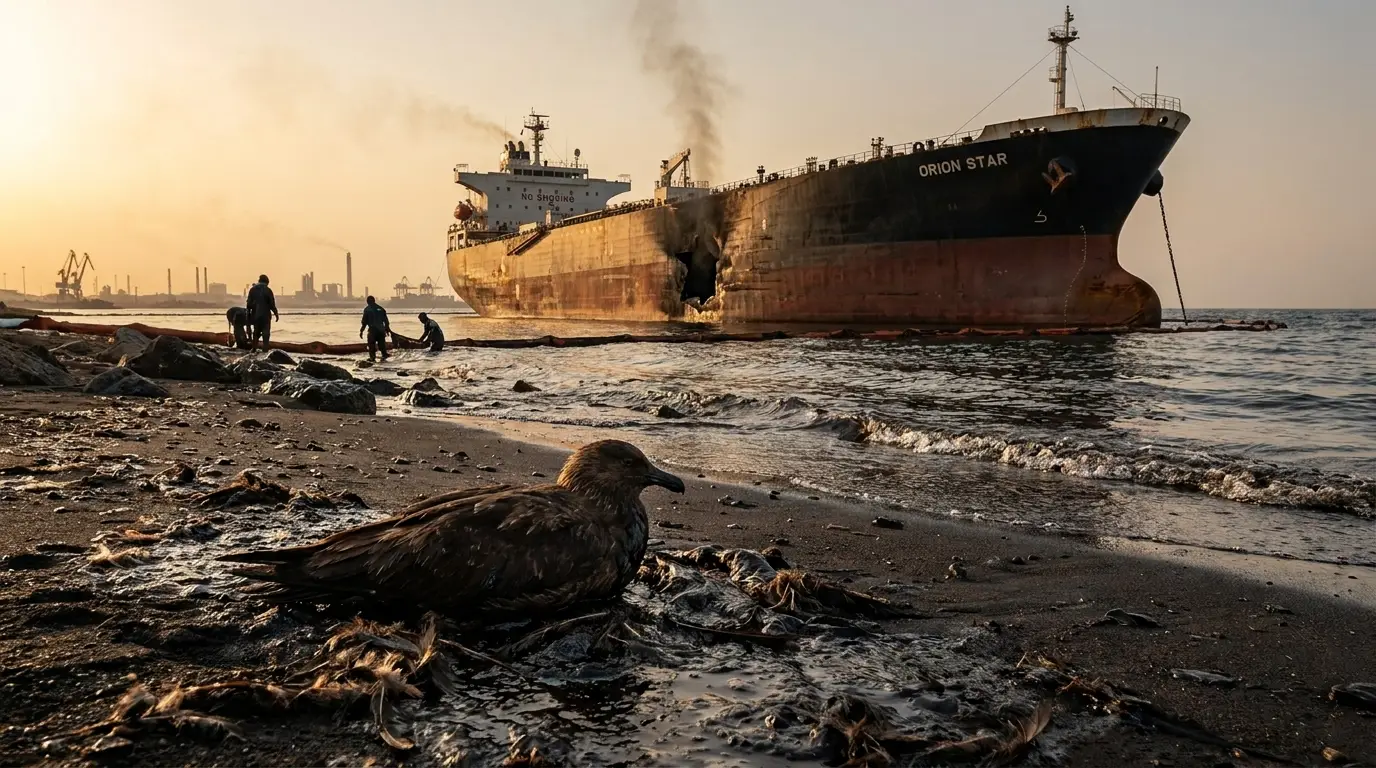
Volatile and Fragile A dead seabird matted with oil lies on a dark beach in the foreground, while a disabled oil tanker with a missile strike hole drifts near an industrial coastline under an amber sky.
Visual logic
The scene captures the literal and metaphorical blockage of global flow. By placing the ecological victim (the skua) in the foreground and the geopolitical catalyst (the tanker) in the midground, the image connects the kinetic escalation in the Gulf with the biosecurity milestone in New Zealand. The material contrast between soft feathers and scorched steel provides the necessary authority and detail to make the volatile mood tangible.
Concept
The Severed Artery
How it was framed
Composition focuses on Asymmetric balance with a foreground anchor on the lower left leading the eye diagonally toward the midground focal point, A clear three-tier depth structure: foreground shoreline, midground maritime wreckage, and background industrial horizon, Full-bleed, edge-to-edge wide-angle perspective with a low horizon line to emphasize the scale of the disabled vessel, and single dominant focal mass.
Visual direction leans on High-contrast realism with a focus on the tactile texture of oil on organic surfaces, Thermal-inflected lighting where the sky glows with a warning amber heat, Sharp focus on the foreground bird carcass to establish immediate human-scale stakes, and Thermal satellite imagery of the Strait of Hormuz showing heat signatures of disabled vessels.
Material treatment uses Scorched industrial steel, Matted avian down, Viscous crude oil, and Wet volcanic sand to keep the image tactile rather than generic.
Color language is built around Petroleum Black, Hormuz Haze, Skua Brown, and Warning Amber.
Sources
Australia news live: police release images of children’s clothing in plea for help investigating alleged abuse at childcare centres
Open sourceUS says latest attack wave on Iran completed – as it happened
Open sourceANU denies it ‘lost control’ to a pro-Palestine encampment, royal commission hears
Open sourceUS attacks oil tanker in strait of Hormuz as strikes reported in Tehran
Open sourceFears for New Zealand’s native species as first bird flu case emerges
Open sourceR Kelly formally appeals to Donald Trump to commute his 31-year prison sentence
Open sourceRelated editions
The World Canvas for 2026-07-15
Global stability is under significant pressure as a naval blockade in the Strait of Hormuz triggers an immediate surge in oil prices, threatening a ripple of inflationary consequences across international markets. While the United States and Iran exchange maritime strikes, domestic agendas in the Pacific are pivoting toward structural defense of both digital and social assets. Australia’s leadership has moved to ringfence the creative economy from generative AI expansion and implement strict utility standards for data centers, while concurrently addressing systemic social friction on university campuses. These developments, alongside legal constraints on international media in Singapore, reflect a global trend toward heightened state intervention and the hardening of national boundaries.
The World Canvas for 2026-07-14
The geopolitical landscape is characterized by a sharp intensification of conflict as the United States enters a third night of military strikes against Iranian infrastructure, prompting a formal blockade of the Strait of Hormuz. This shift has triggered immediate retaliatory strikes from Iran against American facilities in Bahrain and commercial tankers, threatening global energy transit. Simultaneously, the United States is signaling a significant pivot away from international legal frameworks as the Secretary of State launches a campaign to dismantle the International Criminal Court. Domestic issues elsewhere, such as the debate over artificial intelligence regulation in Australia and the infiltration of organized crime into Melbourne's hospitality sector, highlight a world struggling with both high-intensity kinetic warfare and the complex management of emerging technologies and systemic criminality.
The World Canvas for 2026-07-13
The global landscape on July 13, 2026, is marked by a sharp escalation in the Persian Gulf as the United States and Iran exchange heavy missile and drone strikes, threatening the critical energy artery of the Strait of Hormuz. This geopolitical crisis is mirrored by environmental volatility in Europe, where an exceptional scale wildfire in France's Fontainebleau forest has disrupted primary transit routes during an intense heatwave. Concurrently, domestic tragedies in Thailand and Australia highlight ongoing concerns regarding public safety infrastructure and social cohesion, as a devastating pub fire in Bangkok and a high-profile inquiry into antisemitism in Sydney underscore the varied pressures currently weighing on civil stability.
The World Canvas for 2026-07-12
The global state reflects a period of significant structural friction, primarily centered on the intersection of technological advancement and existing social contracts. In Australia, a pivotal divide has emerged within the Labor government over the regulation of artificial intelligence, as the push for data center investment clashes with the protection of creative intellectual property. This tension is mirrored in the political sphere by a rise in populist sentiment, fueled by a 'stagflation impulse' that ties housing scarcity to immigration. Public safety and communal rituals also face scrutiny following a fatal shooting at a Toronto street festival and a tragic death at a bonfire in Belfast. These events, alongside a crushing sporting defeat for Australia's rugby squad against France, suggest a moment where traditional systems and physical infrastructures are struggling to contain the pressures of a more volatile and economically pessimistic era.
Method and provenance
Image prompt
A wide-angle editorial photograph of a disabled oil tanker drifting in the Strait of Hormuz. In the immediate foreground, a single brown skua bird lies dead on a dark, wet volcanic sand beach, its feathers matted with viscous, iridescent petroleum. The midground features the massive, scorched steel hull of the tanker, showing a jagged missile entry point with a thin plume of black smoke rising vertically. The background is the hazy, amber-tinted industrial horizon of Bushehr under a heat-distorted sky. Low-sun directional lighting creates sharp highlights on the oily water and deep shadows across the wreckage.
Full Source Layer for This News Digest
Australia news live: police release images of children’s clothing in plea for help investigating alleged abuse at childcare centres
Open sourceUS says latest attack wave on Iran completed – as it happened
Open sourceANU denies it ‘lost control’ to a pro-Palestine encampment, royal commission hears
Open sourceUS attacks oil tanker in strait of Hormuz as strikes reported in Tehran
Open sourceFears for New Zealand’s native species as first bird flu case emerges
Open sourceR Kelly formally appeals to Donald Trump to commute his 31-year prison sentence
Open source