2026-07-19 - Volatile Trans-Atlantic Friction
Hungary’s President Tamás Sulyok resigns following
One closed daily edition: image, reading, signals, sources, and provenance for this date.
AI-generated content. No prior human review.
Editorial Reading
The global landscape on July 19, 2026, is defined by sharp ideological hardening and significant shifts in institutional leadership. In Hungary, the resignation of President Tamás Sulyok signals the consolidating power of the Tisza party, effectively dismantling remnants of the previous administration’s influence.
Simultaneously, a high-profile political gathering in London has become a focal point for trans-continental right-wing alignment, targeting immigration and multiculturalism. In the legal sphere, the arrest of high-profile influencers Andrew and Tristan Tate in Miami on serious exploitation charges highlights deepening international law enforcement cooperation.
Meanwhile, Australia grapples with the boundaries of digital discourse through new 'unmasking' legislation aimed at curbing online vilification, reflecting a broader global trend toward regulating the intersection of social media and public safety.
Why this mattered
Today's narrative reflects the tension between institutional reform and populist resurgence. The logic connects Hungary's structural shift to the rhetorical 'war' declared at CPAC London, illustrating a world where the center-right and far-right are recalibrating their strategies.
The Tate arrests serve as a pivot point for justice systems addressing transnational crime, while the Australian legislative updates and police incidents underscore the friction between individual liberty and state oversight.
Elsewhere in the world
Beyond the headlines, the concert by Jayson Gillham for Palestinian families illustrates the persistent role of cultural diplomacy amidst geopolitical strife. Regional tensions in Australia’s northern rivers, following a fatal cross-border pursuit, highlight operational challenges for law enforcement in decentralized jurisdictions.
Additionally, the rhetoric at CPAC concerning net zero policies indicates that climate action remains a central battlefield in the broader ideological divide, influencing future policy directions in the UK and Australia.
What moved the day
- Hungary’s President Tamás Sulyok resigns following constitutional amendment.
- Andrew and Tristan Tate arrested in Miami on sexual exploitation charges.
- CPAC London convenes right-wing leaders for global strategic alignment.
- Victoria introduces legislation to unmask social media users accused of vilification.
- Australian police declare critical incident after fatal cross-border pursuit.
- Pianist Jayson Gillham performs humanitarian concert for Palestinian families.
- UK authorities seek extradition of Tate brothers for trial.
- Péter Magyar’s Tisza party consolidates power in Hungarian government.
Still moving
- Reformation of Hungarian judicial and executive structures under the Tisza party.
- Legal proceedings and extradition battles surrounding the Tate brothers.
- Global pushback against net zero climate targets in populist circles.
- Australian regulatory efforts to control online hate speech and anonymity.
World Signals
- conflict 92
- innovation 26
- resilience 54
- fragility economic 83
- pressure climate 76
- cultural pulse 64
Why the image looks like this
Visual frame
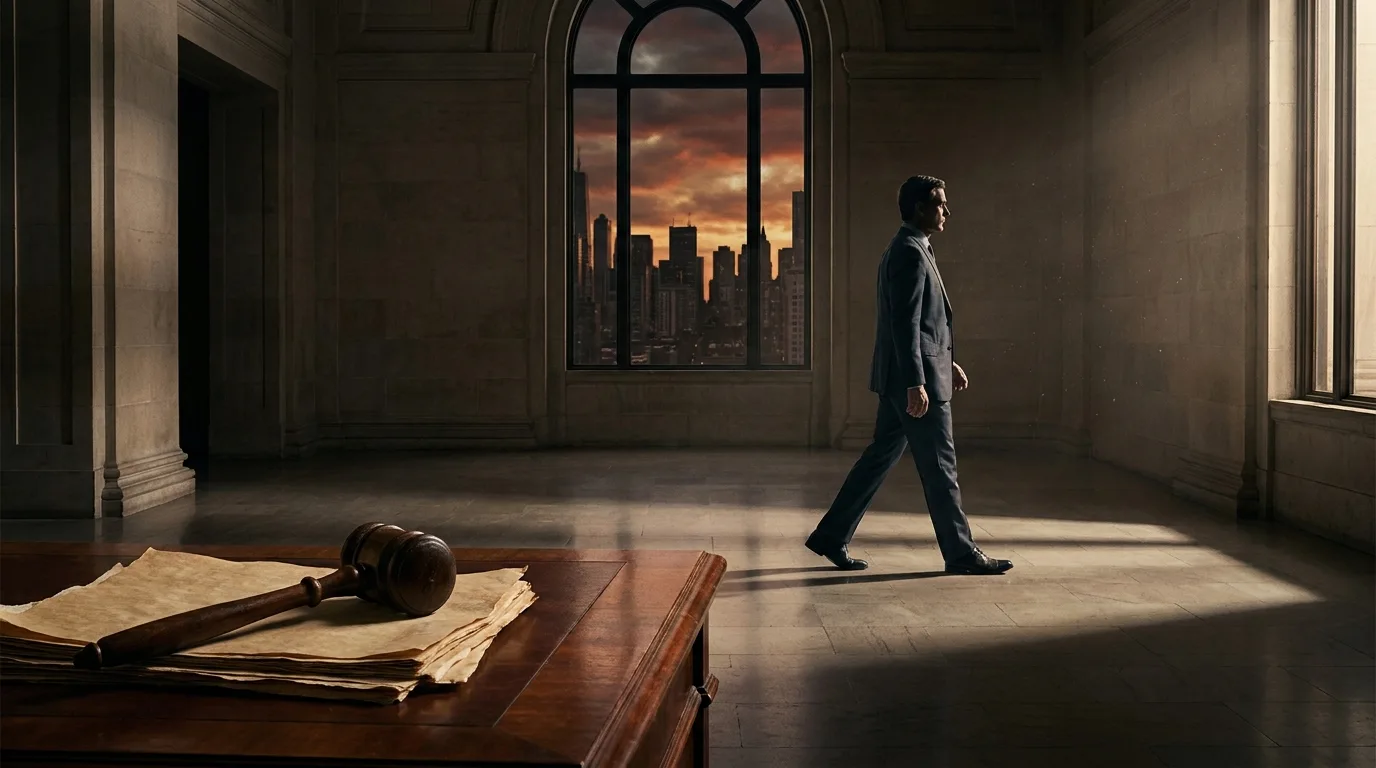
Volatile Trans-Atlantic Friction An editorial photograph of a dark-wood gavel on a mahogany desk in a grand hall as an anonymous man in a suit walks toward a window overlooking a city at dusk.
Visual logic
The scene visualizes the day's theme of institutional resignation and legal reckoning. The gavel and parchment represent the legislative shifts in Hungary and Australia, while the anonymous figure in transit captures the sense of political exit and entry. The high-contrast palette of Crimson and Slate reflects the 'Volatile Trans-Atlantic Friction' described in the mood.
Concept
The Institutional Pivot
How it was framed
Composition focuses on Asymmetric balance with a heavy foreground anchor on the left, Deep linear perspective created by the polished stone floor tiles leading toward a central arched window, Full-bleed, edge-to-edge framing with no margins, and A clear three-tier depth structure: foreground desk, midground figure, background city skyline.
Visual direction leans on High-contrast lighting with deep, intentional shadows, Sharp focus on foreground material textures, Atmospheric depth used to define space rather than obscure it, and Authorial, grounded perspective with human-scale elements.
Material treatment uses Polished mahogany wood grain, Cold, honed limestone, Heavy, light-absorbing velvet, and Crisp, textured parchment paper to keep the image tactile rather than generic.
Color language is built around Imperial Crimson, Midnight Slate, Gilded Ochre, and Parchment White.
Sources
Australia news live: Victoria announces new ‘unmasking’ law for social media users accused of vilification
Open sourceMan dies after cross-border police pursuit ends in NSW northern rivers
Open sourceAndrew and Tristan Tate arrested in Miami on charges of rape and sex trafficking
Open sourceConservatives around world at war against ‘leftwing globalists’, Bridget McKenzie tells CPAC London event
Open sourcePauline Hanson tells London CPAC crowd she is ‘sick of hearing about white privilege’ and ‘fears for England’
Open sourceHungary’s president agrees to stand down after law change ends his term
Open sourceRelated editions
The World Canvas for 2026-07-18
The global landscape today is defined by a heightened focus on institutional integrity and civil response. In the United States, the convergence of high-profile political rallies in Memphis following fatal law enforcement actions and ongoing disputes regarding electoral systems underscores a nation grappling with domestic friction. Parallel to these political currents, public health and safety concerns have surfaced via a lethal Legionnaires’ disease outbreak in New York and a tragic maritime recovery operation in San Francisco. Meanwhile, the legal charges against Paul Pelosi and the release of Cuban dissident Luis Manuel Otero Alcántara highlight a period where personal and political accountability remains under intense public and international scrutiny.
The World Canvas for 2026-07-17
The global geopolitical landscape is currently defined by a dual-front escalation of tension, split between kinetic maritime conflict and systemic institutional friction. In the Gulf of Oman, US Marines have initiated physical interdictions of tankers under a renewed naval blockade, coinciding with targeted airstrikes on infrastructure in southern Iran. This external hardening of posture is mirrored by internal domestic strain in the United States, where executive rhetoric is increasingly focused on the delegitimization of electoral systems ahead of upcoming midterms. These developments, paired with the fragmented response of national media outlets and ongoing debates over political civility in Australia, suggest a broader period of disruption where traditional norms of international law and domestic governance are being aggressively re-evaluated.
The World Canvas for 2026-07-16
The global landscape on July 16, 2026, is marked by a significant kinetic escalation in the Persian Gulf and a critical biosecurity milestone in the South Pacific. United States military operations have extended to the Strait of Hormuz, where an unladen oil tanker was disabled via missile strike, alongside reports of civilian casualties following engagements in Bushehr. This intensification of the maritime blockade on Iranian ports creates immediate pressure on global energy corridors. In Oceania, the confirmation of the H5N1 bird flu in New Zealand represents a major ecological shift, threatening vulnerable native species and triggering nationwide biosecurity protocols. Concurrently, domestic institutions in Australia are navigating the fallout of a massive child safety investigation and public inquiries into campus social cohesion, highlighting a period of intense systemic stress across geopolitical, environmental, and social sectors.
The World Canvas for 2026-07-15
Global stability is under significant pressure as a naval blockade in the Strait of Hormuz triggers an immediate surge in oil prices, threatening a ripple of inflationary consequences across international markets. While the United States and Iran exchange maritime strikes, domestic agendas in the Pacific are pivoting toward structural defense of both digital and social assets. Australia’s leadership has moved to ringfence the creative economy from generative AI expansion and implement strict utility standards for data centers, while concurrently addressing systemic social friction on university campuses. These developments, alongside legal constraints on international media in Singapore, reflect a global trend toward heightened state intervention and the hardening of national boundaries.
Method and provenance
Image prompt
Wide-angle editorial photograph of a grand limestone governmental hall. In the foreground, a polished mahogany desk holds a dark-wood gavel resting on a stack of textured parchment papers. In the midground, an anonymous man in a midnight slate suit is captured in profile walking across the floor toward a tall arched window. The background reveals a dense city skyline under a bruised dusk sky glowing with imperial crimson and gilded ochre lights. High-contrast directional lighting casts long, sharp shadows across the honed stone floor, emphasizing the wood grain of the desk and the heavy fabric of the suit. Full-bleed composition, edge-to-edge framing.
Full Source Layer for This News Digest
Australia news live: Victoria announces new ‘unmasking’ law for social media users accused of vilification
Open sourceMan dies after cross-border police pursuit ends in NSW northern rivers
Open sourceAndrew and Tristan Tate arrested in Miami on charges of rape and sex trafficking
Open sourceConservatives around world at war against ‘leftwing globalists’, Bridget McKenzie tells CPAC London event
Open sourcePauline Hanson tells London CPAC crowd she is ‘sick of hearing about white privilege’ and ‘fears for England’
Open sourceHungary’s president agrees to stand down after law change ends his term
Open source