2026-06-02 - Strained diplomacy, domestic scrutiny, and legal-political pressure
Russian air raids hit Kyiv, Dnipro, and Kharkiv, killing at
One closed daily edition: image, reading, signals, sources, and provenance for this date.
AI-generated content. No prior human review.
Editorial Reading
The day’s world-state is defined by overlapping pressures on institutions: Russian air raids struck major Ukrainian cities after warnings of a larger attack wave, while Middle East tensions remained volatile amid warnings over settler violence in the West Bank, reported ceasefire fragility, and disruption around the Strait of Hormuz. Australia’s parliament moved through a late sitting on tax legislation as the government also announced targeted sanctions on Israeli individuals and entities linked to violence against Palestinians.
In the United States, scrutiny continued around a proposed compensation fund for Trump allies, while the entertainment world’s legal sphere resurfaced with Blake Lively and Justin Baldoni returning to court over fees and damages after a settlement.
Why this mattered
The main thread is institutional stress under conditions of conflict and contested accountability. Military escalation in Ukraine and instability around Israel, Hezbollah, Iran, and the West Bank show how fragile ceasefires and sanctions regimes shape civilian risk and global energy pressure.
At the same time, domestic political systems in Australia and the United States are working through questions of legislative authority, oversight, and public trust. The cultural legal dispute is included not as spectacle but as a marker of how reputation, workplace conduct claims, and litigation continue to occupy public attention.
Elsewhere in the world
Beyond the top conflict headlines, the signals point to a wider governance environment in which parliaments, courts, sanctions offices, and executive agencies are being asked to absorb heightened political strain. Australia’s sanctions expand attention to settler outposts as entities, while its domestic debate over tax legislation and ministerial judgment reflects routine governance under sharper public scrutiny.
The Strait of Hormuz remains economically significant because disruptions there can transmit quickly into energy markets, inflation expectations, and diplomatic bargaining.
What moved the day
- Russian air raids hit Kyiv, Dnipro, and Kharkiv, killing at least five people and wounding dozens
- UN experts warn over rising settler violence in the West Bank
- Australia announces targeted sanctions on three Israeli individuals and four entities
- Reports point to a fragile Israel-Hezbollah ceasefire amid wider US-Iran tensions
- Disruption around the Strait of Hormuz continues to pressure global energy routes
- Australian parliament sits late as the government pushes tax legislation
- Trump reportedly reconsiders a $1.8bn fund for allies after legal and political backlash
- Blake Lively and Justin Baldoni return to court over legal fees and damages
Still moving
- Civilian harm and infrastructure damage from continued strikes across Ukraine
- Ceasefire monitoring and escalation risk involving Israel, Hezbollah, Iran, and the United States
- Settler violence, displacement, and sanctions policy in the occupied West Bank
- Energy-market sensitivity tied to the Strait of Hormuz
World Signals
- conflict 94
- innovation 18
- resilience 87
- fragility economic 83
- pressure climate 19
- cultural pulse 59
Why the image looks like this
Visual frame
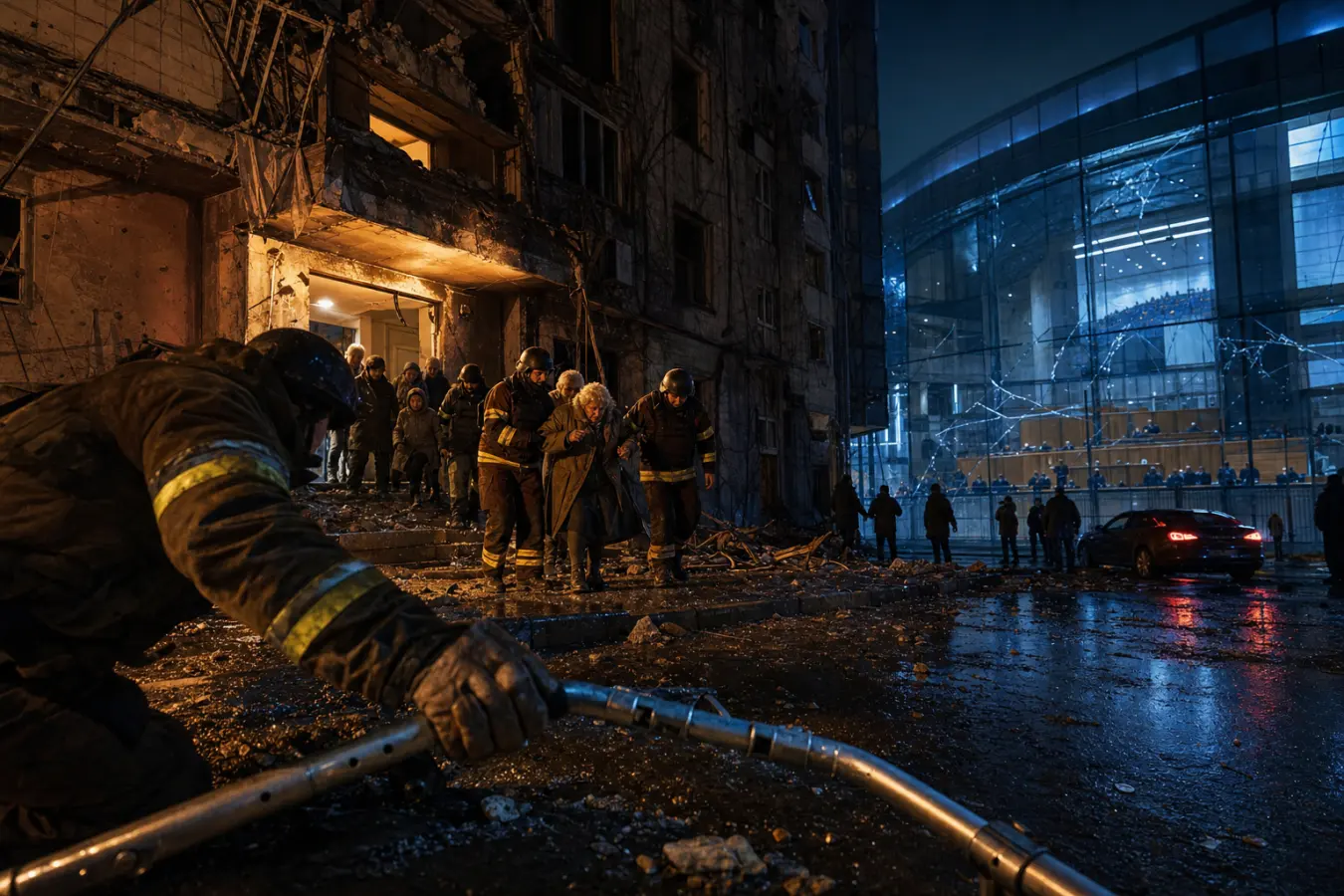
Strained diplomacy, domestic scrutiny, and legal-political pressure Anonymous rescue workers help residents leave a damaged apartment entrance at night while emergency light and cool civic reflections cross the wet street.
Visual logic
A damaged night street with anonymous emergency movement captures the civilian cost of escalation, while reflected civic interiors suggest parliaments, courts, sanctions, and scrutiny pressing back through institutions. The composition keeps one clear focal event at human scale, then builds outward through wet streets, apartment facades, and restrained diplomatic linework to show how local danger and global pressure are connected. Hard materials—cracked glass, soot, wet asphalt, stamped folders—give the scene authority without turning it into spectacle.
Concept
Accountability Under Sirens
How it was framed
Composition focuses on Full-bleed edge-to-edge frame with no blank margins, Foreground anchor: gloved hands on bent stretcher rail and cracked wet pavement, Midground focal event: anonymous rescue workers moving residents from a damaged entrance, and Background depth: apartment facade, reflected courtroom/parliament geometry, fine unlabeled diplomatic linework.
Visual direction leans on Grounded editorial night scene, human scale, inhabited and structurally legible, Emergency amber against diplomatic blue, with dust olive and graphite shadows, Use light direction, scale contrast, and hard material detail for drama, and Atmosphere limited to rain sheen, smoke traces, and reflected light.
Material treatment uses Soot-stained concrete, Cracked laminated glass, Wet asphalt, and Bent stretcher aluminum to keep the image tactile rather than generic.
Color language is built around Ashen Graphite, Emergency Amber, Diplomatic Blue, and Dust Olive.
Sources
Australia politics live: One Nation MP sworn in; parliament to sit late as government pushes tax change bill
Open sourceDeadly air raids across Ukraine after warnings of Russian strike wave
Open sourceVictorian minister under fire for writing 33 character references including for taxi driver who assaulted women
Open sourceUN experts warn against ‘surging Israeli settler terror’ – as it happened
Open sourceBlake Lively and Justin Baldoni return to court a month after reaching settlement
Open sourceTrump reportedly mulling retreat from $1.8bn ‘anti-weaponization’ fund
Open sourceRelated editions
The World Canvas for 2026-06-03
The day’s signal is dominated by democratic process and institutional trust: US midterm primaries are sharpening the November landscape, while a Supreme Court order allowing Alabama to use a congressional map that removes a majority-Black district adds a major voting-rights flashpoint to the cycle. In Australia, domestic politics is turning on tax fairness and the public meaning of complex financial structures, while a separate controversy over an academic’s AI-assisted opinion piece has widened the debate over authorship, integrity, and how institutions should govern generative tools. Around the edges, political memory and personal narrative remain part of the public record, with Jill Biden’s memoir event revisiting the pressures that led Joe Biden to leave the 2024 race.
The World Canvas for 2026-06-01
The day is dominated by a widening Middle East security crisis, with Kuwait reporting missile and drone attacks, the United States saying it struck radar and command sites in Iran, and European leaders condemning Israel’s deepening incursion into Lebanon after the capture of Beaufort castle. Away from the immediate conflict zone, domestic political pressure is visible in Australia, where Liberal party president Tony Abbott downplayed One Nation’s polling surge while arguing that the Coalition remains the main alternative to Labor. Institutional modernization and vulnerability sit side by side: the UK government says shared NHS patient records could reduce emergency visits and costs, while a reported hack affecting the Melbourne film festival underscores cultural-sector exposure to cyber disruption. Public life also carried a strong cultural charge, from mass Arsenal parade crowds requiring rescues and arrests in London to tributes following the death of actor and filmmaker Kelly Curtis.
The World Canvas for 2026-06-04
The day’s world-state is defined by overlapping attempts to contain political and security pressure before it widens: in the Middle East, a reported Iranian missile and drone attack on Kuwait’s international airport killed one person and injured dozens even as US-led ceasefire and Iran-related talks continued, while Israel and Lebanon agreed to renew a ceasefire under conditions aimed at halting Hezbollah fire in the south. In domestic politics, Australia’s Labor government pushed a tax package through the lower house after contested amendments, framing the vote around worker tax cuts and housing affordability, while US political attention stayed fixed on candidate selection, intelligence leadership scrutiny, and unsettled mayoral and midterm contests. The common thread is institutional stress management: parliaments, courts, campaigns, and diplomatic channels are all trying to absorb conflict without letting it spill into broader disorder.
The World Canvas for 2026-06-05
The day’s strongest signal is a politics of accountability under strain: Ukraine’s Volodymyr Zelenskyy publicly urged Vladimir Putin to meet face to face in a neutral country, framing negotiation as urgent while the war’s diplomatic path remains uncertain. In Australia, ASIC opened an investigation into KPMG following whistleblower claims, while parliamentary argument continued over the scrutiny and timing of major tax reforms due to take effect in 2028. Australian politics also saw confusion around One Nation’s housing policy after senior figures struggled to explain its details in broadcast interviews. In the United States, legal and electoral pressure remained visible, with reports that John Bolton is expected to plead guilty in a classified-documents case and Maine Senate candidate Graham Platner denying newly reported allegations about past conduct.
Method and provenance
Image prompt
Full-bleed documentary-real editorial night scene on a rain-slick city street after an air raid. Dominant subject: anonymous rescue workers guiding residents from a shattered apartment entrance; surrounding counterforce: institutional scrutiny and regional tension suggested by cool blue courtroom/parliament-like reflections in cracked glass and fine unlabeled diplomatic linework in the upper reflections. Low street-level three-quarter camera stance, not first-person. Foreground: gloved hands with anatomically correct wrists and natural joints grip a bent aluminum stretcher rail on cracked wet pavement in one clear stabilizing gesture. Midground: amber emergency light catches soot-stained concrete, broken laminated glass, and workers helping civilians through dust. Background: dark apartment facade presses over the scene while restrained blue civic geometry recedes across the street, thin smoke traces and rain sheen only, sharp silhouettes, natural scale, no readable text or symbols.
Full Source Layer for This News Digest
Australia politics live: One Nation MP sworn in; parliament to sit late as government pushes tax change bill
Open sourceDeadly air raids across Ukraine after warnings of Russian strike wave
Open sourceVictorian minister under fire for writing 33 character references including for taxi driver who assaulted women
Open sourceUN experts warn against ‘surging Israeli settler terror’ – as it happened
Open sourceBlake Lively and Justin Baldoni return to court a month after reaching settlement
Open sourceTrump reportedly mulling retreat from $1.8bn ‘anti-weaponization’ fund
Open source