2026-06-27 - Tense & Volatile
U.S. strikes Iranian targets following Strait of Hormuz
One closed daily edition: image, reading, signals, sources, and provenance for this date.
AI-generated content. No prior human review.
Editorial Reading
The global landscape is currently defined by a sharp contrast between rapid technological intervention and escalating environmental and geopolitical volatility. While AI-integrated search-and-rescue operations demonstrate new levels of tactical efficiency in Australia, the natural world faces unprecedented stress, evidenced by historic wildfire warnings in Utah and the early arrival of glacier loss day in the Swiss Alps.
Concurrently, maritime tensions in the Strait of Hormuz have triggered retaliatory strikes and assertive diplomatic rhetoric, complicating the international security architecture. Domestically in the United States, the intersection of fiscal policy and technology takes center stage as debates over billionaire taxation and state-level AI ownership stakes reflect shifting economic paradigms.
Why this mattered
Today’s report highlights a world oscillating between extreme vulnerability and advanced mitigation. The climate signals indicate that environmental tipping points are no longer future projections but current operational realities requiring emergency states.
Geopolitically, the escalation involving Iran and the US narrative signifies a departure from managed tension toward active deterrence. The editorial thread tying these disparate events together is the emergence of Techno-Resilience—the application of AI for both life-saving rescue and as a central pillar of future fiscal strategy—as a response to both human-led conflict and environmental instability.
Elsewhere in the world
Beyond the immediate headlines of military strikes and wildfires, the conviction of Samuel Bateman underscores a continuing legal focus on the fringes of societal insulation and the protection of vulnerable minors. Meanwhile, Governor Newsom’s pivot toward national fiscal policy highlights a strategic realignment between state and federal interests, specifically addressing the vast wealth generated by the burgeoning AI sector and its potential for public ownership.
What moved the day
- U.S. strikes Iranian targets following Strait of Hormuz cargo ship attack
- Utah declares historic red flag emergency amid explosive wildfire risk
- Swiss glaciers reach glacier loss day months ahead of seasonal expectations
- AI-powered thermal drone executes first successful rapid rescue in NSW
- Sect leader Samuel Bateman convicted on state child abuse charges in Arizona
- Gavin Newsom proposes national billionaires tax and federal AI equity
Still moving
- Escalating maritime security threats in the Middle East
- Global acceleration of the AI-integrated emergency response sector
- Debates over wealth redistribution and the fiscal role of technology giants
- Western European heatwave impact on alpine ecosystems and water security
World Signals
- conflict 78
- innovation 84
- resilience 61
- fragility economic 58
- pressure climate 91
- cultural pulse 74
Why the image looks like this
Visual frame
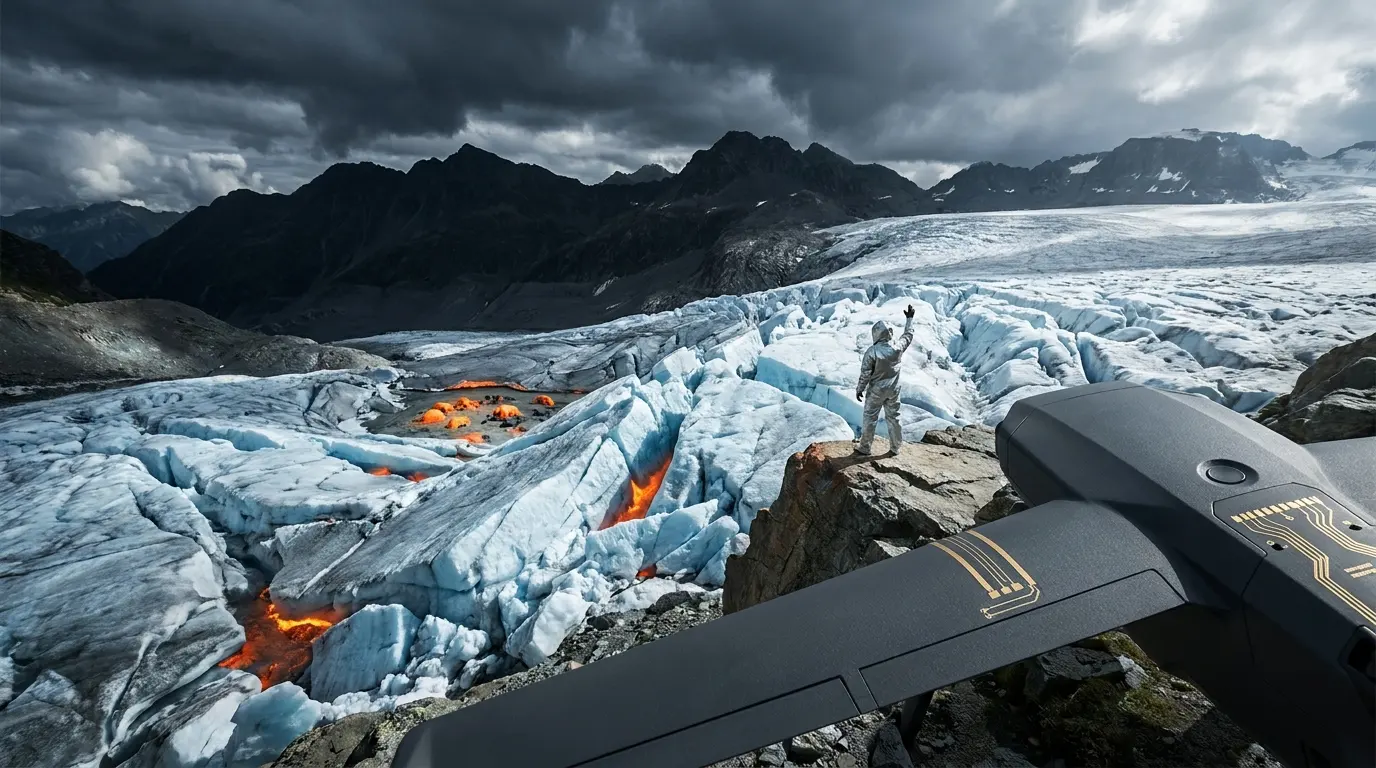
Tense & Volatile A high-altitude editorial photograph of a tactical drone wing overlooking a fracturing blue glacier with glowing orange thermal fissures and a lone figure in a thermal suit.
Visual logic
This scene synthesizes the day's tension between environmental collapse (glacier loss and wildfire risk) and the rise of techno-resilience (AI rescue). By using a high-contrast thermal aesthetic, we highlight the tactical charcoal of human intervention against the glacial blue and emergency amber of a world in flux. The presence of a single, anonymous figure provides a human scale to the vast, volatile landscape, while the gold circuitry subtly nods to the fiscal debates surrounding AI equity.
Concept
The Thermal Sentinel
How it was framed
Composition focuses on Asymmetric high-angle perspective looking down from a drone's viewpoint, Foreground anchor featuring the matte-black edge of a tactical drone wing, Deep midground showing a fractured alpine valley with glowing thermal fissures, and Background of dark, jagged mountain silhouettes under a volatile sky.
Visual direction leans on High-contrast thermal-inflected realism, Macro-detail on fracturing ice textures, Clinical yet dramatic lighting, and Spatial depth through scale contrast.
Material treatment uses Matte tactical charcoal polymer, Crystalline fracturing ice, Molten emergency amber heat signatures, and Polished billionaire-gold circuitry to keep the image tactile rather than generic.
Color language is built around Glacial Blue, Emergency Amber, Tactical Charcoal, and Billionaire Gold.
Sources
Hikers lost in Kosciuszko national park rescued within five hours by AI drone
Open sourceSnow and ice on Swiss glaciers melting at alarming rate amid heatwave, expert says
Open sourceJD Vance says ‘violence will be met with violence’ after strikes on Iran – as it happened
Open sourcePolygamous sect leader guilty of abuse after girls found in trailer on highway
Open sourceGavin Newsom urges a national 'billionaires' tax' while fighting one in California
Open sourceUtah under historic ‘red flag’ weather warning amid dangerous wildfires
Open sourceRelated editions
The World Canvas for 2026-06-26
The global landscape is currently defined by significant shifts in judicial power and the tightening of institutional norms. In the United States, the Supreme Court has issued a landmark ruling fundamentally reshaping the asylum system by allowing the administration to end Temporary Protected Status for several nationalities and turn back migrants at the border. Parallel to this, scrutiny is mounting in the United Kingdom over the jurisdictional reach of the US military justice system in domestic criminal cases. Australia finds itself in a state of internal reflection, balancing the celebratory unity of a World Cup campaign against sharp political warnings regarding the normalization of authoritarian rhetoric and the ethical standards of public figures in the media and parliament.
The World Canvas for 2026-06-25
The global landscape today is defined by a volatile mix of seismic disasters and escalating climate-induced scarcity. In Venezuela, back-to-back earthquakes measuring up to 7.5 magnitude have forced a state of emergency as rescue operations intensify in the capital of Caracas. Across the Pacific, Papua New Guinea is grappling with a severe subsistence crisis as El Niño-driven frost and drought decimate agricultural output, threatening the food security of nearly three million people. Meanwhile, Australia navigates complex security challenges ranging from warnings of foreign-state interference to the legal intricacies of repatriating citizens from former conflict zones in Syria, reflecting a broader trend of states managing domestic stability against a backdrop of degraded international norms.
The World Canvas for 2026-06-24
The global landscape is characterized by significant shifts in technological dominance and ideological realignment within major democracies. China has reclaimed the top position in supercomputing with the debut of LineShine, signaling a new phase in the high-performance computing race. In the United States, primary elections highlight a diversifying political base and the emergence of candidates responding to recent administrative purges in the military. Meanwhile, Australian domestic politics are currently defined by internal debates regarding multicultural identity and a growing legislative push to reintroduce human oversight into algorithmic decision-making for aged care, reflecting a broader caution toward automated governance.
The World Canvas for 2026-06-23
On June 23, 2026, the global political landscape is defined by significant domestic recalibration and the acceleration of political cycles. In Australia, the Albanese government has secured a pivotal legislative breakthrough by partnering with the Greens to pass tax reforms targeting capital gains and negative gearing, aimed at addressing systemic housing affordability. This achievement contrasts sharply with the United Kingdom, which is grappling with the resignation of Keir Starmer just two years after a landslide victory, signaling a period of intense institutional volatility. Meanwhile, a legal victory for Los Angeles regarding its sanctuary city status reinforces the autonomy of local jurisdictions against federal oversight, even as the city struggles with a persistent multi-day industrial fire that highlights the complexities of modern green infrastructure in emergency scenarios.
Method and provenance
Image prompt
A wide-angle editorial scene captured from a high-altitude perspective. In the lower corner, the matte-charcoal polymer edge of a tactical drone wing is visible, etched with fine, polished gold circuitry. The midground reveals a vast, fracturing alpine glacier where deep glacial-blue ice slabs separate to expose glowing emergency-amber thermal heat signatures from the valley floor. A single anonymous figure in a reflective silver thermal suit stands on a rocky ledge, gesturing upward with a clear, single-arm motion toward the drone. The background features dark, jagged mountain silhouettes under a heavy, volatile sky. Natural, high-contrast lighting emphasizes the crystalline texture of the breaking ice and the industrial matte finish of the drone hardware.
Full Source Layer for This News Digest
Hikers lost in Kosciuszko national park rescued within five hours by AI drone
Open sourceSnow and ice on Swiss glaciers melting at alarming rate amid heatwave, expert says
Open sourceJD Vance says ‘violence will be met with violence’ after strikes on Iran – as it happened
Open sourcePolygamous sect leader guilty of abuse after girls found in trailer on highway
Open sourceGavin Newsom urges a national 'billionaires' tax' while fighting one in California
Open sourceUtah under historic ‘red flag’ weather warning amid dangerous wildfires
Open source