2026-06-13 - Frictionally assertive and structurally volatile
US forces intercept Iranian attack drones in the Persian
One closed daily edition: image, reading, signals, sources, and provenance for this date.
AI-generated content. No prior human review.
Editorial Reading
The global landscape is currently defined by an intensifying push-pull between executive unilateralism and institutional checks. In the Middle East, the sovereignty of the Strait of Hormuz remains a flashpoint as Iran asserts regional control and excludes international oversight, punctuated by the interception of drone activity.
Domestically, the United States is witnessing a significant judicial pivot against the administration's historical and cultural policies, with courts mandating the restoration of scientific data in national parks and the removal of executive branding from landmark institutions. Meanwhile, the $111 billion merger of Paramount and Warner Bros Discovery signals a massive consolidation of the global media architecture, occurring even as high-stakes military strikes against transnational criminal organizations demonstrate a continued preference for kinetic foreign policy.
Why this mattered
' We are observing a synchronized attempt by the executive branch to redefine physical and digital spaces—ranging from the naming of the Kennedy Center and the content of National Park plaques to the consolidation of news networks. The judicial branch is emerging as the primary friction point to this re-authoring of public history.
On the geopolitical front, the escalation in the Strait of Hormuz serves as a hard-power counterpart to these domestic struggles, where the control of literal and figurative gateways remains the core objective of the state.
Elsewhere in the world
Beyond the headlines of military strikes and media mergers, there is a quiet but significant tension brewing in the maritime security sector. The refusal of regional powers to accept US-led management of the Strait of Hormuz suggests a shifting paradigm in global trade security.
Additionally, the Sydney shark attack has reignited local debates on coastal management and biodiversity, occurring against a backdrop of increasing urban-wildlife interactions in the Southern Hemisphere.
What moved the day
- US forces intercept Iranian attack drones in the Persian Gulf
- Court rejects emergency appeal to keep Trump name on Kennedy Center
- Lethal strike kills Tren de Aragua leader Hector Guerrero Flores
- Judge orders restoration of removed science plaques in National Parks
- US DOJ approves $111bn Paramount and Warner Bros Discovery merger
- Critical shark attack leads to closure of Sydney's Coogee beach
- Iran declares US will have no role in future Hormuz management
- White House discusses legislative moves to void past impeachments
Still moving
- Sovereignty disputes over the Strait of Hormuz maritime corridors
- Judicial challenges to the 'Restoring Truth and Sanity' executive order
- Integration process of CBS News and CNN following the $111bn merger
- Transnational efforts to dismantle Tren de Aragua operational cells
World Signals
- conflict 94
- innovation 51
- resilience 70
- fragility economic 69
- pressure climate 23
- cultural pulse 66
Why the image looks like this
Visual frame
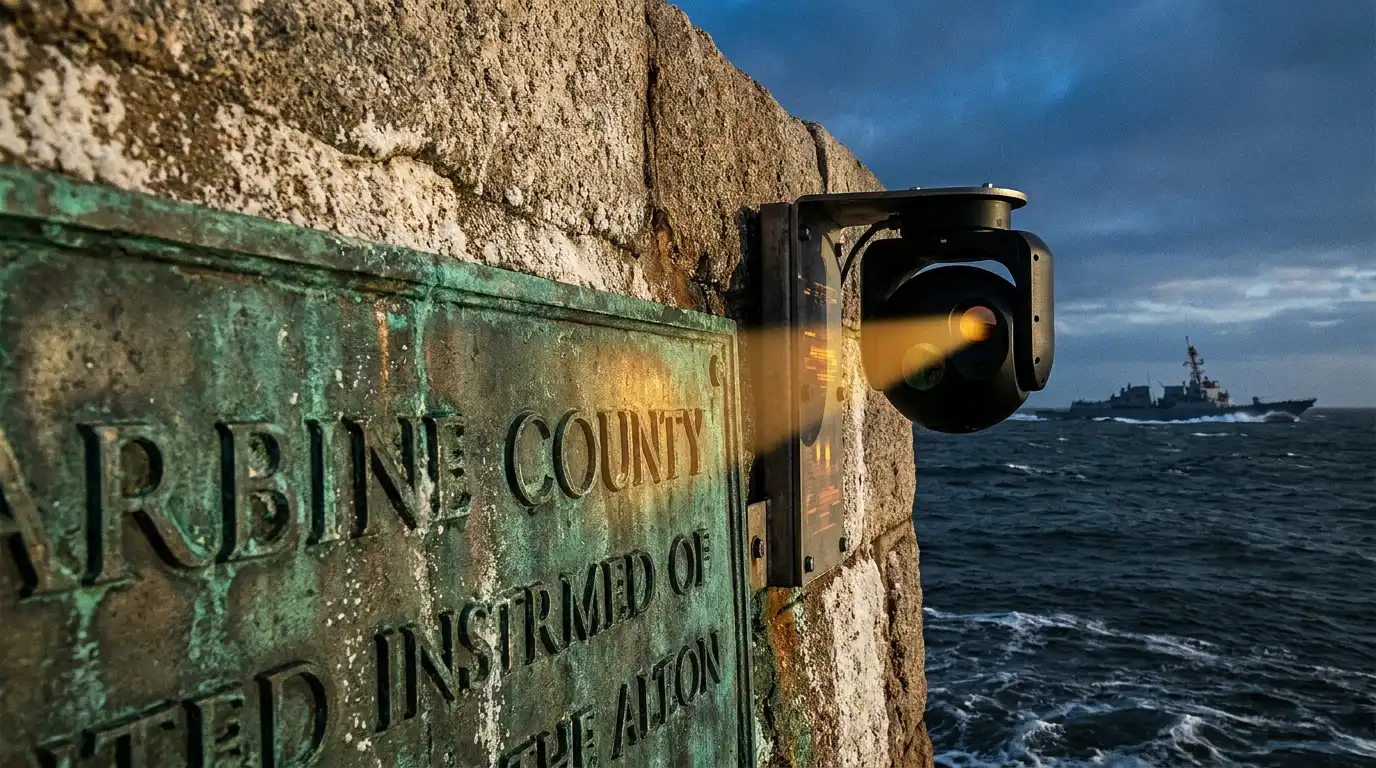
Frictionally assertive and structurally volatile A weathered bronze institutional plaque is scanned by a surveillance drone's amber light against the backdrop of a naval ship in a dark, choppy sea.
Visual logic
This scene bridges the physical maritime tension in the Strait of Hormuz with the domestic judicial struggle over institutional identity. The macro-detail of the bronze plaque represents the 'Crisis of Curation' and the legal fight over public history, while the surveillance drone and naval background ground the image in the day's geopolitical volatility. The use of thermal amber against cobalt blue creates a visual friction that mirrors the push-pull between executive action and institutional checks.
Concept
The Gatekeeper's Friction
How it was framed
Composition focuses on Asymmetric balance with a macro-detailed foreground of an oxidized bronze plaque, A midground featuring a sleek, matte-black surveillance gimbal casting a sharp amber light, A deep background showing a naval vessel silhouette against a dark cobalt maritime horizon, and Full-bleed, edge-to-edge composition with no margins or white borders.
Visual direction leans on Grainy, long-lens thermal surveillance aesthetic, Macro photography with harsh, directional side-lighting, Industrial maritime atmosphere with high structural depth, and Sharp textural contrast between weathered metal and high-tech optics.
Material treatment uses Oxidized verdigris bronze, Matte carbon fiber, Salt-crusted naval steel, and Digital thermal heat-map overlays to keep the image tactile rather than generic.
Color language is built around Hormuz Cobalt, Verdigris Bronze, Thermal Amber, and Monolith Grey.
Sources
US military says it downed Iranian attack drones – as it happened
Open sourceWoman in critical condition after shark attack at Coogee beach
Open sourceCrowd gathers at Kennedy Center after court denies Trump’s emergency appeal to keep his name on building – as it happened
Open sourceTrump says leader of Venezuelan Tren de Aragua gang killed in US strike
Open sourceJudge orders restoration of national park plaques removed under Trump directive
Open sourceUS justice department approves $111bn merger of Paramount and Warner Bros Discovery
Open sourceRelated editions
The World Canvas for 2026-06-14
The global landscape on June 14, 2026, is defined by the friction between individual safety and systemic reform. In Australia, the tragic shooting of a young national in Pakistan has cast a shadow over regional travel safety, while domestic politics are unsettled by the departure of key leadership figures and a high-stakes legislative battle over the National Disability Insurance Scheme. Meanwhile, in North America, a massive industrial fire in California enters its third day, emphasizing the vulnerability of supply chains and the immediate environmental impact of large-scale logistics failures. These events collectively highlight a world grappling with sudden tragedies while attempting to manage the long-term sustainability of social and industrial infrastructure.
The World Canvas for 2026-06-12
The global landscape is currently defined by a sharp dissonance between high-level diplomatic claims and ground-level volatility. While the White House signals an imminent peace agreement with Tehran, the reality on the water remains fraught, evidenced by the interception of tankers in the Strait of Hormuz and the tragic loss of civilian seafarers. Simultaneously, internal social fractures are deepening in Northern Ireland, where anti-immigrant unrest has escalated into targeted arson. From the structural failure of digital infrastructure in Australia to the legislative deadlock over intelligence oversight in Washington, institutional stability is being tested by both technical fragility and partisan friction.
The World Canvas for 2026-06-15
The global landscape is currently defined by a sharp dichotomy between high-level diplomatic breakthroughs and localized escalatory violence. A landmark agreement between the United States and Iran, facilitating the reopening of the Strait of Hormuz, has injected a sense of cautious relief into international markets and maritime security sectors. However, this progress is shadowed by significant military activity in Lebanon, where strikes on Beirut's southern suburbs signal a volatile frontier that diplomacy has yet to stabilize. Simultaneously, the United Kingdom faces a pivotal political moment with the Makerfield by-election, which could trigger a fundamental shift in Labour leadership, while Australia grapples with deeply personal domestic tragedies and rigorous debates over environmental and educational policy.
The World Canvas for 2026-06-11
The global landscape is currently defined by a sharp escalation in military friction within the Middle East, as US strikes against Iranian targets continue for a second day following reports of a collapsing ceasefire. While Tehran claims impacts on US regional bases and disputes maritime transit status in the Strait of Hormuz, Washington maintains that commercial lanes remain open despite the increasing kinetic activity. Simultaneously, domestic institutions in Australia face significant strain as state governments warn that proposed National Disability Insurance Scheme (NDIS) overhauls could overwhelm hospital systems, reflecting a broader pattern of fragile social safety nets. Cultural discourse remains active but somber, marked by the legacy of high-profile judicial cases in France and the celebration of cinematic history in Sydney, illustrating a world caught between systemic reform and regional insecurity.
Method and provenance
Image prompt
A macro-detail editorial photograph of an oxidized verdigris bronze plaque mounted on a salt-crusted stone pier. The foreground captures the deep, weathered texture of chiseled lettering partially obscured by sea spray. In the midground, a matte-black surveillance gimbal projects a sharp, directional thermal amber beam across the metal, revealing digital heat signatures on the bronze surface. The background shows the vast, dark cobalt expanse of a choppy strait at dawn, where the sharp silhouette of a grey naval destroyer cuts through white-capped waves. Grainy long-lens aesthetic with harsh side-lighting emphasizing the friction between historical material and modern surveillance optics. Full-bleed, edge-to-edge composition.
Full Source Layer for This News Digest
US military says it downed Iranian attack drones – as it happened
Open sourceWoman in critical condition after shark attack at Coogee beach
Open sourceCrowd gathers at Kennedy Center after court denies Trump’s emergency appeal to keep his name on building – as it happened
Open sourceTrump says leader of Venezuelan Tren de Aragua gang killed in US strike
Open sourceJudge orders restoration of national park plaques removed under Trump directive
Open sourceUS justice department approves $111bn merger of Paramount and Warner Bros Discovery
Open source