2026-06-09 - Strained, watchful, and unsettled
Magnitude-7.8 earthquake strikes off Sarangani, southern
One closed daily edition: image, reading, signals, sources, and provenance for this date.
AI-generated content. No prior human review.
Editorial Reading
8 earthquake off Sarangani in the southern Philippines has killed dozens, injured hundreds, damaged buildings, and left communities facing aftershocks and tsunami-alert anxiety across Mindanao and nearby parts of Indonesia. Alongside the disaster response, public pressure is rising in Australia, where cost-of-living stress is reported to be worsening even as major AI datacentre investment raises questions about energy use, public benefit, and local consent.
Political and media institutions are also under scrutiny, from leadership tensions inside Australia’s ABC to disputes over misogynistic political imagery in Victoria. S.
legal and political appointments, while Mexico’s World Cup preparations carry both cultural excitement and security concerns tied to organized crime.
Why this mattered
The editorial through-line is pressure on systems that are meant to protect, inform, and coordinate public life. The Philippine earthquake foregrounds emergency resilience and infrastructure vulnerability; Australia’s cost-of-living and datacentre debates connect economic stress with the governance of new technology; the ABC leadership dispute and Victorian political controversy show how public institutions and political culture are being tested under polarization.
The Israel-Iran ceasefire signals and World Cup security concerns widen the frame: moments of possible de-escalation and civic celebration remain shadowed by fragile institutions, security risks, and public trust deficits.
Elsewhere in the world
Beyond the immediate death toll and damage in the Philippines, the aftershock risk will likely shape rescue access, shelter needs, and building-safety decisions over the coming days. Australia’s economic mood is being reframed by weak life-satisfaction indicators, market pressure from a tech selloff, and debate over whether AI infrastructure investment delivers broad public value.
The ABC dispute points to a larger question about the independence, direction, and leadership of public media, while the Victorian billboard row reflects persistent gendered hostility in political communication. In North America, the World Cup is emerging not only as a sporting and cultural event but also as a governance and public-security test for host cities.
What moved the day
- Magnitude-7.8 earthquake strikes off Sarangani, southern Philippines, killing dozens and injuring hundreds.
- Authorities warn residents not to enter damaged buildings amid aftershock risk in Mindanao.
- Australian survey signals cost-of-living pressures returning sharply and life satisfaction below pandemic-era levels.
- Australian debate grows over AI datacentres, energy demand, and public returns from major tech investment.
- ABC managing director confirms a secret international search to replace the broadcaster’s news director.
- Victorian premier condemns AI-generated ‘ditch the witch’ billboard as sexist and misogynistic.
- World Cup preparations in Guadalajara draw attention to organized-crime risks around major sporting events.
- Reported Israel-Iran ceasefire discussions add uncertainty to an already volatile regional picture.
Still moving
- Philippines earthquake rescue, casualty assessment, infrastructure inspection, and aftershock monitoring.
- Australia’s cost-of-living pressures and political debate over household economic resilience.
- Public scrutiny of AI datacentre expansion, electricity demand, and local community impacts.
- ABC leadership transition and broader debate over public media direction and independence.
World Signals
- conflict 90
- innovation 56
- resilience 85
- fragility economic 72
- pressure climate 26
- cultural pulse 90
Why the image looks like this
Visual frame
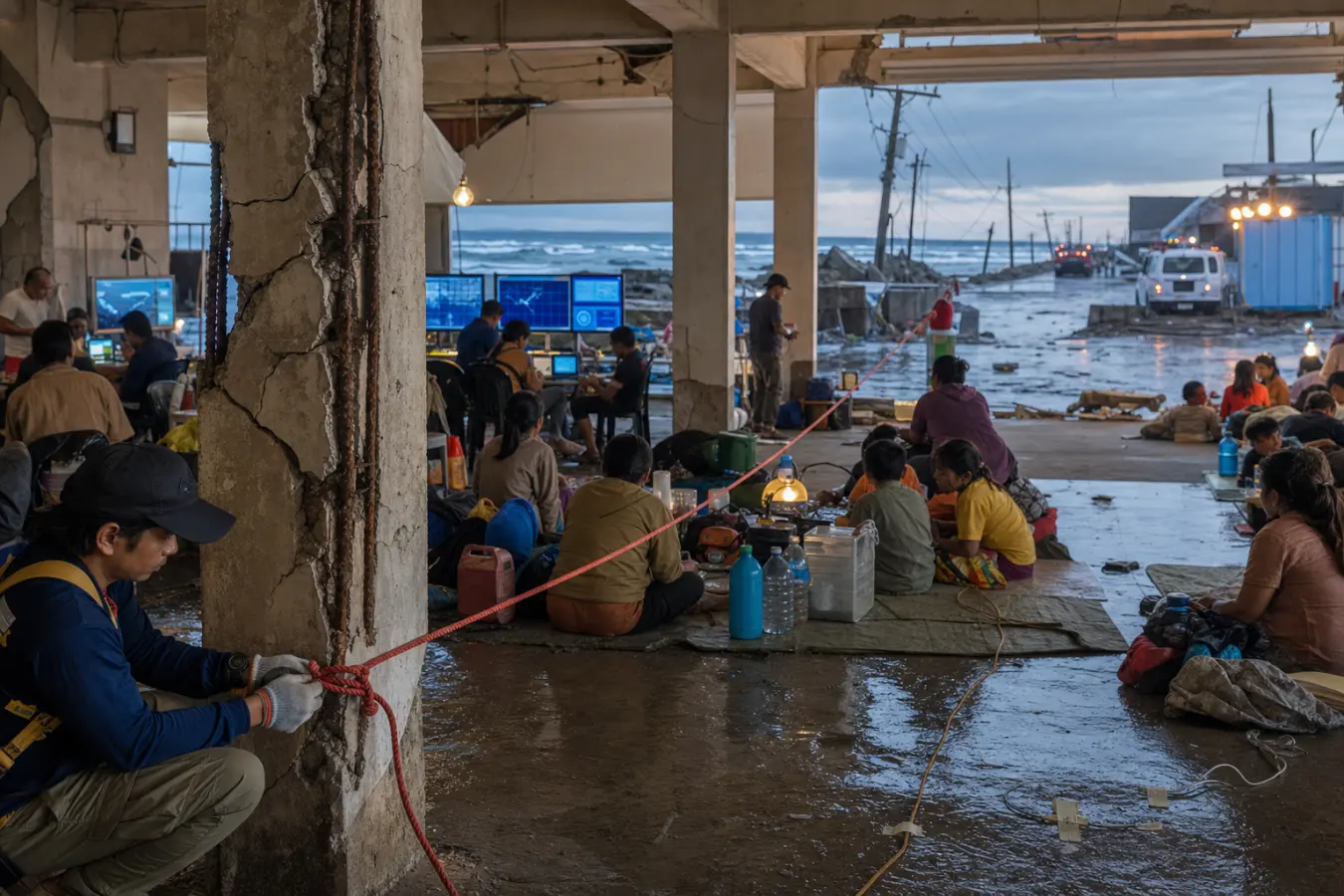
Strained, watchful, and unsettled An anonymous rescue worker ties a red safety cord around a cracked column in a coastal evacuation hall as families, emergency equipment, and the unsettled sea fill the scene.
Visual logic
The earthquake supplies the day’s clearest physical rupture, while the surrounding pressures on energy, media, security, and public trust are best expressed as a strained civic response system rather than a collage of headlines. A coastal evacuation hall gives the image human scale and spatial depth: people, power, communication, damaged infrastructure, and watchful uncertainty in one inhabited frame. The cracked concrete, exposed rebar, emergency lighting, and blue data glow connect natural shock with institutional strain without becoming literal or propagandistic.
Concept
Systems Under Aftershock
How it was framed
Composition focuses on Full-bleed edge-to-edge frame with no margins, Asymmetric foreground anchor: cracked column and rescue worker hand, Diagonal red safety cord creates movement from foreground to sea, and Clear foreground, midground evacuation activity, background coastline.
Visual direction leans on Grounded civic disaster response, not spectacle, One focal act of securing damaged infrastructure, Blue data-power glow countered by amber emergency light, and Atmosphere supports depth but does not obscure draftsmanship.
Material treatment uses Cracked concrete with exposed rusted rebar, Wet asphalt and salt-stained seawall, Canvas mats, plastic water containers, taped cables, and Battery lamps, radio equipment, blue monitor glass to keep the image tactile rather than generic.
Color language is built around Aftershock Slate, Datacentre Blue, Civic Amber, and Faultline Red.
Sources
Powerful earthquake in southern Philippines leaves at least 35 dead
Open sourceAustralia news live: cost-of-living pressures ‘back with a vengeance’, survey shows; ASX slumps amid tech selloff
Open sourceABC began international search to replace Justin Stevens as news director without his knowledge
Open sourceJacinta Allan says Pauline Hanson ‘chooses to barrack for bullies’ over ‘ditch the witch’ billboard
Open sourceThe criminal cartels cashing in on the World Cup – podcast
Open sourceAdam Schiff calls for Senate to ‘vigorously oppose’ Trump’s effort to make Todd Blanche his permanent attorney general – as it happened
Open sourceRelated editions
The World Canvas for 2026-06-10
The day’s strongest signal is a widening Middle East confrontation, with Iran reporting retaliatory attacks on sites linked to US forces after US strikes connected to the downing of an army helicopter, while officials in Washington describe their actions as targeted and defensive. The repercussions are being read well beyond the region, including in Australia, where leaders are warning that instability in the Middle East continues to carry domestic economic and political consequences. At the same time, democratic and legal accountability stories are shaping the wider frame: New South Wales has admitted police assaulted and falsely imprisoned pro-Palestine protester Hannah Thomas, while US state-level politics remain volatile, with California and South Carolina races showing the continuing influence of national partisan currents. The result is a world-state defined less by a single rupture than by overlapping stress: military escalation, institutional scrutiny, election positioning, and the social aftershocks of protest and public grief.
The World Canvas for 2026-06-08
The day’s world-state is led by renewed military escalation between Israel and Iran, with reported Israeli strikes on targets in central and western Iran following Iranian missile launches and visible pressure from Washington to limit further retaliation. In the Asia-Pacific, a powerful 7.8 earthquake in the southern Philippines triggered tsunami warnings across parts of the Philippines, Indonesia, and Malaysia, shifting attention to rescue operations, coastal preparedness, and the fragility of exposed communities. Australia’s political climate remained unsettled, with polling pressure on Labor, criticism of a misogynistic campaign targeting Victorian premier Jacinta Allan, and continuing public attention to medical research and civic resilience. Against this backdrop, culture offered a sharply human register: a stripped-back revival of Death of a Salesman dominated the 2026 Tony awards, underscoring how older works can re-enter public life during periods of uncertainty.
The World Canvas for 2026-06-11
The global landscape is currently defined by a sharp escalation in military friction within the Middle East, as US strikes against Iranian targets continue for a second day following reports of a collapsing ceasefire. While Tehran claims impacts on US regional bases and disputes maritime transit status in the Strait of Hormuz, Washington maintains that commercial lanes remain open despite the increasing kinetic activity. Simultaneously, domestic institutions in Australia face significant strain as state governments warn that proposed National Disability Insurance Scheme (NDIS) overhauls could overwhelm hospital systems, reflecting a broader pattern of fragile social safety nets. Cultural discourse remains active but somber, marked by the legacy of high-profile judicial cases in France and the celebration of cinematic history in Sydney, illustrating a world caught between systemic reform and regional insecurity.
The World Canvas for 2026-06-07
The day’s signals point to societies trying to manage pressure at several levels at once: household finances are thinning, social housing shortages remain structurally severe, and industrial policy is struggling to keep pace with the electric-vehicle transition. Technology’s consumer-facing promise is also under scrutiny, with reports of AI-assisted shopping journeys leading users toward fraudulent retail sites. Public safety and social cohesion remain prominent concerns, from arrests after an alleged machete brawl in Melbourne to legal proceedings in the US examining alleged attacks on Jewish communities in Europe. Alongside these strains, cultural life still asserts itself through debates over how loud, open and civic public spaces such as the Sydney Opera House should be.
Method and provenance
Image prompt
Full-bleed edge-to-edge documentary editorial artwork, eye-level medium-wide scene inside a damaged coastal civic hall in southern Mindanao converted into an evacuation and emergency coordination center after a major offshore earthquake. Dominant subject: an anonymous rescue worker in three-quarter profile, under 20% of the frame, tying one red safety cord around a cracked concrete column with exposed rusted rebar; anatomically plausible single gesture, two arms, natural joints, correct gloved hand-to-arm connection. Surrounding counterforce: aftershock risk, tsunami-alert anxiety, and strained power/data coordination pressing against the inhabited hall. Foreground: flaking concrete column, wet floor, red cord, damp canvas mats, plastic water containers, taped charging cables. Midground: anonymous families and volunteers sit beside battery lamps, radios, and unlabeled blue monitor glass with abstract seismic and grid-like patterns, no readable text. Background: open doors reveal a fractured seawall, tilted utility poles, wet asphalt, distant emergency vehicles, a dark unsettled sea, and a blue-lit temporary power/data container beside amber emergency lamps. Asymmetric composition with the column on the left and the red cord leading diagonally toward the sea; clear foreground-midground-background hierarchy, humid coastal air and dust in directional natural light, realistic scale, precise material detail, no spectacle.
Full Source Layer for This News Digest
Powerful earthquake in southern Philippines leaves at least 35 dead
Open sourceAustralia news live: cost-of-living pressures ‘back with a vengeance’, survey shows; ASX slumps amid tech selloff
Open sourceABC began international search to replace Justin Stevens as news director without his knowledge
Open sourceJacinta Allan says Pauline Hanson ‘chooses to barrack for bullies’ over ‘ditch the witch’ billboard
Open sourceThe criminal cartels cashing in on the World Cup – podcast
Open sourceAdam Schiff calls for Senate to ‘vigorously oppose’ Trump’s effort to make Todd Blanche his permanent attorney general – as it happened
Open source