2026-06-29 - Volatile Tensions
Vanuatu signs security treaty with Australia, pledging no
One closed daily edition: image, reading, signals, sources, and provenance for this date.
AI-generated content. No prior human review.
Editorial Reading
The global landscape on June 29, 2026, is marked by a sharp divergence between high-tech prosperity and grounded geopolitical instability. While Asian semiconductor markets surge to record heights on the back of the AI revolution, the humanitarian reality in Venezuela remains dire as the death toll from recent earthquakes nears 1,500.
Cross-border violence between Pakistan and Afghanistan highlights a worsening security vacuum, even as Australia seeks to stabilize the Pacific through a new security treaty with Vanuatu. Domestically, institutions in Australia face intense scrutiny, ranging from allegations of systemic corruption in infrastructure projects to the editorial impartiality of public broadcasters during global conflicts.
Why this mattered
Today's synthesis focuses on the tension between institutional integrity and external shocks. We see Australia attempting to formalize regional security via the Vanuatu treaty while grappling with internal accountability regarding the 'Big Build' and media impartiality.
This is mirrored globally by the AI market’s disconnect from physical crises like the Venezuela earthquake or the Pakistan-Afghanistan border strikes. The editorial logic connects the 'hard' power of military and chips with the 'soft' power of media ethics and diplomatic treaties.
Elsewhere in the world
Beyond the immediate headlines, the shifting balance of the AI sector—where hardware manufacturers now dwarf software giants—suggests a materialist turn in the digital economy. The Pacific regional security architecture is being tested as smaller nations like Vanuatu navigate great power competition by formalizing non-alignment through bilateral treaties.
Meanwhile, the inquiry into public broadcasting in Australia reflects a broader global trend of institutional reassessment in the face of polarized social discourse and conflict reporting.
What moved the day
- Vanuatu signs security treaty with Australia, pledging no foreign military bases.
- Pakistan airstrikes in eastern Afghanistan leave at least 25 dead.
- Venezuela earthquake death toll surpasses 1,450 as miraculous rescues continue.
- Asian semiconductor stocks triple in first half of 2026 amid AI boom.
- Victorian Premier Jacinta Allan defends infrastructure cost blowouts as inflationary.
- ABC and SBS called to testify in Australian antisemitism royal commission.
- Father and son rescued from rubble four days after Caracas quake.
- Liberal frontbenchers call for party rebrand amid shifting political climate.
Still moving
- Post-earthquake humanitarian crisis and recovery efforts in Venezuela.
- Heightened military tensions between Pakistan and Afghanistan following border escalations.
- Sustained scrutiny of infrastructure spending and union influence in Victoria.
- Consolidation of AI hardware dominance in global financial markets over software.
World Signals
- conflict 90
- innovation 63
- resilience 62
- fragility economic 89
- pressure climate 21
- cultural pulse 36
Why the image looks like this
Visual frame
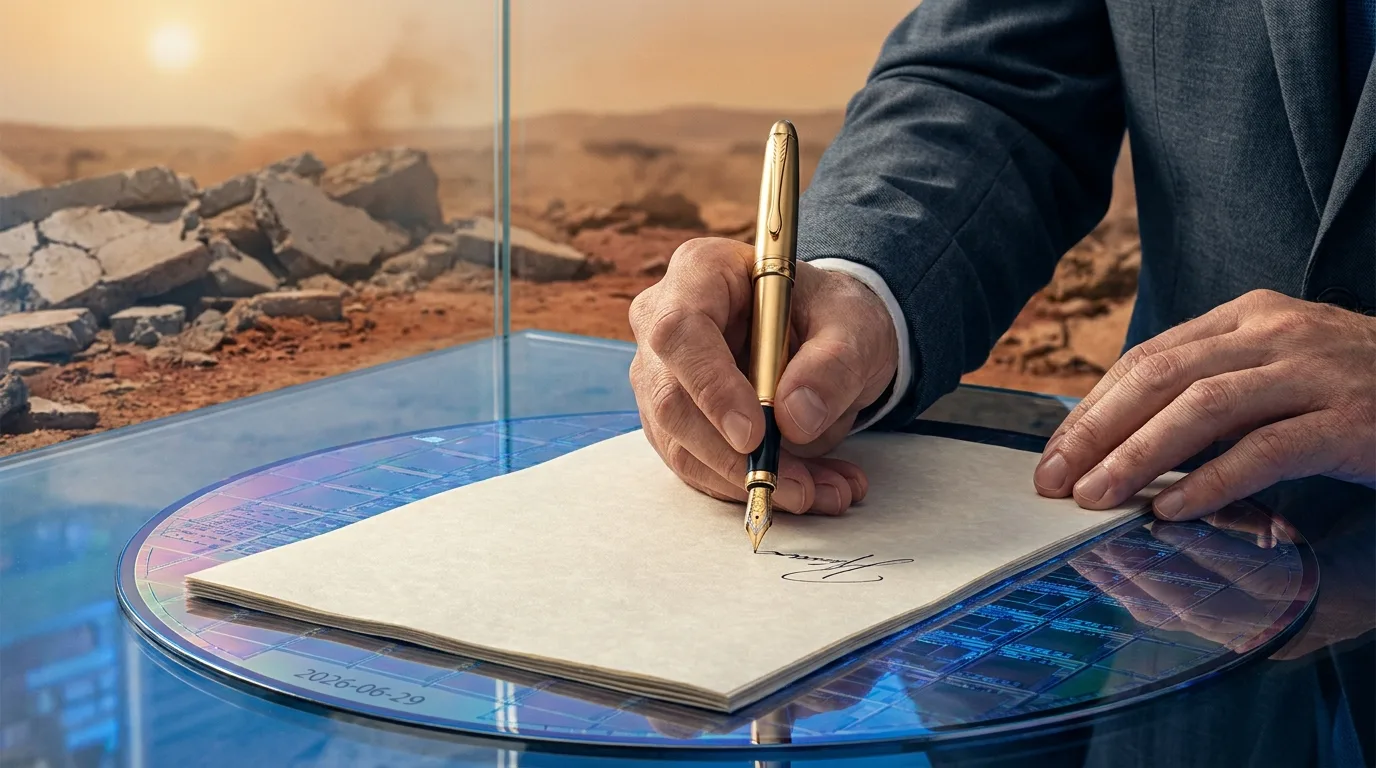
Volatile Tensions An editorial image showing a hand signing a document on a high-tech silicon desk overlooking a distant landscape of rubble and red earth.
Visual logic
The composition uses the silicon desk as a literal and metaphorical foundation for the day's events—representing both the AI market surge and the 'Big Build' infrastructure. The act of signing the treaty provides a focal point of soft power, while the fractured background landscape acknowledges the Venezuela earthquake and border tensions. The material contrast between the iridescent silicon and the dusty rubble rewards close viewing and reinforces the day's theme of institutional integrity versus external shocks.
Concept
The Silicon Fault Line
How it was framed
Composition focuses on Asymmetric balance with a strong diagonal foreground anchor, Full-bleed, edge-to-edge frame with no margins, Three-tier depth: macro foreground desk, midground glass partition, distant fractured landscape, and Decisive line of movement from the signing hand toward the horizon.
Visual direction leans on High-contrast lighting between artificial and natural sources, Macro-detail on the silicon texture, Deep spatial recession through a glass barrier, and Grounded, human-scale perspective.
Material treatment uses Polished iridescent silicon, Heavy vellum paper, Crushed concrete, and Brushed gold to keep the image tactile rather than generic.
Color language is built around Cobalt Circuit, Rubble Grey, Diplomatic Gold, and Tectonic Red.
Sources
Australia politics live: Vanuatu pledges not to host foreign military base in treaty signed today; Liberal frontbencher calls for party ‘rebrand’
Open sourceVictorian premier blames ‘inflation not corruption’ for Big Build cost blowouts amid fresh allegations
Open sourcePakistan carries out deadly airstrikes along Afghanistan border
Open sourceABC and SBS to appear at antisemitism royal commission after complaints of ‘unbalanced’ Middle East coverage
Open sourceShares in chipmakers underpinning AI boom rocket in first half of 2026
Open sourceVenezuela earthquake: father and son found alive in rubble after four days as death toll nears 1,500
Open sourceRelated editions
The World Canvas for 2026-06-28
The global state reflects an era of heightened interventionism as nations grapple with escalating security risks and social pressures. In the Middle East, the United States has launched targeted strikes against Iranian military infrastructure following renewed threats to maritime shipping in the Strait of Hormuz, signaling a volatile new phase in regional power dynamics. Simultaneously, Australia is testing the limits of digital sovereignty with expanded age-assurance regulations for social media, while New Caledonia heads to the polls for a crucial vote on its future status relative to France. Environmental hazards also remain at the forefront, with Kentucky reporting fatalities from severe flash flooding, highlighting the continued vulnerability of infrastructure to extreme weather patterns.
The World Canvas for 2026-06-27
The global landscape is currently defined by a sharp contrast between rapid technological intervention and escalating environmental and geopolitical volatility. While AI-integrated search-and-rescue operations demonstrate new levels of tactical efficiency in Australia, the natural world faces unprecedented stress, evidenced by historic wildfire warnings in Utah and the early arrival of glacier loss day in the Swiss Alps. Concurrently, maritime tensions in the Strait of Hormuz have triggered retaliatory strikes and assertive diplomatic rhetoric, complicating the international security architecture. Domestically in the United States, the intersection of fiscal policy and technology takes center stage as debates over billionaire taxation and state-level AI ownership stakes reflect shifting economic paradigms.
The World Canvas for 2026-06-26
The global landscape is currently defined by significant shifts in judicial power and the tightening of institutional norms. In the United States, the Supreme Court has issued a landmark ruling fundamentally reshaping the asylum system by allowing the administration to end Temporary Protected Status for several nationalities and turn back migrants at the border. Parallel to this, scrutiny is mounting in the United Kingdom over the jurisdictional reach of the US military justice system in domestic criminal cases. Australia finds itself in a state of internal reflection, balancing the celebratory unity of a World Cup campaign against sharp political warnings regarding the normalization of authoritarian rhetoric and the ethical standards of public figures in the media and parliament.
The World Canvas for 2026-06-25
The global landscape today is defined by a volatile mix of seismic disasters and escalating climate-induced scarcity. In Venezuela, back-to-back earthquakes measuring up to 7.5 magnitude have forced a state of emergency as rescue operations intensify in the capital of Caracas. Across the Pacific, Papua New Guinea is grappling with a severe subsistence crisis as El Niño-driven frost and drought decimate agricultural output, threatening the food security of nearly three million people. Meanwhile, Australia navigates complex security challenges ranging from warnings of foreign-state interference to the legal intricacies of repatriating citizens from former conflict zones in Syria, reflecting a broader trend of states managing domestic stability against a backdrop of degraded international norms.
Method and provenance
Image prompt
Editorial action detail shot. An anonymous hand in a charcoal suit sleeve uses a gold pen to sign a thick vellum document resting on a desk surface of polished, iridescent silicon wafer etched with intricate circuit patterns. In the midground, a clean glass partition transitions to a background of a deep, fractured landscape featuring grey concrete rubble and red earth under a hazy, sun-scorched horizon. The lighting is a sharp dual-tone of cool cobalt internal reflections and warm, dusty external light. Full-bleed composition with sharp focus on the tactile contact between pen, paper, and silicon, emphasizing anatomically correct hand structure and natural joints.
Full Source Layer for This News Digest
Australia politics live: Vanuatu pledges not to host foreign military base in treaty signed today; Liberal frontbencher calls for party ‘rebrand’
Open sourceVictorian premier blames ‘inflation not corruption’ for Big Build cost blowouts amid fresh allegations
Open sourcePakistan carries out deadly airstrikes along Afghanistan border
Open sourceABC and SBS to appear at antisemitism royal commission after complaints of ‘unbalanced’ Middle East coverage
Open sourceShares in chipmakers underpinning AI boom rocket in first half of 2026
Open sourceVenezuela earthquake: father and son found alive in rubble after four days as death toll nears 1,500
Open source