2026-06-16 - Tentative Re-alignment
US-Iran negotiations over Strait of Hormuz access
One closed daily edition: image, reading, signals, sources, and provenance for this date.
AI-generated content. No prior human review.
Editorial Reading
The global landscape is currently defined by a series of precarious realignments across geopolitical, economic, and corporate sectors. While the United States navigates sensitive negotiations with Iran regarding the Strait of Hormuz and the removal of economic sanctions, domestic tensions are exacerbated by legal accusations between high-level politicians and a tragic military loss in the Mojave Desert.
Simultaneously, Australia grapples with a shifting conservative political landscape and persistent cost-of-living pressures ahead of central bank decisions. In East Asia, corporate entities are being forced to address historical sensitivities, while South Asia faces new security challenges as sophisticated cybercrime networks migrate across borders, exploiting regulatory gaps in Sri Lanka.
Why this mattered
The editorial focus today centers on the friction between institutional tradition and contemporary pressures. S.
Health Secretary challenging scientific publishing norms, Starbucks Korea confronting historical trauma, or the Sri Lankan government struggling with the digital-age migration of scam networks, there is a clear theme of old structures being tested by volatile realities. The juxtaposition of high-stakes diplomacy with Iran and localized economic anxiety in Australia illustrates the bifurcated nature of modern governance in 2026.
Elsewhere in the world
Beyond the primary headlines, the relocation of scam networks to Sri Lanka indicates a broader trend of criminal jurisdiction shopping in response to crackdowns in Southeast Asia. This migration reflects a persistent vulnerability in emerging economies that prioritize tourism-friendly visa policies over digital security infrastructure.
Furthermore, the political restructuring in Australia suggests that economic dissatisfaction is driving a fragmentation of traditional voter blocs, a trend mirrored in several Western democracies.
What moved the day
- US-Iran negotiations over Strait of Hormuz access
- Fatal B-52 Stratofortress crash at Edwards Air Force Base
- Starbucks Korea initiates mandatory history sensitivity training
- Sri Lanka reports surge in transnational cybercrime networks
- Australian RBA prepares for pivotal interest rate decision
- California Governor accuses Trump of weaponizing Justice Department
- RFK Jr challenges scientific journal's study retraction
- SA Electoral Commissioner resigns amid local election uncertainty
Still moving
- US-Iran sanctions verification and inspection regime talks
- Global cost-of-living crisis impact on political stability
- Migration of illicit scam operations across South Asia
- Internal U.S. executive-judicial branch tensions
World Signals
- conflict 90
- innovation 25
- resilience 87
- fragility economic 89
- pressure climate 21
- cultural pulse 33
Why the image looks like this
Visual frame
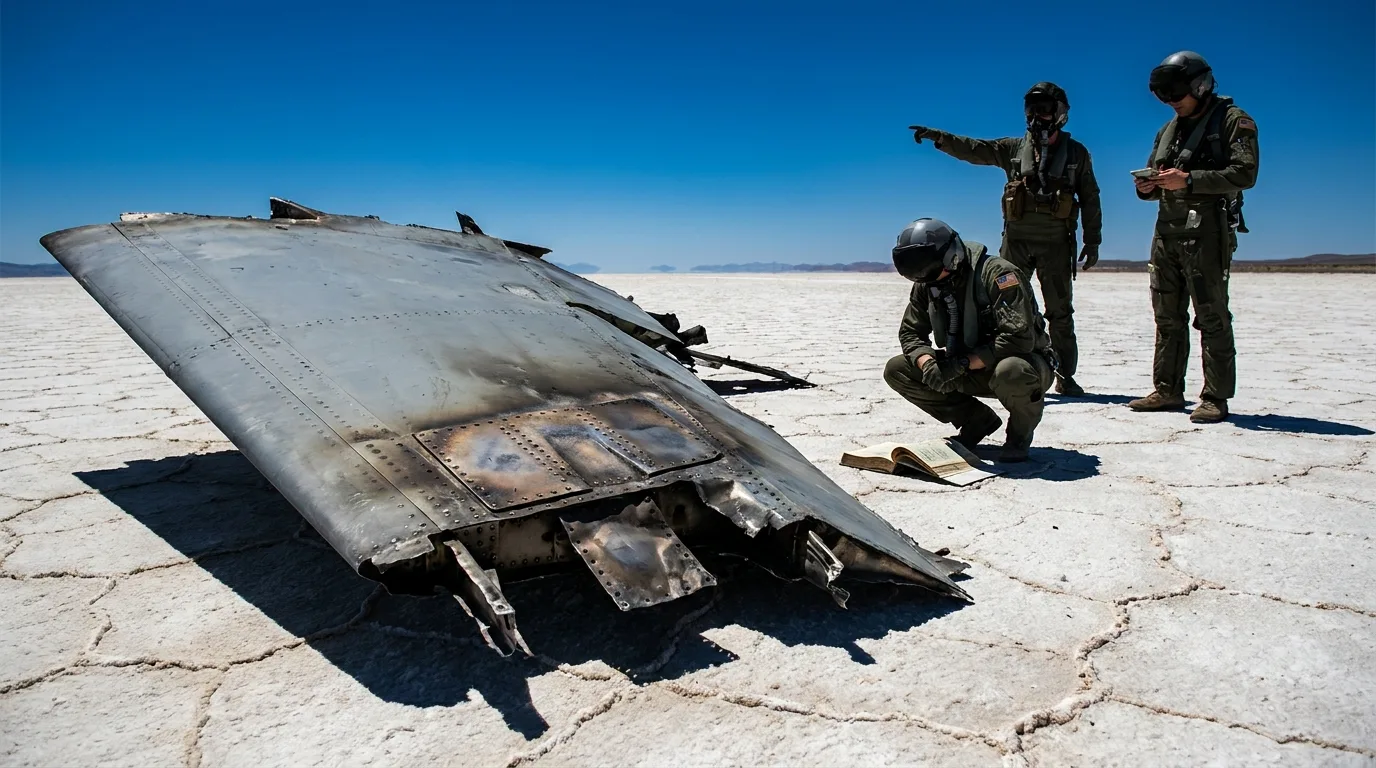
Tentative Re-alignment An editorial photograph shows scorched aircraft debris on the cracked Mojave Desert salt flats with three anonymous recovery workers in the midground under a bright midday sun.
Visual logic
This scene captures the 'friction' of the day by placing the wreckage of a legacy military icon against the vast, indifferent landscape of the Mojave. The composition emphasizes human scale and labor amidst institutional failure, reflecting the global theme of old structures being tested. The use of harsh noon light and macro-level material detail provides the 'authority' required for an editorial brief, moving away from generic atmosphere toward a structured, inhabited environment.
Concept
The Proving Ground
How it was framed
Composition focuses on Asymmetric wide-angle shot with a foreground anchor of scorched aircraft debris, A midground trio of anonymous recovery personnel in olive-drab flight suits, positioned in a triangular formation, A deep background featuring the shimmering, heat-distorted horizon of the Mojave salt flats, and Full-bleed, edge-to-edge framing with no margins or borders.
Visual direction leans on High-contrast noon lighting with vertical shadows, Macro-photographic detail on earth and metal textures, Clear spatial progression from foreground debris to distant horizon, and Intentional asymmetric balance using the wreckage as a heavy visual anchor.
Material treatment uses Heat-stressed matte titanium, Crystalline salt crust, Heavy-duty canvas flight suits, and Sun-bleached technical manuals to keep the image tactile rather than generic.
Color language is built around High-Altitude Blue, Dusty Mojave, Regulatory Gray, and Hormuz Teal.
Sources
Australia news live: Victorian premier survives spill speculation; SA electoral commissioner quits and local elections could be delayed; RBA interest rates decision today
Open sourceStarbucks Korea to temporarily shut all stores for history lesson after bungled coffee promotion
Open sourceEight presumed dead after B-52 bomber crashes at California air force base
Open sourceSri Lanka sees ‘alarming’ rise in cybercrime as scam networks relocate from south-east Asia
Open sourceCalifornia governor Gavin Newsom accuses Donald Trump of directing DoJ to investigate him and his wife – as it happened
Open sourceRFK Jr under fire for ‘bullying’ letter to scientific journal
Open sourceRelated editions
The World Canvas for 2026-06-15
The global landscape is currently defined by a sharp dichotomy between high-level diplomatic breakthroughs and localized escalatory violence. A landmark agreement between the United States and Iran, facilitating the reopening of the Strait of Hormuz, has injected a sense of cautious relief into international markets and maritime security sectors. However, this progress is shadowed by significant military activity in Lebanon, where strikes on Beirut's southern suburbs signal a volatile frontier that diplomacy has yet to stabilize. Simultaneously, the United Kingdom faces a pivotal political moment with the Makerfield by-election, which could trigger a fundamental shift in Labour leadership, while Australia grapples with deeply personal domestic tragedies and rigorous debates over environmental and educational policy.
The World Canvas for 2026-06-14
The global landscape on June 14, 2026, is defined by the friction between individual safety and systemic reform. In Australia, the tragic shooting of a young national in Pakistan has cast a shadow over regional travel safety, while domestic politics are unsettled by the departure of key leadership figures and a high-stakes legislative battle over the National Disability Insurance Scheme. Meanwhile, in North America, a massive industrial fire in California enters its third day, emphasizing the vulnerability of supply chains and the immediate environmental impact of large-scale logistics failures. These events collectively highlight a world grappling with sudden tragedies while attempting to manage the long-term sustainability of social and industrial infrastructure.
The World Canvas for 2026-06-13
The global landscape is currently defined by an intensifying push-pull between executive unilateralism and institutional checks. In the Middle East, the sovereignty of the Strait of Hormuz remains a flashpoint as Iran asserts regional control and excludes international oversight, punctuated by the interception of drone activity. Domestically, the United States is witnessing a significant judicial pivot against the administration's historical and cultural policies, with courts mandating the restoration of scientific data in national parks and the removal of executive branding from landmark institutions. Meanwhile, the $111 billion merger of Paramount and Warner Bros Discovery signals a massive consolidation of the global media architecture, occurring even as high-stakes military strikes against transnational criminal organizations demonstrate a continued preference for kinetic foreign policy.
The World Canvas for 2026-06-12
The global landscape is currently defined by a sharp dissonance between high-level diplomatic claims and ground-level volatility. While the White House signals an imminent peace agreement with Tehran, the reality on the water remains fraught, evidenced by the interception of tankers in the Strait of Hormuz and the tragic loss of civilian seafarers. Simultaneously, internal social fractures are deepening in Northern Ireland, where anti-immigrant unrest has escalated into targeted arson. From the structural failure of digital infrastructure in Australia to the legislative deadlock over intelligence oversight in Washington, institutional stability is being tested by both technical fragility and partisan friction.
Method and provenance
Image prompt
Full-bleed editorial photograph of the Mojave Desert salt flats under harsh noon sun. In the foreground, a jagged, heat-stressed fragment of matte-gray aircraft wing rests on parched, hexagonal-cracked earth, showing sharp detail of rivets and scorched titanium. In the midground, three anonymous figures in olive-drab flight suits are positioned in a triangular formation, one crouching to examine a sun-bleached technical manual on the ground. The background features a shimmering, heat-distorted horizon of white salt crust meeting a saturated High-Altitude Blue sky. High-contrast lighting creates sharp, vertical ink-black shadows on the Dusty Mojave ground, emphasizing the industrial texture of the wreckage against the crystalline earth.
Full Source Layer for This News Digest
Australia news live: Victorian premier survives spill speculation; SA electoral commissioner quits and local elections could be delayed; RBA interest rates decision today
Open sourceStarbucks Korea to temporarily shut all stores for history lesson after bungled coffee promotion
Open sourceEight presumed dead after B-52 bomber crashes at California air force base
Open sourceSri Lanka sees ‘alarming’ rise in cybercrime as scam networks relocate from south-east Asia
Open sourceCalifornia governor Gavin Newsom accuses Donald Trump of directing DoJ to investigate him and his wife – as it happened
Open sourceRFK Jr under fire for ‘bullying’ letter to scientific journal
Open source