2026-06-15 - Precarious De-escalation
US and Iran sign landmark deal to reopen the Strait of
One closed daily edition: image, reading, signals, sources, and provenance for this date.
AI-generated content. No prior human review.
Editorial Reading
The global landscape is currently defined by a sharp dichotomy between high-level diplomatic breakthroughs and localized escalatory violence. A landmark agreement between the United States and Iran, facilitating the reopening of the Strait of Hormuz, has injected a sense of cautious relief into international markets and maritime security sectors.
However, this progress is shadowed by significant military activity in Lebanon, where strikes on Beirut's southern suburbs signal a volatile frontier that diplomacy has yet to stabilize. Simultaneously, the United Kingdom faces a pivotal political moment with the Makerfield by-election, which could trigger a fundamental shift in Labour leadership, while Australia grapples with deeply personal domestic tragedies and rigorous debates over environmental and educational policy.
Why this mattered
The editorial focus today bridges the gap between macro-geopolitical shifts and the fragile domestic realities of the nations involved. The US-Iran deal represents a major success in de-escalation, yet the simultaneous strikes in Beirut highlight the limits of single-track diplomacy in a multi-polar conflict zone.
We are also tracking a shift in internal governance models, from the UK's leadership struggles to Australia's focus on social well-being through device-free education and tax reform, suggesting a global trend toward reassessing domestic stability amid external chaos.
Elsewhere in the world
Beyond the headlines of war and peace, the international community is watching the scientific debate in Australia regarding shark culling, which underscores a growing tension between public safety and marine conservation. In the background, the arrest of a police officer in Pakistan for a mistaken shooting indicates a high-stakes moment for the nation's law enforcement credibility during a period of increased international scrutiny.
What moved the day
- US and Iran sign landmark deal to reopen the Strait of Hormuz
- Israeli military strikes Dahiyeh district in Beirut targeting Hezbollah
- Official signing of US-Iran peace agreement scheduled for Geneva on June 19
- Makerfield by-election begins with Andy Burnham challenging the status quo
- Victorian schools in Australia to implement device-free time for students
- Arrest of police officer in Pakistan following the death of Hania Ahmed
- Australian Senate review begins assessment of Labor’s latest tax reforms
- Tragic suspected murder-suicide investigation in Sydney's Parramatta River
Still moving
- Reopening logistics for the Strait of Hormuz and global energy price impact
- Leadership tensions within the UK Labour party following the Makerfield result
- The evolution of Australian educational reform regarding digital distractions
- Long-term diplomatic fallout of Israeli-Lebanese border escalations
World Signals
- conflict 92
- innovation 26
- resilience 64
- fragility economic 87
- pressure climate 25
- cultural pulse 32
Why the image looks like this
Visual frame
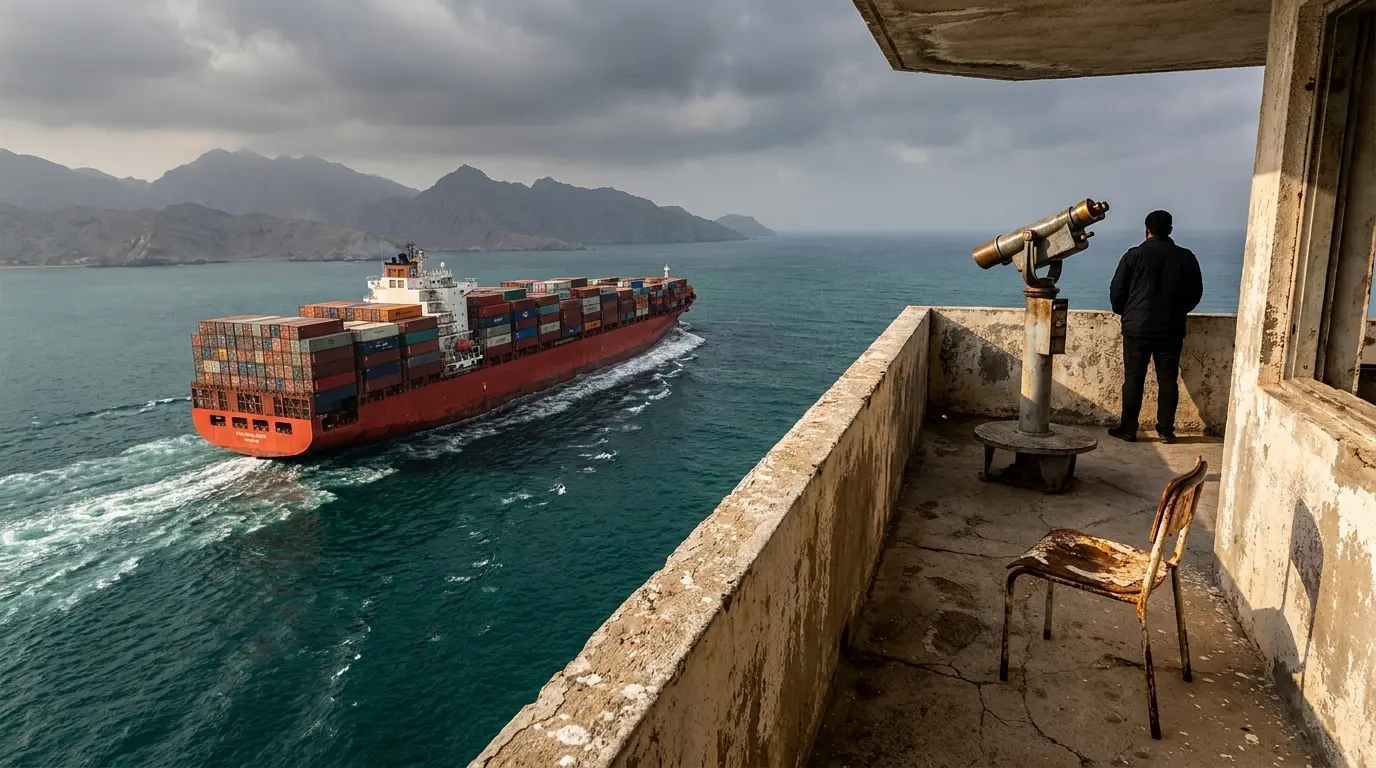
Precarious De-escalation An industrial cargo ship navigates a narrow strait seen from a weathered concrete observation deck with a single chair and telescope.
Visual logic
The Strait of Hormuz is the day's focal point of de-escalation. Using a massive tanker provides a singular, memorable focal event that represents the reopening of trade. The weathered foreground balcony provides a human-scale entry point, suggesting the 'civic' and 'labor' aspects of the news, while the contrast between the industrial steel and the natural teal water creates a sense of grounded authority.
Concept
The Narrow Passage
How it was framed
Composition focuses on Asymmetric wide-angle shot, Foreground anchor of a weathered concrete balcony with a single metal chair, Midground dominated by a massive industrial tanker moving diagonally through the frame, and Background featuring the jagged, hazy silhouettes of coastal mountains.
Visual direction leans on Full-bleed aerial-perspective photography, High-contrast maritime silhouettes, Deep blue and teal gradients, and Industrial and coastal textures.
Material treatment uses Salt-crusted rusted steel, Poured weathered concrete, Deep-toned churned seawater, and Polished glass of an observation lens to keep the image tactile rather than generic.
Color language is built around Diplomatic Slate, Persian Teal, Dahiyeh Smoke, and Outback Ochre.
Sources
Australia news live: Victoria to require device-free time in schools; experts back Labor’s tax reforms in Senate review
Open sourcePakistan PM says signing of agreement – as it happened
Open sourceShark expert says Tony Abbott ‘doesn’t understand the science’ after former PM calls for cull
Open sourcePakistani police officer arrested over shooting death of ‘happy, bubbly, friendly’ Australian girl Hania Ahmed
Open sourceFather may have thrown daughter into Parramatta River in suspected murder-suicide, police say
Open sourceIn Makerfield for the byelection that could change everything - podcast
Open sourceRelated editions
The World Canvas for 2026-06-14
The global landscape on June 14, 2026, is defined by the friction between individual safety and systemic reform. In Australia, the tragic shooting of a young national in Pakistan has cast a shadow over regional travel safety, while domestic politics are unsettled by the departure of key leadership figures and a high-stakes legislative battle over the National Disability Insurance Scheme. Meanwhile, in North America, a massive industrial fire in California enters its third day, emphasizing the vulnerability of supply chains and the immediate environmental impact of large-scale logistics failures. These events collectively highlight a world grappling with sudden tragedies while attempting to manage the long-term sustainability of social and industrial infrastructure.
The World Canvas for 2026-06-13
The global landscape is currently defined by an intensifying push-pull between executive unilateralism and institutional checks. In the Middle East, the sovereignty of the Strait of Hormuz remains a flashpoint as Iran asserts regional control and excludes international oversight, punctuated by the interception of drone activity. Domestically, the United States is witnessing a significant judicial pivot against the administration's historical and cultural policies, with courts mandating the restoration of scientific data in national parks and the removal of executive branding from landmark institutions. Meanwhile, the $111 billion merger of Paramount and Warner Bros Discovery signals a massive consolidation of the global media architecture, occurring even as high-stakes military strikes against transnational criminal organizations demonstrate a continued preference for kinetic foreign policy.
The World Canvas for 2026-06-12
The global landscape is currently defined by a sharp dissonance between high-level diplomatic claims and ground-level volatility. While the White House signals an imminent peace agreement with Tehran, the reality on the water remains fraught, evidenced by the interception of tankers in the Strait of Hormuz and the tragic loss of civilian seafarers. Simultaneously, internal social fractures are deepening in Northern Ireland, where anti-immigrant unrest has escalated into targeted arson. From the structural failure of digital infrastructure in Australia to the legislative deadlock over intelligence oversight in Washington, institutional stability is being tested by both technical fragility and partisan friction.
The World Canvas for 2026-06-11
The global landscape is currently defined by a sharp escalation in military friction within the Middle East, as US strikes against Iranian targets continue for a second day following reports of a collapsing ceasefire. While Tehran claims impacts on US regional bases and disputes maritime transit status in the Strait of Hormuz, Washington maintains that commercial lanes remain open despite the increasing kinetic activity. Simultaneously, domestic institutions in Australia face significant strain as state governments warn that proposed National Disability Insurance Scheme (NDIS) overhauls could overwhelm hospital systems, reflecting a broader pattern of fragile social safety nets. Cultural discourse remains active but somber, marked by the legacy of high-profile judicial cases in France and the celebration of cinematic history in Sydney, illustrating a world caught between systemic reform and regional insecurity.
Method and provenance
Image prompt
A full-bleed editorial photograph from a high-angle coastal lookout overlooking a narrow waterway. In the foreground, a corner of a weathered, salt-crusted concrete balcony holds a single rusted metal chair and a fixed industrial observation telescope. The midground is dominated by the massive, textured hull of a container ship moving diagonally through deep Persian Teal water, its wake cutting a sharp white line. The background features the jagged, hazy silhouettes of coastal mountains under a heavy sky of layered, smoke-colored clouds. Sharp, directional morning light emphasizes the industrial scale of the vessel and the grit of the concrete station.
Full Source Layer for This News Digest
Australia news live: Victoria to require device-free time in schools; experts back Labor’s tax reforms in Senate review
Open sourcePakistan PM says signing of agreement – as it happened
Open sourceShark expert says Tony Abbott ‘doesn’t understand the science’ after former PM calls for cull
Open sourcePakistani police officer arrested over shooting death of ‘happy, bubbly, friendly’ Australian girl Hania Ahmed
Open sourceFather may have thrown daughter into Parramatta River in suspected murder-suicide, police say
Open sourceIn Makerfield for the byelection that could change everything - podcast
Open source