2026-06-07 - uneasy adaptation
AI shopping recommendations linked to fake retail sites and
One closed daily edition: image, reading, signals, sources, and provenance for this date.
AI-generated content. No prior human review.
Editorial Reading
The day’s signals point to societies trying to manage pressure at several levels at once: household finances are thinning, social housing shortages remain structurally severe, and industrial policy is struggling to keep pace with the electric-vehicle transition. Technology’s consumer-facing promise is also under scrutiny, with reports of AI-assisted shopping journeys leading users toward fraudulent retail sites.
Public safety and social cohesion remain prominent concerns, from arrests after an alleged machete brawl in Melbourne to legal proceedings in the US examining alleged attacks on Jewish communities in Europe. Alongside these strains, cultural life still asserts itself through debates over how loud, open and civic public spaces such as the Sydney Opera House should be.
Why this mattered
The editorial thread is institutional stress under changing conditions: housing systems are not producing enough shelter, trade rules are not yet aligned with supply chains, consumer-protection frameworks are being tested by AI-mediated commerce, and policing and courts are responding to highly visible security incidents. The inclusion of cultural space and borrowing pressures keeps the frame grounded in everyday public life rather than only crisis headlines.
Elsewhere in the world
Beyond the top-line security and economic stories, the signals show how long-term policy choices are surfacing as immediate public problems. England’s housing backlog reflects years of underbuilding and constrained local capacity; EV tariff concerns expose the difficulty of building regional battery supply chains fast enough; and AI shopping scams suggest that trust in digital recommendations may become a consumer-safety issue, not just a technology story.
In Australia, cost-of-living strain, youth crime concerns and cultural-place debates are moving through the same civic conversation.
What moved the day
- AI shopping recommendations linked to fake retail sites and consumer losses
- Shelter says England’s social housing waiting lists would take 119 years to clear at current building rates
- EU and UK car industries push for another delay to Brexit-related EV tariffs
- Multiple teenagers arrested after alleged machete brawl at Melbourne’s Flinders Street station
- US court proceedings examine alleged proxy attacks on Jewish communities in Europe
- Australian debate continues over Sydney Opera House sound rules and public cultural use
- Australians reportedly borrowing record amounts in personal loans amid living-cost pressure
Still moving
- England’s social housing backlog and the financing constraints on councils and housing associations
- Consumer protection risks from AI-generated search, recommendation and shopping pathways
- EU-UK electric vehicle rules of origin and the pace of regional battery manufacturing
- Urban youth violence, knife and machete enforcement, and public transport safety in Melbourne
World Signals
- conflict 88
- innovation 83
- resilience 60
- fragility economic 82
- pressure climate 23
- cultural pulse 50
Why the image looks like this
Visual frame
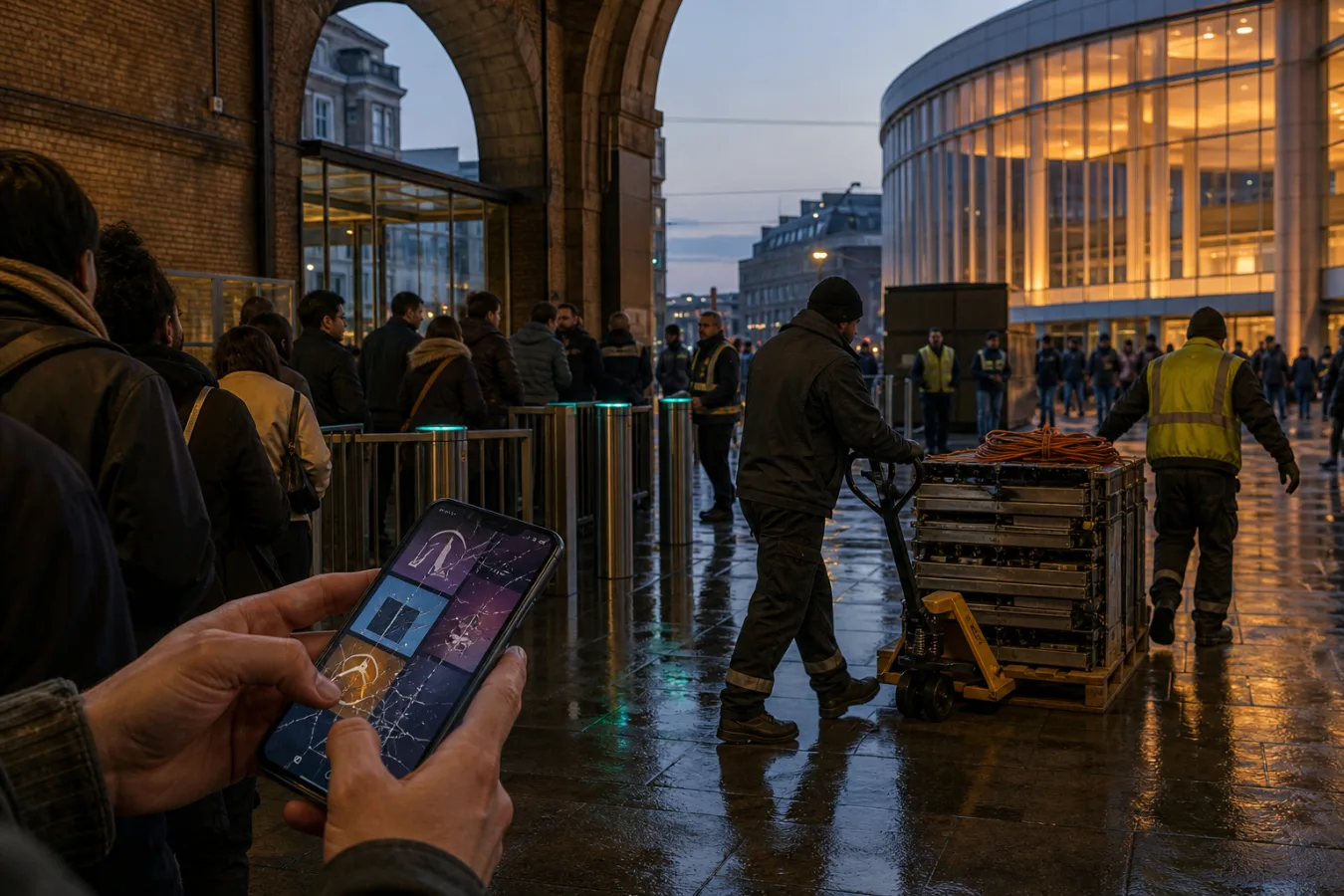
uneasy adaptation An anonymous person grips a cracked phone in a wet city concourse as a housing queue and workers moving EV battery modules share the space under station arches.
Visual logic
A crowded transit-and-cultural concourse captures the day’s uneasy adaptation: people moving through public systems that are still functioning but visibly strained. The foreground phone gesture grounds consumer vulnerability in everyday life, while the midground housing queue and industrial battery crates suggest deeper institutional bottlenecks around shelter, trade and transition. The image uses architecture, light and material contrast to show pressure without turning the scene into spectacle.
Concept
Civic concourse under pressure
How it was framed
Composition focuses on Full-bleed edge-to-edge civic concourse with no empty border, Foreground anchor: anonymous hands gripping a cracked smartphone, Midground counterforce: housing queue and EV battery movement crossing paths, and Background depth: station arches and cultural hall light pulling the eye inward.
Visual direction leans on Grounded editorial realism with collage-like layering in real space, Asymmetric balance, strong silhouettes, clear diagonal movement, Atmosphere kept thin and architectural, not fog-led, and Human scale, inhabited public infrastructure, no identifiable individuals.
Material treatment uses Cracked smartphone glass catching amber reflections, Worn concrete concourse floor with rain sheen, Brushed steel barriers and station railings, and Brick-toned modular housing panels to keep the image tactile rather than generic.
Color language is built around Civic Charcoal, Signal Amber, Housing Brick, and Electric Teal.
Sources
PM backs upping the volume at Sydney Opera House - ‘I’m a member of the fun faction’ – as it happened
Open source‘Poisoned’ AI: the ChatGPT shopping scams that lead to fake websites
Open sourceSocial housing lists ‘would take 119 years to clear at current building rate’
Open sourceCar industry pressing EU for further delay to Brexit EV tariffs
Open sourceMultiple teens arrested over alleged machete brawl in Melbourne as government says crime laws working
Open sourceCould this one man have been behind terrorist attacks on Jewish communities across Europe?
Open sourceRelated editions
The World Canvas for 2026-06-08
The day’s world-state is led by renewed military escalation between Israel and Iran, with reported Israeli strikes on targets in central and western Iran following Iranian missile launches and visible pressure from Washington to limit further retaliation. In the Asia-Pacific, a powerful 7.8 earthquake in the southern Philippines triggered tsunami warnings across parts of the Philippines, Indonesia, and Malaysia, shifting attention to rescue operations, coastal preparedness, and the fragility of exposed communities. Australia’s political climate remained unsettled, with polling pressure on Labor, criticism of a misogynistic campaign targeting Victorian premier Jacinta Allan, and continuing public attention to medical research and civic resilience. Against this backdrop, culture offered a sharply human register: a stripped-back revival of Death of a Salesman dominated the 2026 Tony awards, underscoring how older works can re-enter public life during periods of uncertainty.
The World Canvas for 2026-06-06
The day’s world-state is shaped by renewed military danger in the Gulf, unsettled electoral politics across several democratic arenas, and institutional scrutiny over failures of care and public safety. The sharpest signal comes from the Middle East, where the US and Iran exchanged strikes after drones were launched toward the Strait of Hormuz, prompting Kuwait and Bahrain to issue air-raid alerts and again testing a fragile ceasefire. In parallel, California’s governor’s race and Los Angeles municipal politics point to a volatile US electoral cycle, while Victoria’s leadership speculation underscores how integrity reform and campaign pressure can destabilize incumbents before voters are heard. Beyond geopolitics, a Tasmanian coroner’s finding that irresponsible prescribing directly contributed to two deaths places medical oversight and addiction care back in focus, while the killing of actor James Handy adds a localized but culturally resonant public-safety story.
The World Canvas for 2026-06-09
The day’s world-state is led by acute physical shock and institutional strain: a powerful magnitude-7.8 earthquake off Sarangani in the southern Philippines has killed dozens, injured hundreds, damaged buildings, and left communities facing aftershocks and tsunami-alert anxiety across Mindanao and nearby parts of Indonesia. Alongside the disaster response, public pressure is rising in Australia, where cost-of-living stress is reported to be worsening even as major AI datacentre investment raises questions about energy use, public benefit, and local consent. Political and media institutions are also under scrutiny, from leadership tensions inside Australia’s ABC to disputes over misogynistic political imagery in Victoria. In the wider geopolitical field, reported efforts toward an Israel-Iran ceasefire sit beside uncertainty over U.S. legal and political appointments, while Mexico’s World Cup preparations carry both cultural excitement and security concerns tied to organized crime.
The World Canvas for 2026-06-05
The day’s strongest signal is a politics of accountability under strain: Ukraine’s Volodymyr Zelenskyy publicly urged Vladimir Putin to meet face to face in a neutral country, framing negotiation as urgent while the war’s diplomatic path remains uncertain. In Australia, ASIC opened an investigation into KPMG following whistleblower claims, while parliamentary argument continued over the scrutiny and timing of major tax reforms due to take effect in 2028. Australian politics also saw confusion around One Nation’s housing policy after senior figures struggled to explain its details in broadcast interviews. In the United States, legal and electoral pressure remained visible, with reports that John Bolton is expected to plead guilty in a classified-documents case and Maine Senate candidate Graham Platner denying newly reported allegations about past conduct.
Method and provenance
Image prompt
Full-bleed editorial realism, dusk city concourse beneath station arches and a cultural hall glow. Dominant subject: anonymous adult hands at chest height, under 20% of frame, gripping a cracked smartphone with abstract AI shopping tiles and broken pathway icons, no readable words; anatomically plausible arms, natural joints, one tense gesture. Surrounding counterforce: midground housing queue beside brushed-steel barriers and brick-toned modular panels crossing paths with workers moving EV battery modules and cable coils on a pallet jack, teal lights reflecting on rain-sheened concrete. Camera stance: human-height wide shot with asymmetric diagonal flow from phone foreground through queue and industrial movement to warm hall light in the background; calm security staff and commuters add civic pressure without spectacle, crisp silhouettes, natural dusk lighting, thin architectural atmosphere.
Full Source Layer for This News Digest
PM backs upping the volume at Sydney Opera House - ‘I’m a member of the fun faction’ – as it happened
Open source‘Poisoned’ AI: the ChatGPT shopping scams that lead to fake websites
Open sourceSocial housing lists ‘would take 119 years to clear at current building rate’
Open sourceCar industry pressing EU for further delay to Brexit EV tariffs
Open sourceMultiple teens arrested over alleged machete brawl in Melbourne as government says crime laws working
Open sourceCould this one man have been behind terrorist attacks on Jewish communities across Europe?
Open source