2026-06-30 - institutional friction and administrative recalibration
US Supreme Court expands executive power to dismiss federal
One closed daily edition: image, reading, signals, sources, and provenance for this date.
AI-generated content. No prior human review.
Editorial Reading
The global landscape on June 30, 2026, is defined by a significant shift in executive power and the ongoing friction between institutional frameworks and technological growth. In the United States, landmark judicial rulings have expanded the executive branch's authority over federal regulators, signaling a period of deep administrative transformation and intensified scrutiny of immigration protections.
Concurrently, Australia faces an intersection of infrastructure and economic stability as the Reserve Bank warns that the rapid expansion of datacentres could fuel domestic inflation. These systemic movements are punctuated by a series of legal accountability measures, from the sentencing of a director for high-scale streaming fraud to the judicial enforcement of settlement integrity in public cultural disputes.
Why this mattered
Today's selection highlights a global trend toward 'rebranding' and structural adjustment. Whether it is the US Supreme Court reshaping the hierarchy of federal agencies or Australia's Liberal party debating its identity to capture 'heartland' voters, there is a clear editorial thread of entities seeking to consolidate or redefine their influence.
The economic signals are particularly complex; the mention of datacentres as an inflationary driver links digital infrastructure directly to the cost of living, while the housing market softness in Sydney and Melbourne suggests a cooling of previously overheated sectors under new policy pressures.
Elsewhere in the world
Beyond the headlines of judicial shifts and infrastructure, the global community is dealing with the granular fallout of housing policy changes. In Australia, the debate over Capital Gains Tax (CGT) discounts reflects a broader global struggle to balance investment incentives with housing affordability for younger generations.
Meanwhile, the sentencing of high-profile creators for financial misconduct underscores a tightening of corporate oversight in the entertainment industry after a decade of rapid, often less-scrutinized spending by streaming platforms.
What moved the day
- US Supreme Court expands executive power to dismiss federal regulators
- RBA identifies datacentre boom as emerging inflationary risk in Australia
- Director Carl Rinsch sentenced to prison for $11m Netflix production fraud
- Sydney allocates $6.6m for dedicated ebike parking to resolve urban clutter
- Australian Liberal party considers 'brand' overhaul to regain voter cut-through
- Alaska Supreme Court permits two candidates named Dan Sullivan on primary ballot
- Federal court rules activist breached settlement terms with Cairo Takeaway
- Trump administration moves to strip protected status from Haitian and Syrian nationals
Still moving
- Adjustment of the Australian housing market following revised CGT discount policies
- Legal challenges regarding the removal of Temporary Protected Status for various nationalities
- Long-term impact of digital infrastructure growth on national energy and inflation targets
- Evolving political strategies within conservative parties to reach demographic 'battlers'
World Signals
- conflict 90
- innovation 29
- resilience 79
- fragility economic 80
- pressure climate 25
- cultural pulse 92
Why the image looks like this
Visual frame
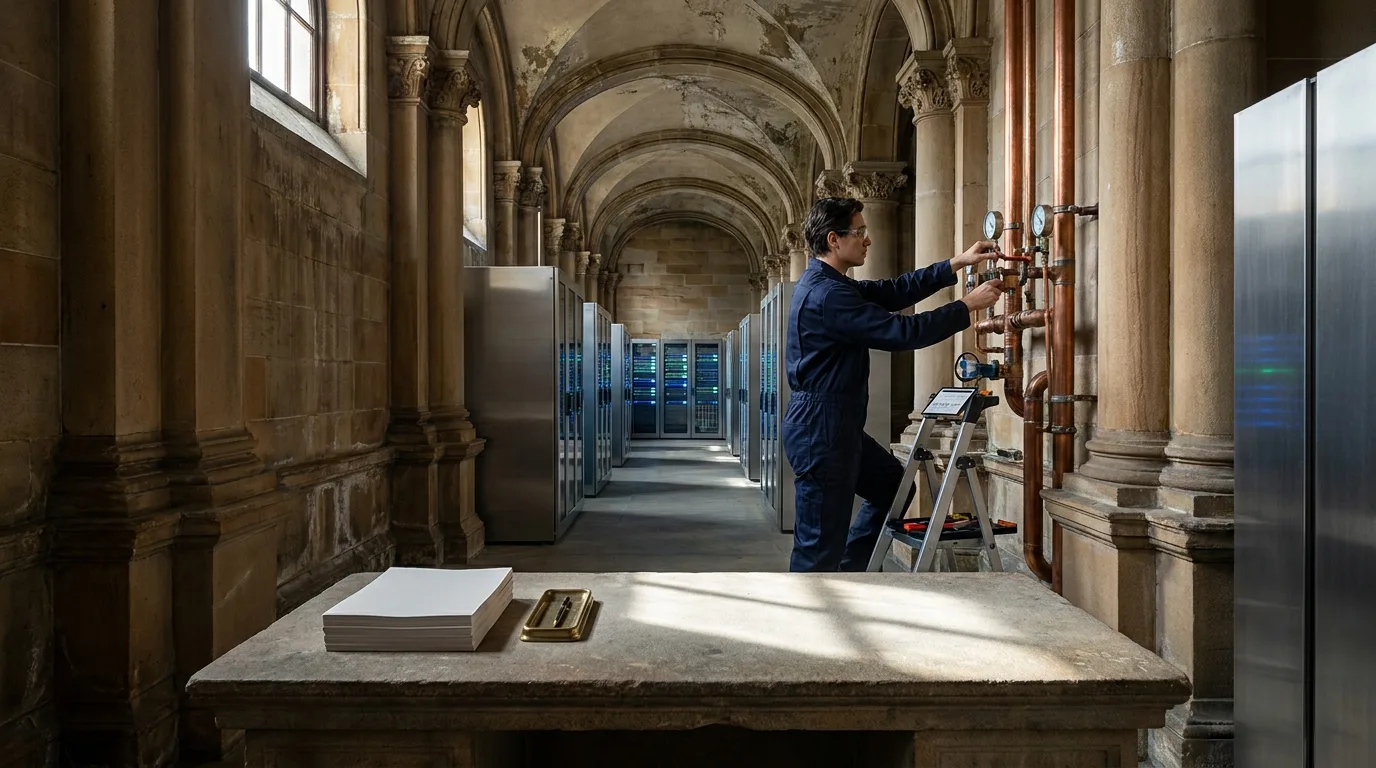
institutional friction and administrative recalibration A technician in a navy uniform works on industrial copper pipes installed within a grand neoclassical sandstone hallway filled with administrative documents.
Visual logic
The scene represents the 'administrative recalibration' by merging the physical symbols of judicial and executive power (the stone hall) with the emerging economic pressures of the datacenter boom (the copper pipes). The anonymous technician provides a human scale to the systemic shift, while the high-contrast lighting emphasizes the friction between the materials.
Concept
The Infrastructure of Authority
How it was framed
Composition focuses on Asymmetric balance with a heavy foreground anchor of an administrative desk, Deep linear perspective through a neoclassical corridor being retrofitted with technology, Full-bleed, edge-to-edge framing with no margins or borders, and One decisive line of movement following a copper conduit from foreground to background.
Visual direction leans on High-contrast architectural photography, Sharp focus on material textures and metallic sheen, Directional lighting creating deep, intentional shadows, and Human scale through an anonymous, back-turned figure.
Material treatment uses Polished copper cooling pipes, Weathered Sydney sandstone, Matte administrative bond paper, and Cold, brushed-steel server casings to keep the image tactile rather than generic.
Color language is built around Executive Navy, Inflationary Copper, Regulatory Grey, and Sydney Sandstone.
Sources
Australia politics live: Josh Burns tells antisemitism inquiry of online hate; RBA warns datacentre boom may fire up inflation
Open sourceLiberal supreme court justices condemn ‘destabilizing’ ruling that expands Trump’s power to fire regulators – as it happened
Open sourceDirector sentenced to more than two years for defrauding Netflix out of $11m
Open sourceCairo Takeaway secures court win over pro-Israel activist who claimed he was ‘completely vindicated’ after settlement
Open sourceBoth Republican Dan Sullivans can compete in Alaska primary, court rules
Open sourceSydney to get parking zones for shared ebikes in bid to stop ‘wild west scenes’ of blocked footpaths
Open sourceRelated editions
The World Canvas for 2026-06-29
The global landscape on June 29, 2026, is marked by a sharp divergence between high-tech prosperity and grounded geopolitical instability. While Asian semiconductor markets surge to record heights on the back of the AI revolution, the humanitarian reality in Venezuela remains dire as the death toll from recent earthquakes nears 1,500. Cross-border violence between Pakistan and Afghanistan highlights a worsening security vacuum, even as Australia seeks to stabilize the Pacific through a new security treaty with Vanuatu. Domestically, institutions in Australia face intense scrutiny, ranging from allegations of systemic corruption in infrastructure projects to the editorial impartiality of public broadcasters during global conflicts.
The World Canvas for 2026-06-28
The global state reflects an era of heightened interventionism as nations grapple with escalating security risks and social pressures. In the Middle East, the United States has launched targeted strikes against Iranian military infrastructure following renewed threats to maritime shipping in the Strait of Hormuz, signaling a volatile new phase in regional power dynamics. Simultaneously, Australia is testing the limits of digital sovereignty with expanded age-assurance regulations for social media, while New Caledonia heads to the polls for a crucial vote on its future status relative to France. Environmental hazards also remain at the forefront, with Kentucky reporting fatalities from severe flash flooding, highlighting the continued vulnerability of infrastructure to extreme weather patterns.
The World Canvas for 2026-06-27
The global landscape is currently defined by a sharp contrast between rapid technological intervention and escalating environmental and geopolitical volatility. While AI-integrated search-and-rescue operations demonstrate new levels of tactical efficiency in Australia, the natural world faces unprecedented stress, evidenced by historic wildfire warnings in Utah and the early arrival of glacier loss day in the Swiss Alps. Concurrently, maritime tensions in the Strait of Hormuz have triggered retaliatory strikes and assertive diplomatic rhetoric, complicating the international security architecture. Domestically in the United States, the intersection of fiscal policy and technology takes center stage as debates over billionaire taxation and state-level AI ownership stakes reflect shifting economic paradigms.
The World Canvas for 2026-06-26
The global landscape is currently defined by significant shifts in judicial power and the tightening of institutional norms. In the United States, the Supreme Court has issued a landmark ruling fundamentally reshaping the asylum system by allowing the administration to end Temporary Protected Status for several nationalities and turn back migrants at the border. Parallel to this, scrutiny is mounting in the United Kingdom over the jurisdictional reach of the US military justice system in domestic criminal cases. Australia finds itself in a state of internal reflection, balancing the celebratory unity of a World Cup campaign against sharp political warnings regarding the normalization of authoritarian rhetoric and the ethical standards of public figures in the media and parliament.
Method and provenance
Image prompt
An eye-level editorial photograph inside a grand neoclassical hallway of weathered Sydney sandstone. In the foreground, a heavy stone desk holds a stack of matte administrative bond paper under sharp, directional light. The midground features an anonymous technician in a dark navy uniform, shown in a three-quarter profile, adjusting a complex interface of polished copper cooling pipes that are bolted directly into the ornate stone pillars. The background recedes into a deep corridor of Executive Navy shadows, where the metallic sheen of brushed-steel server casings glows with faint status lights. The composition follows a deep linear perspective, highlighting the friction between traditional architecture and modern industrial infrastructure. Full-bleed, edge-to-edge frame.
Full Source Layer for This News Digest
Australia politics live: Josh Burns tells antisemitism inquiry of online hate; RBA warns datacentre boom may fire up inflation
Open sourceLiberal supreme court justices condemn ‘destabilizing’ ruling that expands Trump’s power to fire regulators – as it happened
Open sourceDirector sentenced to more than two years for defrauding Netflix out of $11m
Open sourceCairo Takeaway secures court win over pro-Israel activist who claimed he was ‘completely vindicated’ after settlement
Open sourceBoth Republican Dan Sullivans can compete in Alaska primary, court rules
Open sourceSydney to get parking zones for shared ebikes in bid to stop ‘wild west scenes’ of blocked footpaths
Open source