2026-06-18 - Precarious Diplomacy
US and Iran sign Memorandum of Understanding at Versailles
One closed daily edition: image, reading, signals, sources, and provenance for this date.
AI-generated content. No prior human review.
Editorial Reading
The global stage is defined by a high-stakes diplomatic gamble as the United States and Iran sign a Memorandum of Understanding at Versailles, coinciding with the 250th anniversary of American independence. While the agreement seeks to stabilize the Strait of Hormuz, Tehran's subsequent announcement of intent to charge transit fees and the abrasive rhetoric from Washington highlight the fragility of this newfound alignment.
Meanwhile, Australia faces a complex domestic internal landscape where the government is forced to soften capital gains tax reforms to appease small businesses, even as the rise of populist rhetoric and a localized tragedy in Sydney prompt deeper reflections on national identity and urban safety.
Why this mattered
The editorial focus bridges the gap between macro-geopolitical maneuvering and localized socioeconomic friction. The US-Iran MoU is treated as a tactical pivot rather than a definitive peace, given the immediate introduction of maritime transit fees as a new economic lever.
This tension is mirrored in Australia’s domestic sphere, where the Albanese government's retreat on tax policy reflects a broader theme of institutional flexibility in the face of rising populism and economic anxiety. The juxtaposition of high-level diplomacy with the rising rates of micro-mobility theft and community tragedy provides a comprehensive look at a world attempting to balance systemic stability with human-scale vulnerability.
Elsewhere in the world
Beyond the headlines of the Versailles summit, the global economy is grappling with the shift from flat-rate taxation to inflation-linked models, a transition causing significant friction between governments and the private sector. Additionally, the rise in high-value e-bike thefts signals a shift in urban crime patterns, where the rapid adoption of green technology is outpacing traditional security infrastructures and law enforcement strategies.
What moved the day
- US and Iran sign Memorandum of Understanding at Versailles
- Tehran declares intent to levy transit fees on Strait of Hormuz shipping
- PM Albanese announces capital gains tax carve-outs for Australian startups
- One Nation party triggers press gallery backlash over journalist ban threats
- Fatal SUV collision in Cabramatta claims lives of two young siblings
- Victoria crime statistics show first overall decrease in four years
- E-bike thefts surge across New South Wales and Victoria
- Trump meets with President al-Sisi to discuss Middle East investment frameworks
Still moving
- Verification of terms within the US-Iran maritime security memorandum
- Public response to Australian tax policy amendments for small businesses
- Monitoring of One Nation's polling surge and impact on media access
- Implementation of new safety protocols in Sydney school zones following tragedy
World Signals
- conflict 92
- innovation 29
- resilience 74
- fragility economic 91
- pressure climate 26
- cultural pulse 68
Why the image looks like this
Visual frame
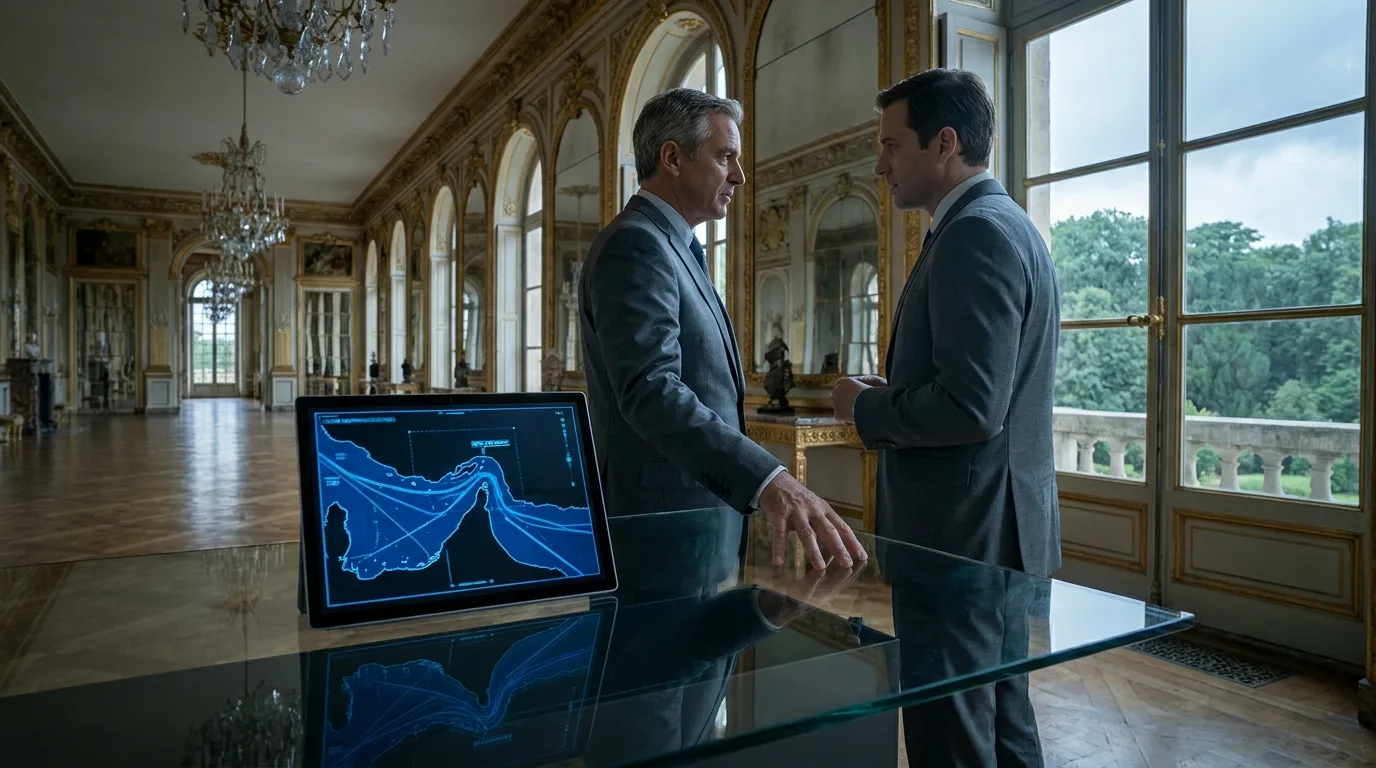
Precarious Diplomacy A modern digital maritime map glows on a glass table inside the ornate gold-leaf Hall of Mirrors at Versailles as two anonymous diplomats confer.
Visual logic
The scene uses the Hall of Mirrors as a symbol of high-stakes diplomacy, while the modern tablet serves as the 'focal event' representing the technical reality of the Strait of Hormuz fees. The contrast between the gold leaf (Versailles) and the cobalt digital glow (Hormuz) creates a visual tension that mirrors the day's news. The anonymous figure provides human scale and a sense of individual weight within a systemic event, while the eucalyptus-green exterior subtly nods to the Australian domestic context without being literal.
Concept
The Gilded Pivot
How it was framed
Composition focuses on One-point perspective through a grand historical corridor, Asymmetric foreground anchor with a modern diplomatic table, Deep spatial hierarchy from foreground technology to background architecture, and Full-bleed, edge-to-edge cinematic wide shot.
Visual direction leans on Modern-Baroque contrast, High-shutter-speed clarity, Brutalist technical data integrated into the environment, and Intentional asymmetric balance.
Material treatment uses Polished gold leaf, Tempered glass, Digital luminescence, and Heavy wool suiting to keep the image tactile rather than generic.
Color language is built around Versailles Gold, Hormuz Cobalt, Slate Grey, and Eucalyptus Green.
Sources
Middle East crisis live: agreement signed by US-Iran presidents; Tehran claims it will charge ships to transit strait of Hormuz
Open sourceAustralia news live: press gallery ‘strongly objects’ to One Nation threats to ban journalists
Open source‘I wish it hit me’: Sydney mother shares anguish after siblings in pram hit and killed by car
Open sourceAlbanese announces ‘generous’ capital gains tax exemptions for small businesses after budget backlash
Open sourceEbike thefts soar in NSW as Victoria’s crime rate drops for first time in four years
Open sourceTrump says he has signed peace deal with Iran at Versailles – US politics live
Open sourceRelated editions
The World Canvas for 2026-06-17
The global political landscape on June 17, 2026, is characterized by a sharp rise in populist rhetoric and intensified internal party friction across both hemispheres. In Australia, the National Press Club served as a flashpoint for debates on multiculturalism and energy policy, coinciding with an aggressive ultimatum from labor unions demanding stronger grassroots engagement to counter right-wing shifts. Meanwhile, the United Kingdom joins Australia in a contentious push to restrict social media access for minors, a move that highlights a growing generational divide regarding digital autonomy. In the United States, the Georgia Republican primaries have solidified the influence of Trump-aligned candidates, setting the stage for high-stakes midterm battles that reflect a deeply polarized electorate navigating the balance between traditional conservative bases and new executive leadership.
The World Canvas for 2026-06-16
The global landscape is currently defined by a series of precarious realignments across geopolitical, economic, and corporate sectors. While the United States navigates sensitive negotiations with Iran regarding the Strait of Hormuz and the removal of economic sanctions, domestic tensions are exacerbated by legal accusations between high-level politicians and a tragic military loss in the Mojave Desert. Simultaneously, Australia grapples with a shifting conservative political landscape and persistent cost-of-living pressures ahead of central bank decisions. In East Asia, corporate entities are being forced to address historical sensitivities, while South Asia faces new security challenges as sophisticated cybercrime networks migrate across borders, exploiting regulatory gaps in Sri Lanka.
The World Canvas for 2026-06-15
The global landscape is currently defined by a sharp dichotomy between high-level diplomatic breakthroughs and localized escalatory violence. A landmark agreement between the United States and Iran, facilitating the reopening of the Strait of Hormuz, has injected a sense of cautious relief into international markets and maritime security sectors. However, this progress is shadowed by significant military activity in Lebanon, where strikes on Beirut's southern suburbs signal a volatile frontier that diplomacy has yet to stabilize. Simultaneously, the United Kingdom faces a pivotal political moment with the Makerfield by-election, which could trigger a fundamental shift in Labour leadership, while Australia grapples with deeply personal domestic tragedies and rigorous debates over environmental and educational policy.
The World Canvas for 2026-06-14
The global landscape on June 14, 2026, is defined by the friction between individual safety and systemic reform. In Australia, the tragic shooting of a young national in Pakistan has cast a shadow over regional travel safety, while domestic politics are unsettled by the departure of key leadership figures and a high-stakes legislative battle over the National Disability Insurance Scheme. Meanwhile, in North America, a massive industrial fire in California enters its third day, emphasizing the vulnerability of supply chains and the immediate environmental impact of large-scale logistics failures. These events collectively highlight a world grappling with sudden tragedies while attempting to manage the long-term sustainability of social and industrial infrastructure.
Method and provenance
Image prompt
An eye-level wide shot inside the Hall of Mirrors at Versailles. In the sharp foreground, a sleek tempered glass diplomatic table holds a glowing digital tablet displaying a brutalist technical map of the Strait of Hormuz with cobalt-blue shipping coordinates. In the midground, two anonymous diplomats in sharp slate-grey wool suits are shown in three-quarter profile, one resting a hand on the table with natural joints and a clear gesture of negotiation. The ornate baroque architecture, gold leaf, and mirrors stretch into a deep one-point perspective, reflecting the digital luminescence of the map. Through the tall arched windows, a muted eucalyptus-green garden is visible under an overcast sky. The composition is full-bleed and edge-to-edge, balancing historical grandeur with modern geopolitical technology.
Full Source Layer for This News Digest
Middle East crisis live: agreement signed by US-Iran presidents; Tehran claims it will charge ships to transit strait of Hormuz
Open sourceAustralia news live: press gallery ‘strongly objects’ to One Nation threats to ban journalists
Open source‘I wish it hit me’: Sydney mother shares anguish after siblings in pram hit and killed by car
Open sourceAlbanese announces ‘generous’ capital gains tax exemptions for small businesses after budget backlash
Open sourceEbike thefts soar in NSW as Victoria’s crime rate drops for first time in four years
Open sourceTrump says he has signed peace deal with Iran at Versailles – US politics live
Open source