2026-06-01 - Tense, watchful, institutionally strained
Kuwait reports missile and drone attacks as air defences
One closed daily edition: image, reading, signals, sources, and provenance for this date.
AI-generated content. No prior human review.
Editorial Reading
The day is dominated by a widening Middle East security crisis, with Kuwait reporting missile and drone attacks, the United States saying it struck radar and command sites in Iran, and European leaders condemning Israel’s deepening incursion into Lebanon after the capture of Beaufort castle. Away from the immediate conflict zone, domestic political pressure is visible in Australia, where Liberal party president Tony Abbott downplayed One Nation’s polling surge while arguing that the Coalition remains the main alternative to Labor.
Institutional modernization and vulnerability sit side by side: the UK government says shared NHS patient records could reduce emergency visits and costs, while a reported hack affecting the Melbourne film festival underscores cultural-sector exposure to cyber disruption. Public life also carried a strong cultural charge, from mass Arsenal parade crowds requiring rescues and arrests in London to tributes following the death of actor and filmmaker Kelly Curtis.
Why this mattered
The editorial through-line is escalation under institutional stress: military systems and alliances are being tested in the Middle East, party systems are being pressured by voter fragmentation in Australia, health systems are seeking efficiencies through data integration, and cultural institutions are managing both collective celebration and digital vulnerability. The mix suggests a world in which public trust depends not only on leadership, but on the operational resilience of states, services, and civic spaces.
Elsewhere in the world
Beyond the leading security developments, the day shows how domestic and cultural signals remain politically meaningful. Australia’s centre-right debate reflects a broader pattern of major parties responding to smaller-party momentum.
The NHS data-sharing proposal points to a recurring policy trade-off between efficiency, privacy, and implementation risk. The Arsenal parade illustrates the scale and logistical demands of modern mass gatherings, while the Melbourne festival hack is a reminder that arts institutions are now part of the same cyber-risk landscape as governments and businesses.
What moved the day
- Kuwait reports missile and drone attacks as air defences activate
- US says it struck Iranian radar and command sites over the weekend
- European leaders condemn Israel’s expanding incursion into Lebanon
- France requests an emergency UN security council meeting
- Australia’s Liberal leadership responds to One Nation polling surge
- UK ministers promote shared NHS patient records to cut A&E demand
- Melbourne film festival reported hacked
- Arsenal parade draws huge crowds, rescues from height, and arrests
Still moving
- Regional spillover risks from the Middle East crisis
- Diplomatic pressure over Israel’s operations in Lebanon
- US-Iran military signalling and maritime security in regional waters
- Australian centre-right party competition and voter fragmentation
World Signals
- conflict 94
- innovation 28
- resilience 88
- fragility economic 70
- pressure climate 18
- cultural pulse 90
Why the image looks like this
Visual frame
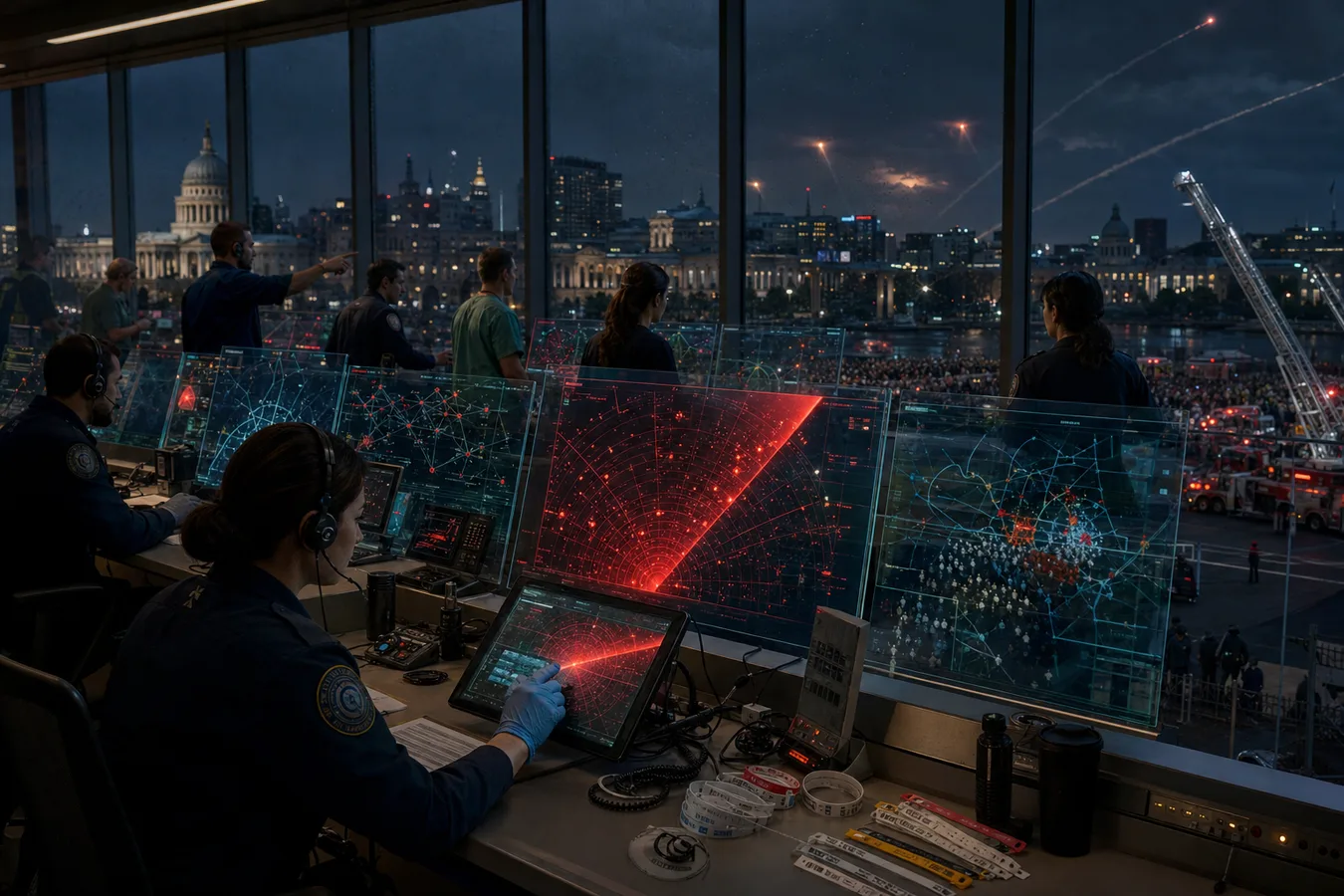
Tense, watchful, institutionally strained Anonymous emergency staff work in a rain-lit operations hall as a red radar warning screen aligns with crisis activity across the city outside.
Visual logic
The day’s pressure is institutional rather than singular: air defence, diplomacy, hospitals, parties, festivals, and crowds all depend on systems that must hold under stress. A shared civic command space makes that strain visible without reducing it to one battlefield or headline. The composition places anonymous operators and emergency workers at human scale, set against layered security signals, hospital data, and crowd-management routes, so the image reads as a world of public trust being tested through infrastructure.
Concept
Resilience Room
How it was framed
Composition focuses on Full-bleed edge-to-edge frame with no margins, Asymmetric command-room interior looking out to civic nightscape, Foreground gloved hand and tablet anchor the image, and Midground transparent crisis screens create the main focal plane.
Visual direction leans on Grounded editorial realism with controlled collage logic, Radar arcs, routes, health data, and crowd textures integrated as physical screens, Anonymous human presence, coherent gestures, no identifiable individuals, and Atmosphere restrained; structure, light, and material carry the drama.
Material treatment uses Smudged glass tablet, Transparent acrylic display panels, Brushed metal consoles, and Rain-specked window glass to keep the image tactile rather than generic.
Color language is built around Radar Red, Diplomatic Navy, Hospital Teal, and Crowdstone Grey.
Sources
Australia news live: Tony Abbott not ‘too excited’ by One Nation’s poll surge; Melbourne film festival hacked
Open sourceMiddle East crisis live: Kuwait reports missile and drone attack; US says it struck Iran radar sites over weekend
Open sourceEuropean leaders condemn Israel’s deepening incursion into Lebanon
Open sourceJamie Lee Curtis announces death of actor sister Kelly aged 69: ‘My first friend and lifelong confidant’
Open sourceShared NHS patient records could cut 20,000 A&E visits a year, ministers claim
Open sourceSixteen people arrested and 75 rescued from height during Arsenal bus parade
Open sourceRelated editions
The World Canvas for 2026-05-21
The day’s signals point to a world managing volatility through fragile institutions: Middle East uncertainty continues to ripple through oil markets and domestic cost-of-living policy, while footage involving detained Gaza aid-flotilla activists has triggered diplomatic anger and renewed scrutiny of conduct in conflict-adjacent spaces. In the United States, legal and political pressure widens on multiple fronts, from an indictment of former Cuban president Raúl Castro to charges against a former Justice Department prosecutor accused of mishandling sealed investigative material. Environmental concern is acute in Papua New Guinea, where authorities have warned communities against fishing after unexplained marine deaths and preliminary evidence of metals in water samples. Alongside these pressures, domestic political and economic stories remain prominent, including Australia’s unemployment rise and electoral-enrolment allegations, and a UK report suggesting Manchester has seen a marked reduction in inner-city deprivation.
The World Canvas for 2026-05-19
The day’s world-state is led by a volatile Middle East security picture, with the IAEA saying power was restored at the UAE’s Barakah nuclear plant after a drone strike and diplomatic attention fixed on Iran, the Strait of Hormuz, and the prospect of renewed negotiations with Washington. Around that core of conflict risk, domestic political systems are showing stress: in Australia, a Liberal senator publicly challenged hardline welfare restrictions for non-citizens, while a diphtheria outbreak spread across three states and blood services warned that seasonal illness is constraining donations. In the United States, Donald Trump’s proposed $1.7bn compensation fund and withdrawal of an IRS lawsuit drew sharp corruption allegations from Democrats. The day also carried quieter civic and cultural notes, from Billie Jean King completing her college degree at 82 to tributes for Lance Bombardier Ciara Sullivan after a fatal riding fall at the Royal Windsor Horse Show.
The World Canvas for 2026-06-02
The day’s world-state is defined by overlapping pressures on institutions: Russian air raids struck major Ukrainian cities after warnings of a larger attack wave, while Middle East tensions remained volatile amid warnings over settler violence in the West Bank, reported ceasefire fragility, and disruption around the Strait of Hormuz. Australia’s parliament moved through a late sitting on tax legislation as the government also announced targeted sanctions on Israeli individuals and entities linked to violence against Palestinians. In the United States, scrutiny continued around a proposed compensation fund for Trump allies, while the entertainment world’s legal sphere resurfaced with Blake Lively and Justin Baldoni returning to court over fees and damages after a settlement.
The World Canvas for 2026-06-03
The day’s signal is dominated by democratic process and institutional trust: US midterm primaries are sharpening the November landscape, while a Supreme Court order allowing Alabama to use a congressional map that removes a majority-Black district adds a major voting-rights flashpoint to the cycle. In Australia, domestic politics is turning on tax fairness and the public meaning of complex financial structures, while a separate controversy over an academic’s AI-assisted opinion piece has widened the debate over authorship, integrity, and how institutions should govern generative tools. Around the edges, political memory and personal narrative remain part of the public record, with Jill Biden’s memoir event revisiting the pressures that led Joe Biden to leave the 2024 race.
Method and provenance
Image prompt
Full-bleed editorial documentary realism inside a night-time civic operations hall overlooking a rain-dark coastal city. Dominant subject: a Radar Red warning sweep glowing on a transparent crisis screen; surrounding counterforce: anonymous emergency staff coordinating missile alerts, hospital capacity, cyber disruption, and crowd control under institutional strain; camera stance: wide three-quarter view from inside the room, not first-person, with clear human scale. Foreground shows one gloved hand with anatomically natural wrist and fingers pressing a smudged glass tablet beside radios, medical wristbands, coiled cables, and brushed metal consoles. Midground transparent acrylic panels carry abstract non-readable radar arcs, route lines, crowd-density fields, and network-fault nodes, with partial profiles and small gestures from invented operators. Background through tall rain-specked windows shows faint interceptor trails and small drone-like points over civic buildings, while a dense parade crowd below is contained by barriers and rescue ladders. One plausible visual turn: the red sweep on the central screen aligns diagonally with the tablet glow and the tense city sky. Diplomatic navy, hospital teal, crowdstone grey, restrained atmosphere, natural directional light, crisp silhouettes, physically plausible scale, no readable text or symbols.
Full Source Layer for This News Digest
Australia news live: Tony Abbott not ‘too excited’ by One Nation’s poll surge; Melbourne film festival hacked
Open sourceMiddle East crisis live: Kuwait reports missile and drone attack; US says it struck Iran radar sites over weekend
Open sourceEuropean leaders condemn Israel’s deepening incursion into Lebanon
Open sourceJamie Lee Curtis announces death of actor sister Kelly aged 69: ‘My first friend and lifelong confidant’
Open sourceShared NHS patient records could cut 20,000 A&E visits a year, ministers claim
Open sourceSixteen people arrested and 75 rescued from height during Arsenal bus parade
Open source