2026-06-24 - Analytical and Recalibrating
China’s LineShine supercomputer debuts as world’s fastest
One closed daily edition: image, reading, signals, sources, and provenance for this date.
AI-generated content. No prior human review.
Editorial Reading
The global landscape is characterized by significant shifts in technological dominance and ideological realignment within major democracies. China has reclaimed the top position in supercomputing with the debut of LineShine, signaling a new phase in the high-performance computing race.
In the United States, primary elections highlight a diversifying political base and the emergence of candidates responding to recent administrative purges in the military. Meanwhile, Australian domestic politics are currently defined by internal debates regarding multicultural identity and a growing legislative push to reintroduce human oversight into algorithmic decision-making for aged care, reflecting a broader caution toward automated governance.
Why this mattered
This assessment connects the theme of institutional accountability across disparate sectors. Whether it is the demand for human discretion over algorithms in Australia or the scrutiny applied to artistic authenticity in the portrait circuit, there is a distinct societal movement toward transparency and human-centric validation.
The technological shift in Shenzhen serves as a high-stakes backdrop to these internal cultural and political tensions, suggesting that while machines become faster, the focus on human governance and identity remains the primary source of friction.
Elsewhere in the world
Beyond the immediate headlines, the shift in supercomputing leadership highlights a persistent move toward technological sovereignty in Asia, potentially impacting global research in materials science and cryptography. Concurrently, the friction within the Australian opposition party regarding multiculturalism mirrors similar identity debates occurring across the Commonwealth, where traditionalist and modernizing wings are struggling to define national identity for the mid-2020s.
What moved the day
- China’s LineShine supercomputer debuts as world’s fastest
- Progressive candidates sweep New York City Democratic primaries
- Australian aged care reform seeks to limit algorithmic decision-making
- Admiral Nancy Lacore wins primary after being fired in defense purge
- Darling Portrait Prize winner accused of imitating Basquiat and Harding
- Internal Liberal Party debate over Australian multiculturalism intensifies
- Jack Schlossberg fails to advance in Manhattan district race
Still moving
- Accountability measures for AI-driven public services
- Post-purge military personnel transitioning into legislative roles
- The evolving standard of 'originality' in the era of digital and algorithmic art
- Sino-US technological parity in high-performance computing
World Signals
- conflict 85
- innovation 64
- resilience 72
- fragility economic 79
- pressure climate 23
- cultural pulse 65
Why the image looks like this
Visual frame
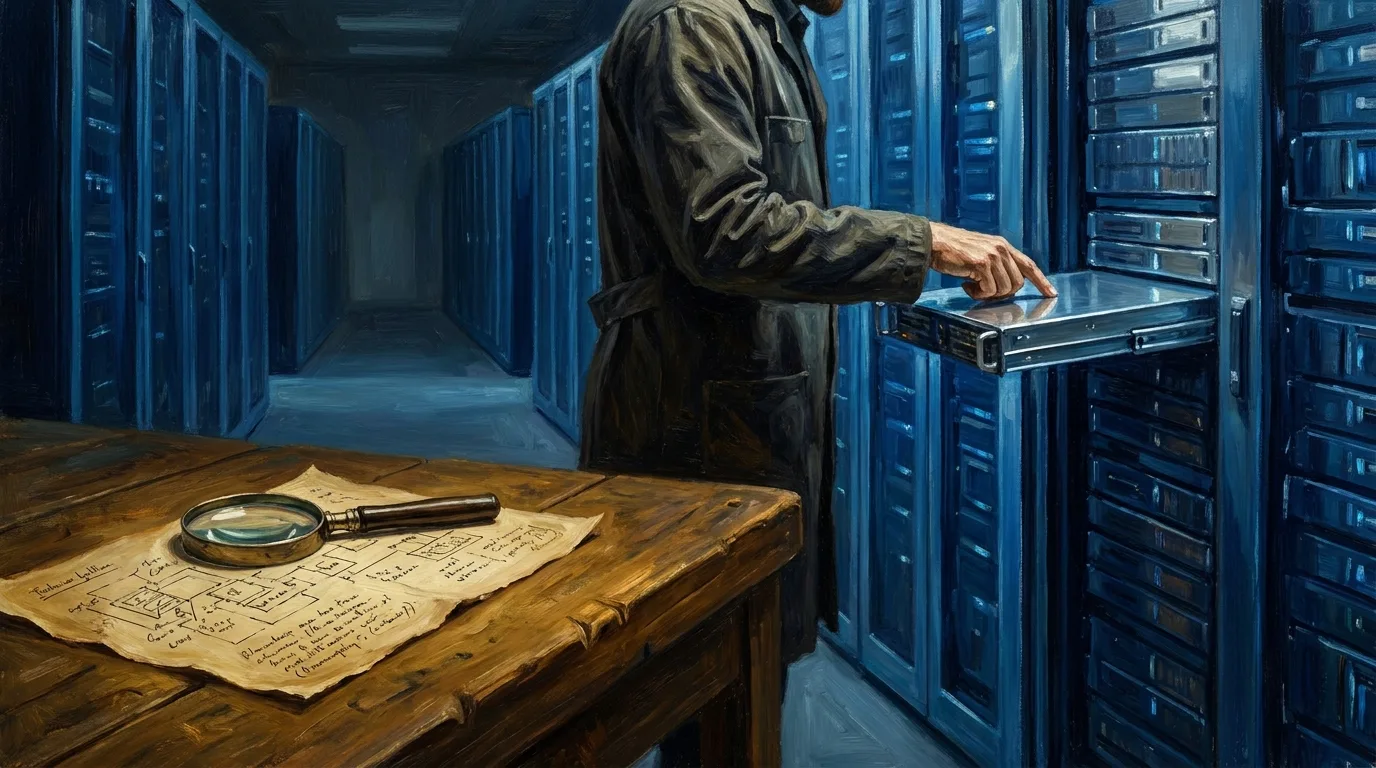
Analytical and Recalibrating A technician performs a manual audit in a vast, blue-lit supercomputer hall, juxtaposed with a foreground workbench holding analog technical diagrams.
Visual logic
The scene visualizes the friction between the cold, hyper-efficient rise of supercomputing and the urgent global demand for human accountability. The technician acts as the 'auditor'—a symbolic representation of the Australian aged care reforms and the US political shifts. The painterly texture applied to the technical environment references the Darling Portrait Prize controversy, emphasizing that human identity and oversight remain the primary source of friction in an increasingly automated world.
Concept
The Human Audit
How it was framed
Composition focuses on Asymmetric balance with a heavy foreground anchor on the left workbench, Deep one-point perspective leading into a receding server hall, Human figure as a central vertical axis providing scale and focus, and Full-bleed, edge-to-edge framing with no margins.
Visual direction leans on Macro-photography detail on metallic circuit nodes, Painterly oil-on-canvas textures overlaid on technical structures, High-contrast chiaroscuro lighting, and Atmospheric depth created through scale contrast rather than haze.
Material treatment uses Brushed Aluminum, Aged Vellum, Polished Silicon, and Heavy Oil Pigment to keep the image tactile rather than generic.
Color language is built around Prussian Blue, Deep Ochre, Anodized Silver, and Shadow Slate.
Sources
Australia politics live: Ted O’Brien dismisses ‘silly’ debate over monoculturalism, asking ‘who’s in the mono?’
Open sourceArtist accused of winning prize with ‘imitation’ won Australian award with piece ‘influenced’ by Basquiat
Open sourceLiberals dumbfounded by Angus Taylor’s multiculturalism comments: ‘Embrace the reality of modern Australia’
Open sourceMamdani-backed candidates sweep Democratic primaries in New York City
Open sourceAdmiral fired in Hegseth purge wins Democratic primary in South Carolina
Open sourceChinese supercomputer leapfrogs best US machines to be ranked world’s fastest
Open sourceRelated editions
The World Canvas for 2026-06-23
On June 23, 2026, the global political landscape is defined by significant domestic recalibration and the acceleration of political cycles. In Australia, the Albanese government has secured a pivotal legislative breakthrough by partnering with the Greens to pass tax reforms targeting capital gains and negative gearing, aimed at addressing systemic housing affordability. This achievement contrasts sharply with the United Kingdom, which is grappling with the resignation of Keir Starmer just two years after a landslide victory, signaling a period of intense institutional volatility. Meanwhile, a legal victory for Los Angeles regarding its sanctuary city status reinforces the autonomy of local jurisdictions against federal oversight, even as the city struggles with a persistent multi-day industrial fire that highlights the complexities of modern green infrastructure in emergency scenarios.
The World Canvas for 2026-06-22
The global landscape is characterized by high-stakes diplomatic friction and significant political shifts. In Switzerland, US-Iran negotiations have hit a severe impasse following aggressive rhetoric from the American presidency, prompting walkouts and forcing mediators from Qatar and Pakistan into intensified back-channel roles. Meanwhile, South America experiences a sharp rightward turn as Abelardo de la Espriella secures a narrow, contested victory in Colombia’s presidential runoff. Australia faces a multi-front challenge, with the real estate market hitting its lowest clearance rates in six years, the mainland's first detection of H5N1 bird flu triggering agricultural lockdowns, and a persistent legislative deadlock over disability support and gambling reforms. In North America, a state of emergency in Los Angeles underscores the difficulty of containing large-scale industrial fires and their resulting environmental impact.
The World Canvas for 2026-06-21
The global landscape on June 21, 2026, is marked by a dual focus on institutional transparency and the domestic repercussions of economic policy. In a historic move, King Charles has announced the publication of his personal tax bill, signaling an attempt to modernize the British monarchy's financial relationship with the public. Simultaneously, Australia is embroiled in a heated debate over Capital Gains Tax reforms and parental leave, with economists warning that isolationist social policies could regress decades of progress for working families. These systemic shifts are punctuated by localized tragedies, including a fatal building fire in London and the shooting of a domestic pet by police in Los Angeles, alongside the ongoing high-risk environment for journalists in Gaza.
The World Canvas for 2026-06-20
The global landscape today is defined by a series of narrow escapes and crossing thresholds. Australia has confirmed its first mainland case of H5N1 bird flu, marking a significant breach in biosecurity as the virus was detected in a migratory seabird in Western Australia. In the Middle East, a fragile ceasefire between Israel and Hezbollah has been hastily reinstated following a violent 24-hour escalation that killed dozens and threatened to derail broader diplomatic negotiations in Switzerland. Meanwhile, the United Kingdom faces both tragedy and political upheaval as a fatal rail collision in Bedford occurs alongside the parliamentary return of Andy Burnham, whose victory signals a potential shift in the national power dynamic. In the United States, the unveiling of a foreign-gifted presidential aircraft introduces a new chapter of transactional symbolism in executive diplomacy.
Method and provenance
Image prompt
An editorial scene in a high-performance computing facility where a heavy wooden workbench in the foreground holds a magnifying glass over a sheet of aged vellum with hand-drawn technical diagrams. In the midground, an anonymous technician in a dark coat stands in profile, their hand reaching out to a polished silicon server node in a gesture of manual inspection. The background recedes into a deep one-point perspective of server aisles glowing with a sharp Prussian Blue light. The entire scene is rendered with heavy oil pigment textures and expressive brushstrokes that soften the edges of the anodized silver machinery. Chiaroscuro lighting creates high contrast between the deep ochre of the wood and the shadow slate of the receding corridor.
Full Source Layer for This News Digest
Australia politics live: Ted O’Brien dismisses ‘silly’ debate over monoculturalism, asking ‘who’s in the mono?’
Open sourceArtist accused of winning prize with ‘imitation’ won Australian award with piece ‘influenced’ by Basquiat
Open sourceLiberals dumbfounded by Angus Taylor’s multiculturalism comments: ‘Embrace the reality of modern Australia’
Open sourceMamdani-backed candidates sweep Democratic primaries in New York City
Open sourceAdmiral fired in Hegseth purge wins Democratic primary in South Carolina
Open sourceChinese supercomputer leapfrogs best US machines to be ranked world’s fastest
Open source