2026-06-06 - Tense, procedural, and watchful
US and Iran exchange strikes, threatening the Gulf ceasefire
One closed daily edition: image, reading, signals, sources, and provenance for this date.
AI-generated content. No prior human review.
Editorial Reading
The day’s world-state is shaped by renewed military danger in the Gulf, unsettled electoral politics across several democratic arenas, and institutional scrutiny over failures of care and public safety. The sharpest signal comes from the Middle East, where the US and Iran exchanged strikes after drones were launched toward the Strait of Hormuz, prompting Kuwait and Bahrain to issue air-raid alerts and again testing a fragile ceasefire.
In parallel, California’s governor’s race and Los Angeles municipal politics point to a volatile US electoral cycle, while Victoria’s leadership speculation underscores how integrity reform and campaign pressure can destabilize incumbents before voters are heard. Beyond geopolitics, a Tasmanian coroner’s finding that irresponsible prescribing directly contributed to two deaths places medical oversight and addiction care back in focus, while the killing of actor James Handy adds a localized but culturally resonant public-safety story.
Why this mattered
The editorial logic links three forms of strain: hard-security escalation, democratic contestation, and institutional accountability. The Gulf confrontation is the central risk because it carries immediate regional spillover potential, particularly around US bases and the Strait of Hormuz.
The election stories matter less as isolated horse-race updates than as evidence of political systems under pressure from leadership doubts, polarized narratives, and late-moving vote counts. The healthcare and criminal-justice items broaden the frame by showing how public trust is also shaped by everyday systems of care, regulation, and safety.
Elsewhere in the world
Several lower-volume but significant threads sit behind the main headlines. US deportation arrangements with the Democratic Republic of Congo remain under scrutiny after most of a small group of third-country deportees reportedly returned to their home countries, raising questions about bilateral migration deals and post-deportation pathways.
California’s primary count is still incomplete, leaving the general-election matchup unsettled even as Xavier Becerra advances. In Australia, the Tasmanian prescribing inquest intersects with wider concerns over opioid dependency, medical monitoring, and the responsibilities of regulators when warning signs accumulate.
What moved the day
- US and Iran exchange strikes, threatening the Gulf ceasefire
- Kuwait and Bahrain issue air-raid alerts after Iranian targeting claims
- Xavier Becerra advances in California’s governor’s race
- Los Angeles mayoral contest tightens as vote counting continues
- Victorian leadership speculation grows ahead of the state election
- Tasmanian coroner finds irresponsible prescribing directly contributed to two deaths
- Nine of 15 migrants deported from the US to the DRC reportedly return to home countries
- Man charged with murder in the death of actor James Handy
Still moving
- Fragile Middle East ceasefire and risks around the Strait of Hormuz
- US-Iran military signaling and the security posture of Gulf states hosting US forces
- California vote counting and the emerging general-election field
- Victorian integrity reforms and leadership stability before the election
World Signals
- conflict 93
- innovation 18
- resilience 87
- fragility economic 82
- pressure climate 22
- cultural pulse 26
Why the image looks like this
Visual frame
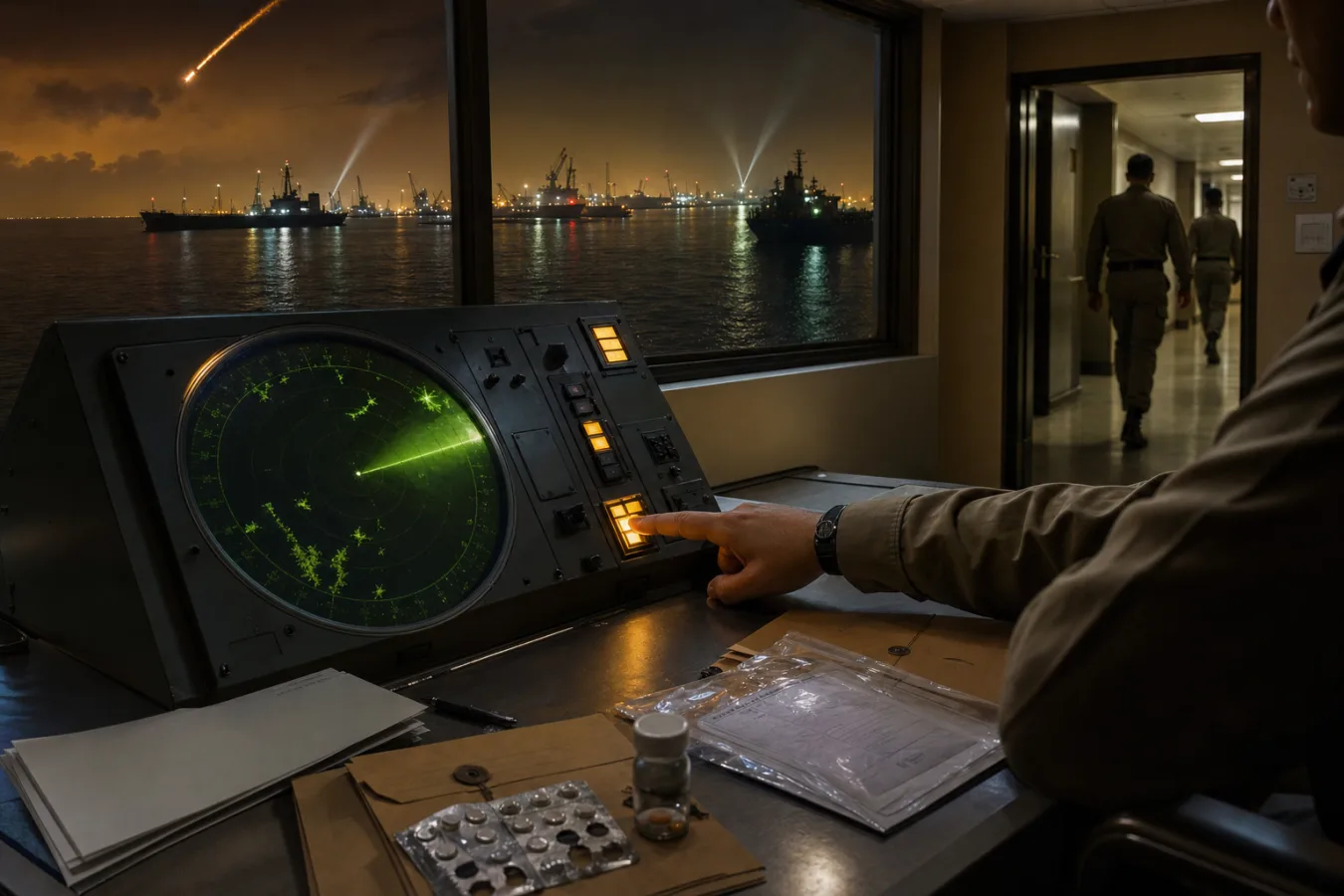
Tense, procedural, and watchful An anonymous operator acknowledges an amber alert at a Gulf emergency watch desk overlooking tankers and harbor lights at night.
Visual logic
A Gulf emergency operations room gives the day a procedural center of gravity: military escalation is visible as a live civic burden rather than spectacle. The foreground documents and clinical materials bring elections, oversight, and failures of care into the same field of scrutiny without turning the image into a literal collage. The composition uses a single alert acknowledgment as the focal event, the dark strait beyond the glass as the counterforce, and precise paper, plastic, and radar-glass details to make institutional pressure feel tangible.
Concept
The Watch Desk
How it was framed
Composition focuses on Asymmetric command-room interior with harbor depth beyond glass, Foreground desk anchors civic, medical, and procedural materials, Single focal gesture: operator acknowledging amber alert, and Diagonal movement from hand to radar sweep to strait lights.
Visual direction leans on Tense procedural realism, editorial rather than literal, Human-scale inhabited infrastructure with watchful civic labor, Crisp silhouettes, controlled reflections, minimal supportive haze, and Full-bleed edge-to-edge frame with no margins.
Material treatment uses Smudged radar glass, Matte ballot paper, Dented prescription blister foil, and Brushed metal console to keep the image tactile rather than generic.
Color language is built around Ceasefire Amber, Radar Green, Civic Slate, and Coroner’s Ink.
Sources
Doctor’s ‘grossly irresponsible prescribing’ played direct role in two deaths, Tasmanian coroner finds
Open sourceIn LA mayor’s race, Nithya Raman makes up ground on Spencer Pratt in contest to face Karen Bass – as it happened
Open sourceXavier Becerra advances in California’s hotly contested governor’s race
Open sourceRegrettable references and claims of ‘rigged’ election laws: why this week has reignited Jacinta Allan spill rumours
Open sourceGulf countries targeted by Iran after exchange of fire with US, in latest threat to fragile ceasefire
Open sourceMan charged with murder of veteran US character actor James Handy
Open sourceRelated editions
The World Canvas for 2026-06-07
The day’s signals point to societies trying to manage pressure at several levels at once: household finances are thinning, social housing shortages remain structurally severe, and industrial policy is struggling to keep pace with the electric-vehicle transition. Technology’s consumer-facing promise is also under scrutiny, with reports of AI-assisted shopping journeys leading users toward fraudulent retail sites. Public safety and social cohesion remain prominent concerns, from arrests after an alleged machete brawl in Melbourne to legal proceedings in the US examining alleged attacks on Jewish communities in Europe. Alongside these strains, cultural life still asserts itself through debates over how loud, open and civic public spaces such as the Sydney Opera House should be.
The World Canvas for 2026-06-05
The day’s strongest signal is a politics of accountability under strain: Ukraine’s Volodymyr Zelenskyy publicly urged Vladimir Putin to meet face to face in a neutral country, framing negotiation as urgent while the war’s diplomatic path remains uncertain. In Australia, ASIC opened an investigation into KPMG following whistleblower claims, while parliamentary argument continued over the scrutiny and timing of major tax reforms due to take effect in 2028. Australian politics also saw confusion around One Nation’s housing policy after senior figures struggled to explain its details in broadcast interviews. In the United States, legal and electoral pressure remained visible, with reports that John Bolton is expected to plead guilty in a classified-documents case and Maine Senate candidate Graham Platner denying newly reported allegations about past conduct.
The World Canvas for 2026-06-08
The day’s world-state is led by renewed military escalation between Israel and Iran, with reported Israeli strikes on targets in central and western Iran following Iranian missile launches and visible pressure from Washington to limit further retaliation. In the Asia-Pacific, a powerful 7.8 earthquake in the southern Philippines triggered tsunami warnings across parts of the Philippines, Indonesia, and Malaysia, shifting attention to rescue operations, coastal preparedness, and the fragility of exposed communities. Australia’s political climate remained unsettled, with polling pressure on Labor, criticism of a misogynistic campaign targeting Victorian premier Jacinta Allan, and continuing public attention to medical research and civic resilience. Against this backdrop, culture offered a sharply human register: a stripped-back revival of Death of a Salesman dominated the 2026 Tony awards, underscoring how older works can re-enter public life during periods of uncertainty.
The World Canvas for 2026-06-04
The day’s world-state is defined by overlapping attempts to contain political and security pressure before it widens: in the Middle East, a reported Iranian missile and drone attack on Kuwait’s international airport killed one person and injured dozens even as US-led ceasefire and Iran-related talks continued, while Israel and Lebanon agreed to renew a ceasefire under conditions aimed at halting Hezbollah fire in the south. In domestic politics, Australia’s Labor government pushed a tax package through the lower house after contested amendments, framing the vote around worker tax cuts and housing affordability, while US political attention stayed fixed on candidate selection, intelligence leadership scrutiny, and unsettled mayoral and midterm contests. The common thread is institutional stress management: parliaments, courts, campaigns, and diplomatic channels are all trying to absorb conflict without letting it spill into broader disorder.
Method and provenance
Image prompt
Full-bleed documentary-realism editorial scene, mid-wide oblique view inside a Gulf coastal emergency operations room at night: the dominant subject is a brushed-metal watch desk and radar console, pressed by the counterforce of amber air-raid warning light and tense strait traffic beyond the glass. Foreground: smudged radar glass, unmarked ballot papers, sealed administrative folders, an unreadable clinical file, dented prescription blister foil, and an unlabeled pharmacy vial on the desk. Midground: one anonymous operator in partial profile, under 20% of frame, makes a single clear gesture pressing an amber acknowledgment button with anatomically correct arm, wrist, hand, and fingers; two other anonymous staff pass through a lit civic corridor. Background: dark harbor water, tanker silhouettes, cranes, base lights, and low searchlight beams under an amber-green sky, with minimal haze only around lamps; diagonal composition from hand to radar sweep to strait lights, crisp silhouettes, natural lighting, human scale.
Full Source Layer for This News Digest
Doctor’s ‘grossly irresponsible prescribing’ played direct role in two deaths, Tasmanian coroner finds
Open sourceIn LA mayor’s race, Nithya Raman makes up ground on Spencer Pratt in contest to face Karen Bass – as it happened
Open sourceXavier Becerra advances in California’s hotly contested governor’s race
Open sourceRegrettable references and claims of ‘rigged’ election laws: why this week has reignited Jacinta Allan spill rumours
Open sourceGulf countries targeted by Iran after exchange of fire with US, in latest threat to fragile ceasefire
Open sourceMan charged with murder of veteran US character actor James Handy
Open source