2026-07-26 - Strained and Precautionary
Suspected extremist vehicle attack at Berlin Pride kills one
One closed daily edition: image, reading, signals, sources, and provenance for this date.
AI-generated content. No prior human review.
Editorial Reading
The global landscape is currently defined by a confluence of acute climate stress and legislative friction. In the United States, a third consecutive heat dome is placing 70 million residents under extreme temperature advisories, while new data reveals the staggering scale of food assistance loss for millions of citizens following recent policy shifts.
Security concerns have spiked in Europe following a fatal vehicle attack at Berlin Pride, currently under investigation for extremist links. Meanwhile, institutional accountability is under the lens in the United Kingdom as police probe political donations, and Australian leadership faces a growing internal and cross-bench divide over the digitalization of end-of-life medical consultations.
Why this mattered
The synthesis of today's developments highlights a widening gap between administrative policy and human security. Whether through the withdrawal of social safety nets in the US or the regulatory hurdles for telehealth in Australia, the tension lies in how institutional frameworks adapt—or fail to adapt—to modern crises.
The environmental signals from Scotland and the American Midwest further underscore a cycle of recurring climate emergencies that are no longer anomalous but systemic, demanding a shift from reactive to structural resilience.
Elsewhere in the world
While the headlines focus on immediate security and heat, a secondary layer of development involves the long-tail effects of 2025's legislative overhaul in the US, specifically the 'One Big Beautiful Bill Act,' which continues to reshape domestic social welfare. In the UK, the investigation into Reform UK signals a period of heightened scrutiny regarding the transparency of third-party campaign financing.
These undercurrents suggest a broader global trend toward legal and fiscal accountability in the wake of populist political movements.
What moved the day
- Suspected extremist vehicle attack at Berlin Pride kills one
- Third major heat dome of the month affects 70 million Americans
- Analysis shows 1 million US children lost SNAP food benefits
- Scotland Yard investigates £500,000 in donations to Reform UK
- Australian PM Albanese faces pressure over telehealth euthanasia ban
- Cairngorms wildfire threat recedes as villagers return home
- Metropolitan Police scrutinize Richard Tice-linked company payments
Still moving
- Persistent heatwave cycles across the Gulf of Mexico and Great Plains
- Systemic impacts of the SNAP benefit reductions across 50 states
- Security post-mortem and threat level assessment in German urban centers
- The internal policy debate within the Australian Labor Party regarding medical technology
World Signals
- conflict 91
- innovation 25
- resilience 87
- fragility economic 86
- pressure climate 64
- cultural pulse 64
Why the image looks like this
Visual frame
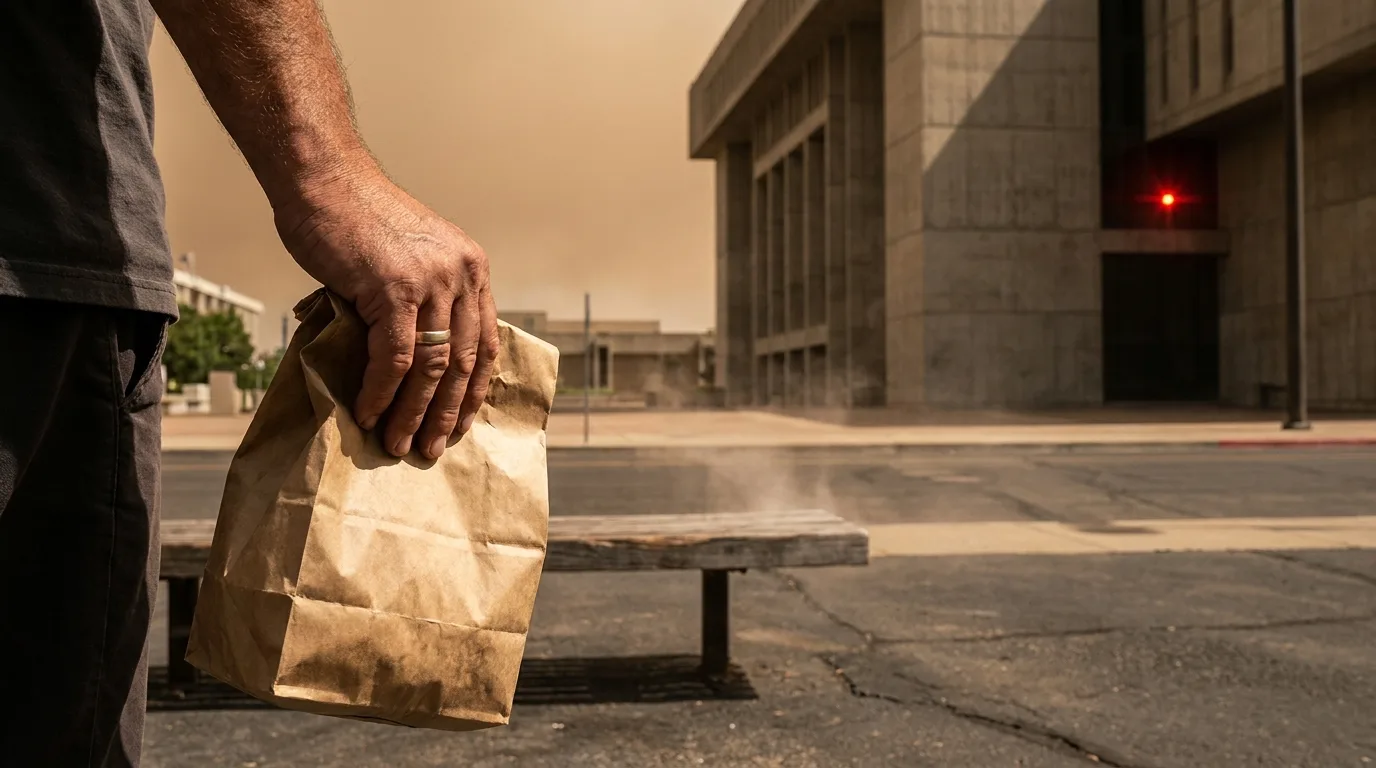
Strained and Precautionary A person's hand grips a weathered paper bag in a sun-drenched, heat-warped civic plaza before a brutalist building.
Visual logic
The scene visualizes the day's tension between institutional policy and human vulnerability. The heat dome is rendered through tangible distortion and amber light, while the loss of food assistance is symbolized by the fragile, empty-looking paper bag. The brutalist architecture represents the rigid, sometimes failing, administrative frameworks. This grounded, human-scale perspective avoids abstraction in favor of a legible, inhabited environment under stress.
Concept
The Threshold of Provision
How it was framed
Composition focuses on Asymmetric wide-angle editorial shot, Foreground anchor of a hand clutching a brittle paper bag, Midground featuring heat-warped asphalt and a lone transit bench, and Background dominated by a monolithic, brutalist civic structure.
Visual direction leans on High-contrast thermal-inspired lighting, Sharp foreground texture versus atmospheric midground distortion, Deep spatial progression from tactile detail to civic scale, and Intentional use of Siren Red as a warning element.
Material treatment uses Sun-bleached, creased paper, Heat-softened asphalt, Weathered brutalist concrete, and Distorted, shimmering air to keep the image tactile rather than generic.
Color language is built around Thermal Amber, Asphalt Grey, Siren Red, and Institutional Parchment.
Sources
Albanese at odds with Labor policy which now says telehealth should be allowed for euthanasia consultations
Open sourceOne killed and 16 injured after van crashes into crowd at Berlin Pride
Open sourceEvacuated villagers in Cairngorms allowed home after wildfire threat lifts
Open sourcePolice investigate payments to Reform UK first revealed by The Guardian
Open sourceMore than 1 million children lost access to food benefits after Trump bill passed
Open sourceScorching US heatwave to hit 70 million people with third ‘heat dome’ in month
Open sourceRelated editions
The World Canvas for 2026-06-22
The global landscape is characterized by high-stakes diplomatic friction and significant political shifts. In Switzerland, US-Iran negotiations have hit a severe impasse following aggressive rhetoric from the American presidency, prompting walkouts and forcing mediators from Qatar and Pakistan into intensified back-channel roles. Meanwhile, South America experiences a sharp rightward turn as Abelardo de la Espriella secures a narrow, contested victory in Colombia’s presidential runoff. Australia faces a multi-front challenge, with the real estate market hitting its lowest clearance rates in six years, the mainland's first detection of H5N1 bird flu triggering agricultural lockdowns, and a persistent legislative deadlock over disability support and gambling reforms. In North America, a state of emergency in Los Angeles underscores the difficulty of containing large-scale industrial fires and their resulting environmental impact.
The World Canvas for 2026-07-25
The global landscape is currently defined by a sharp intersection of institutional friction in North America and severe environmental emergencies in Europe. In the United States, executive rhetoric has increasingly targeted historical and media institutions, manifested in direct challenges to the Smithsonian’s curation and sharp critiques of press coverage. Simultaneously, Southwest Europe is grappling with an escalating climate crisis as massive wildfires force the evacuation of over 200,000 people across France and Spain, leading to the declaration of a national emergency. Security concerns remain elevated in the British Isles following the interception of military-grade explosives near the Irish border, while legal proceedings in California continue to highlight high-profile criminal cases within the cultural sector.
The World Canvas for 2026-07-24
Global trade stability has been significantly disrupted as the United States implements a broad 12.5% tariff on more than 80 nations, including key allies like Australia, citing concerns over forced labor. This economic pivot coincides with an escalating security crisis in the Strait of Hormuz, where the detention of oil tankers has prompted direct military threats against Iranian infrastructure. While the US House has moved to pass a War Powers Resolution to constrain executive military action, the geopolitical friction is compounded by internal social upheaval in South Asia, where the 'Cockroach' movement has mobilized tens of thousands of students against the Indian government. These developments signal a coordinated shift toward isolationism and direct confrontation, challenging established international norms and supply chain reliability.
The World Canvas for 2026-07-23
The global landscape on July 23, 2026, is defined by a high-stakes recalibration of power in the Middle East alongside critical tests of domestic resilience in the Pacific. The United States has formalized a landmark nuclear cooperation agreement with Saudi Arabia, a move that potentially allows for domestic uranium enrichment and fundamentally alters regional security architecture. This diplomatic maneuver occurs against a backdrop of escalating kinetic friction, as the U.S. administration issues direct threats to Iranian infrastructure following Houthi attacks on Red Sea shipping. Concurrently, Australia is navigating internal political pressure regarding gas export taxation while preparing for its first nationwide emergency alert test, a move that has sparked specific safety concerns for vulnerable populations using covert mobile devices.
Method and provenance
Image prompt
Full-bleed editorial photograph of a sun-scorched civic plaza under a severe heat dome. In the foreground, a sharp-focus medium shot of an anonymous person's hand clutching a brittle, sun-bleached paper bag with visible creases. The midground features a weathered transit bench and shimmering heat-distortion rising from dark, cracked asphalt. In the background, a monolithic brutalist government building stands against a heavy, thermal-amber sky. Harsh vertical lighting creates deep asphalt-grey shadows, while a single sharp red light glows on the distant structure. The composition is an asymmetric wide-angle scene with the subject in a three-quarter profile, emphasizing the tension between the individual and the institutional architecture.
Full Source Layer for This News Digest
Albanese at odds with Labor policy which now says telehealth should be allowed for euthanasia consultations
Open sourceOne killed and 16 injured after van crashes into crowd at Berlin Pride
Open sourceEvacuated villagers in Cairngorms allowed home after wildfire threat lifts
Open sourcePolice investigate payments to Reform UK first revealed by The Guardian
Open sourceMore than 1 million children lost access to food benefits after Trump bill passed
Open sourceScorching US heatwave to hit 70 million people with third ‘heat dome’ in month
Open source