2026-05-24 - Tense diplomacy under climate and civic pressure
Trump claims a US-Iran peace deal is largely negotiated
One closed daily edition: image, reading, signals, sources, and provenance for this date.
AI-generated content. No prior human review.
Editorial Reading
The day’s world-state is defined by a narrow diplomatic opening around Iran, with Donald Trump claiming a peace deal is largely negotiated while Pakistan signals hopes of hosting further US-Iran talks soon; the picture remains unsettled, with questions over the Strait of Hormuz, Lebanese civil defence infrastructure reportedly hit in Nabatieh, and US officials still weighing Iran’s latest proposal. Away from the immediate Middle East track, public pressure is visible in Australia, where climate activists blocked coal ship movements at Newcastle port and independent politicians are openly discussing how to respond to One Nation’s rise.
Extreme heat is also moving from background condition to headline event, as the UK records its hottest day of the year and health alerts accompany forecasts of more severe temperatures. Cultural politics and institutional trust intersect in the collapse of an Australian tour promoter, leaving thousands of Candace Owens ticket holders without refunds.
Why this mattered
The editorial logic ties together negotiation, pressure, and accountability: high-stakes diplomacy over Iran sits at the center, but the surrounding signals show societies testing their institutions from multiple directions — climate protest at fossil fuel infrastructure, heat stress on public health systems, electoral realignment debates in Australia, and consumer fallout from a politically charged media tour collapse. The through-line is not a single crisis but a pattern of strained systems seeking exits, fixes, or leverage under public scrutiny.
Elsewhere in the world
Beyond the headline diplomacy, the day points to an increasingly compressed political environment: climate disruption is becoming an immediate health and infrastructure issue rather than a distant forecast; domestic political movements are searching for new organizational forms; and polarizing public figures remain embedded in wider questions about money, platforms, and accountability. The Middle East developments also carry global economic implications because any durable change around the Strait of Hormuz would affect energy markets, shipping confidence, and regional security calculations.
What moved the day
- Trump claims a US-Iran peace deal is largely negotiated
- Pakistan says it hopes to host US-Iran talks very soon
- Iran-related discussions continue over the Strait of Hormuz
- Lebanese civil defence facility in Nabatieh reportedly destroyed by Israeli strike
- UK records its hottest day of the year with amber health alerts in place
- Climate activists block coal ship movements at Newcastle port
- David Pocock says independents are discussing responses to One Nation’s rise
- Candace Owens’ cancelled Australia tour leaves 15,000 ticket holders without refunds
Still moving
- US-Iran diplomacy and the terms of any ceasefire or memorandum of understanding
- Security conditions in Lebanon and the wider Israel-Iran regional confrontation
- Potential energy and shipping-market effects linked to the Strait of Hormuz
- Extreme heat preparedness in the UK as early-season temperature records emerge
World Signals
- conflict 93
- innovation 21
- resilience 87
- fragility economic 85
- pressure climate 32
- cultural pulse 30
Why the image looks like this
Visual frame
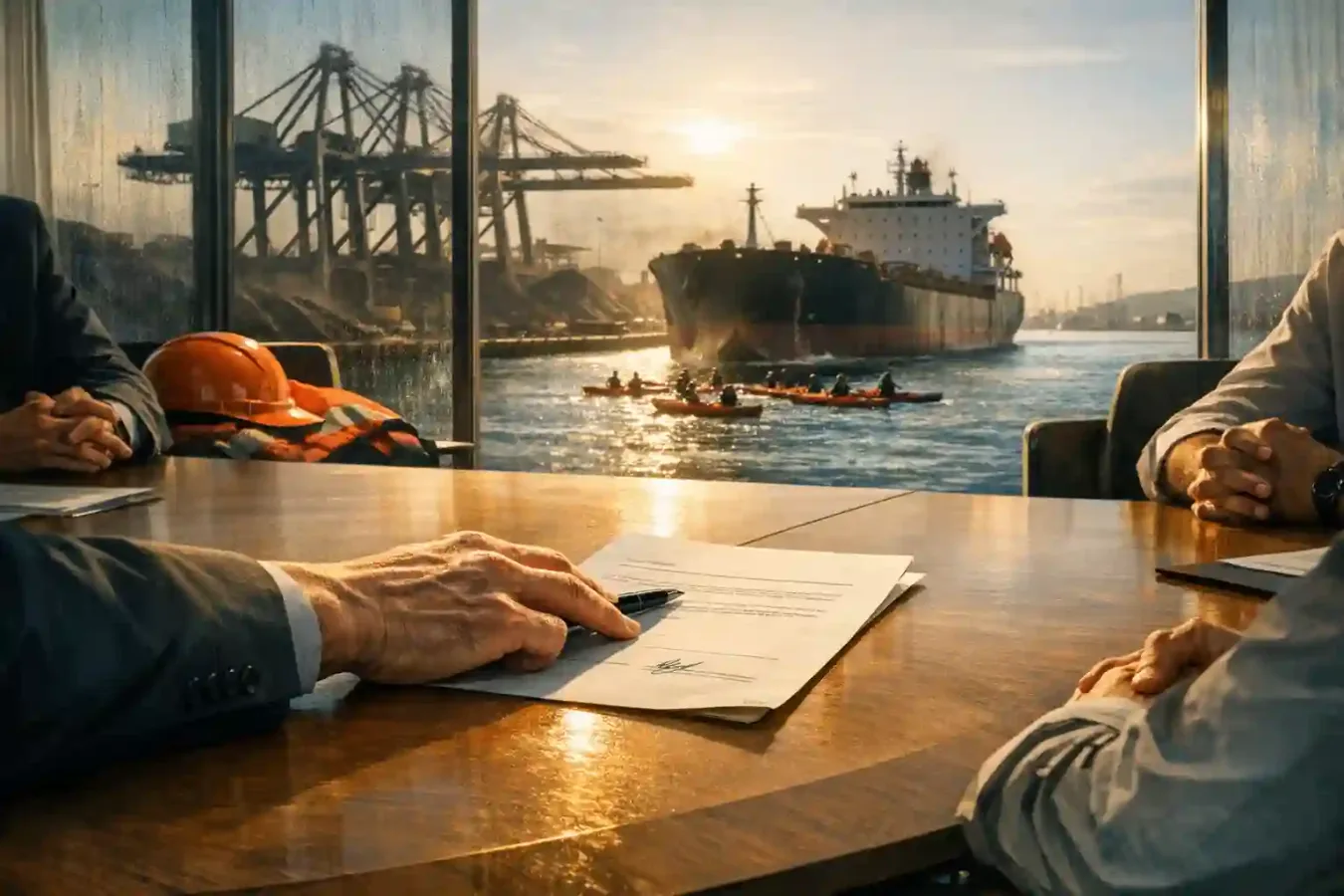
Tense diplomacy under climate and civic pressure An unsigned table beside a blocked channel.
Visual logic
The day is about leverage under pressure: diplomacy appears close but unresolved, while ports, heat systems, civic institutions, and public trust are all being tested. A waterfront negotiation room gives the image human scale and places the diplomatic opening directly beside the physical forces shaping it: shipping lanes, coal infrastructure, protest, emergency readiness, and punishing heat. The close foreground hand and paper make the stakes intimate, while the windowed port depth keeps the wider world visibly pressing in.
Concept
An unsigned table beside a blocked channel.
How it was framed
Composition focuses on Foreground: tense hand, pen, unsigned paper, table edge as anchor, Midground: anonymous negotiators, emergency helmet and rescue jacket, salt-streaked glass, Background: blocked coal port channel, kayaks, cranes, ship, heat shimmer, and single dominant focal mass.
Visual direction leans on Asymmetric diplomatic interior opening onto civic-industrial landscape, One decisive diagonal from paper to port blockade, Atmosphere supports heat and pressure but does not obscure structure, and Full-bleed, edge-to-edge map-like composition of sea lanes, heat bands, and protest silhouettes with no white margins.
Material treatment uses Polished sand-toned conference wood, Salt-streaked glass, Coal dust on metal and concrete, and Scuffed orange emergency fabric to keep the image tactile rather than generic.
Color language is built around Hormuz Blue, Heat Alert Amber, Coal Port Black, and Diplomatic Sand.
Sources
Australia news live: David Pocock open to independents forming party to counter One Nation; man in critical condition after shark attack south of Cairns
Open sourceMiddle East crisis live: Pakistan hopes to host US-Iran peace talks ‘very soon’, says PM, after Trump claims Tehran deal ‘largely negotiated’
Open sourceTrump claims peace deal with Iran ‘largely negotiated’ with strait of Hormuz to open
Open sourceNo refunds for 15,000 Australian ticket holders after Candace Owens’ tour cancelled
Open sourceUK records hottest day of year as forecasters warn of more extreme heat
Open sourceTrump to meet with US negotiators to decide on Iran’s ceasefire proposal
Open sourceRelated editions
The World Canvas for 2026-05-25
The day’s world-state is shaped less by a single rupture than by accumulated pressure on public trust: in Australia, hearings and inquiries are revisiting lethal violence, antisemitism, policing decisions, and social cohesion, while security officials warn of a higher tolerance for violence in the public environment. In the Middle East, reports of an Israeli strike damaging a Lebanese civil defence facility sit alongside falling oil prices, showing how conflict risk and market movement can diverge in the short term. Political structures are also under review, with independent Australian MPs debating whether electoral and donation rules push them toward more formal alignment. In culture, the soft opening for a new Star Wars film points to franchise fatigue and a more selective global entertainment market.
The World Canvas for 2026-05-23
The day’s signals are defined less by a single rupture than by several points of institutional stress: maritime diplomacy around the Strait of Hormuz appears to be nearing a decisive phase, with Qatari mediators in Tehran seeking a framework that could reopen shipping lanes while postponing the hardest nuclear questions; in California, 40,000 residents have been ordered to evacuate as officials manage the risk of a chemical tank failure; and in the digital sphere, Trump Mobile is investigating a website flaw that may have exposed personal details of about 27,000 prospective customers. Alongside these risk-management stories, political and civic tensions remain visible in the United States and Australia, from protest disruptions at a Trump rally to the dropping of a case against an artist whose work was deemed by internal legal advice to be political satire.
The World Canvas for 2026-05-26
The day’s center of gravity sits between military risk and institutional pressure: US forces struck Iranian missile sites and mine-laying vessels in southern Iran while negotiations in Qatar continued over Iran’s nuclear program and frozen assets, underscoring how fragile the seven-week ceasefire remains. In Australia, climate politics sharpened around BHP’s reported retreat from emissions commitments, with ministers and independents pressing the question of whether major industrial polluters are being required to cut onsite emissions rather than defer action. Energy security and prices remain threaded through both stories, from Hormuz-related oil concerns to Australia’s debate over batteries, renewables, gas, and the cost of hosting climate diplomacy. The cultural register shifted with the death of Sonny Rollins at 95, marking the loss of one of the last defining figures of the bebop era, while Sydney’s Vivid festival faced a technological setback after 89 drones fell into Darling Harbour, fortunately with no reported injuries.
The World Canvas for 2026-05-22
The day’s signals cluster around institutions under pressure: in Washington, a canceled House vote on a war powers resolution points to weakening congressional support for the US war with Iran, while Democratic debate over a 2024 election postmortem shows Gaza continuing to shape domestic political fault lines. In Australia’s orbit, the reported departure of the last Australian women and children linked to Islamic State from a Syrian detention camp raises legal, security, and reintegration questions ahead of their expected return, while Guzman y Gomez’s withdrawal from the US underscores the difficulty of translating national consumer brands into saturated foreign markets. Alongside these larger currents, the reported death of an Australian tourist on Peru’s Inca Trail and the unusual dynamics of a Los Angeles mayoral race touched by Donald Trump’s endorsement of Spencer Pratt add human and cultural texture to a news cycle defined by political constraint, reputational risk, and contested public trust.
Method and provenance
Image prompt
Full-bleed, edge-to-edge editorial image with no blank margins or borders. Inside a spare waterfront diplomatic room, anonymous negotiators sit around an asymmetrical sand-colored table; the dominant focal event is a single unsigned agreement sheet being slid across the table by a tense, anatomically coherent hand holding a dark pen, knuckles and tendons clearly modeled. Through a tall salt-streaked glass wall, a deep port channel recedes into the background: coal-black loading cranes, a halted bulk carrier, small activist kayaks blocking its path, and heat shimmer rising from the quay. In the side midground, an orange emergency helmet and folded rescue jacket rest on a chair, scuffed and dusty, suggesting strained civil defence without showing violence. Strong diagonal movement runs from the foreground hand to the stopped ship outside. Low hard amber sunlight cuts across the table, contrasting polished wood, coal dust, glass glare, and blue water. Anonymous figures only, no identifiable public figures, no national symbols, no readable signage. Tense, authored, civic, spatially built, with clear foreground, midground, and background.
Full Source Layer for This News Digest
Australia news live: David Pocock open to independents forming party to counter One Nation; man in critical condition after shark attack south of Cairns
Open sourceMiddle East crisis live: Pakistan hopes to host US-Iran peace talks ‘very soon’, says PM, after Trump claims Tehran deal ‘largely negotiated’
Open sourceTrump claims peace deal with Iran ‘largely negotiated’ with strait of Hormuz to open
Open sourceNo refunds for 15,000 Australian ticket holders after Candace Owens’ tour cancelled
Open sourceUK records hottest day of year as forecasters warn of more extreme heat
Open sourceTrump to meet with US negotiators to decide on Iran’s ceasefire proposal
Open source