2026-05-15 - Tense diplomacy, domestic churn, and institutional strain
Trump and Xi continue Beijing summit discussions touching
One closed daily edition: image, reading, signals, sources, and provenance for this date.
AI-generated content. No prior human review.
Editorial Reading
The day’s world-state is shaped less by a single rupture than by overlapping tests of political management: Washington and Beijing are using high-level talks to contain risk around Iran, Taiwan, trade, and strategic technology, while a reported CIA visit to Havana suggests quiet channels are being reopened amid severe Cuban fuel shortages and strained US-Cuba relations. In Australia, migration policy, party fragmentation, and accountability questions around flood-related travel expenses are converging into a sharper domestic contest over governance, public money, and social cohesion.
Britain’s Labour turmoil adds another note of instability among incumbent political blocs, while cultural life still cuts through the heaviness, with Eurovision qualifying news offering a softer counterpoint to the geopolitical and institutional pressure.
Why this mattered
The main editorial thread is the effort by governments and political actors to manage volatility without appearing to lose control. US-China talks, alleged US-Cuba dialogue, Australian immigration politics, and UK Labour uncertainty all point to systems under stress seeking channels of containment, repositioning, or narrative discipline.
The climate-linked flood travel story is included not only as a domestic accountability issue but because disaster response, public trust, and political optics increasingly overlap in climate-exposed democracies.
Elsewhere in the world
Beyond the leading diplomatic stories, the Australian political field is showing multiple forms of realignment: debate over permanent residents’ access to welfare, scrutiny of publicly funded travel connected to flood-affected communities, and speculation around figures moving between conservative and populist spaces. In the UK, leadership speculation around Labour indicates that even governments or governing parties with formal authority can face rapid internal destabilisation.
Cuba’s fuel crisis adds an economic and humanitarian dimension to diplomatic engagement, while Taiwan remains a sensitive background issue in US-China relations even where public silence may itself be read as a strategic signal.
What moved the day
- Trump and Xi continue Beijing summit discussions touching Iran, Taiwan, Hormuz, and semiconductor export controls
- US official says Beijing is being pragmatic on Iran and has an interest in keeping the Strait of Hormuz open
- Cuba says CIA director John Ratcliffe met officials in Havana to improve dialogue amid severe fuel shortages
- Australia’s opposition proposes immigration cuts and welfare restrictions limited to citizens
- Migrant and refugee advocates warn against scapegoating permanent residents in Australian policy debate
- Pauline Hanson faces scrutiny over taxpayer-funded charter flights linked to flood-affected Queensland visits
- UK Labour faces renewed leadership speculation after Wes Streeting’s resignation as health secretary
- Delta Goodrem qualifies for the Eurovision final, adding a cultural counterpoint to the political news cycle
Still moving
- US-China management of Taiwan tensions and strategic technology controls
- Iran-related diplomacy and the security of the Strait of Hormuz
- US-Cuba relations as Cuba confronts fuel scarcity and economic pressure
- Australian migration policy debate and its impact on permanent residents
World Signals
- conflict 91
- innovation 24
- resilience 88
- fragility economic 89
- pressure climate 55
- cultural pulse 26
Why the image looks like this
Visual frame
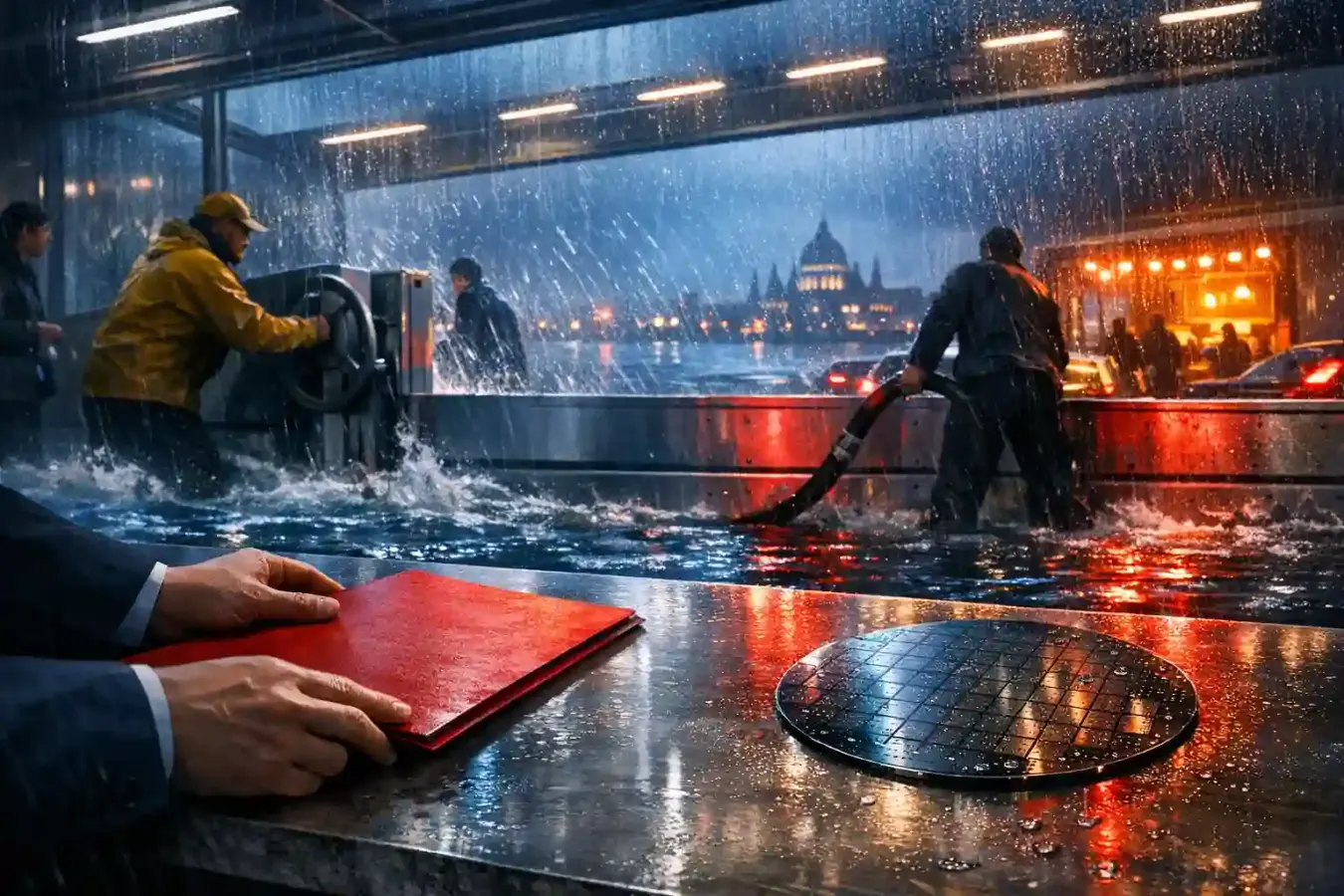
Tense diplomacy, domestic churn, and institutional strain Anonymous officials and workers manage documents, technology, fuel equipment, and flood barriers inside a rain-soaked civic ferry terminal.
Visual logic
The day is about institutions trying to hold pressure inside controlled channels: summit diplomacy, quiet backchannels, migration politics, accountability fights, and cultural distraction. A civic terminal turned crisis room gives the scene human scale and lets diplomacy, fuel scarcity, flood exposure, travel, and parliamentary strain occupy one believable public space. The flood barrier and sea-lane lighting create a visible counterforce, while the close material detail of a wet silicon wafer and worn documents anchors the geopolitical technology thread without making the image literal.
Concept
Containment Room
How it was framed
Composition focuses on Full-bleed edge-to-edge frame with no blank margins, Foreground anchor: wet table, anonymous hands, crimson folder, silicon wafer, Midground action: flood barrier being cranked shut in an inhabited civic hall, and Background depth: harbor lanes, generic parliamentary silhouettes, small warm stage light.
Visual direction leans on Grounded editorial civic realism, Tense but controlled atmosphere, Human-scale institutional environment under strain, and Atmosphere supports structure, not haze-dependent.
Material treatment uses rain-wet limestone, brushed steel table edge, etched silicon wafer, and rubber pump hoses to keep the image tactile rather than generic.
Color language is built around Strait Blue, Parliament Grey, Floodplain Ochre, and Signal Crimson.
Sources
Australia news live: defection speculation as ex-Liberal senator Hollie Hughes prepares to host Pauline Hanson at her NSW pub
Open sourceTrump China visit live: Beijing being ‘very pragmatic’ on Iran, says top US official, as Trump and Xi meet for final day of summit
Open sourcePauline Hanson claimed $16,000 for private charter despite claiming floods tour was at ‘no cost to taxpayer’
Open source‘We are not in Trump’s America’: migrant groups say Angus Taylor in race to bottom with far right
Open sourceLabour, u ok hun? - podcast
Open sourceCIA director has met officials in Havana for talks, Cuba claims
Open sourceRelated editions
The World Canvas for 2026-05-16
The day’s signals cluster around governments trying to manage pressure without clear resolution: US-China talks left the Jimmy Lai case unresolved while trade and semiconductor export controls remained largely outside the central discussion; Washington’s proposed Colorado River plan raised the prospect of steep water-supply cuts for Arizona, California and Nevada; and US authorities charged an Iraqi national over alleged attacks and plots targeting sites in the US and Europe. In Australia, scrutiny turned inward as transparency advocates warned that the national audit office may lack the funding needed to perform effective oversight, while the federal budget was also being packaged through increasingly platform-native political communication. Together, the picture is one of institutional stress, diplomatic caution and environmental scarcity shaping public life across regions.
The World Canvas for 2026-05-14
The day’s world-state is defined by political repositioning, high-stakes diplomacy, and institutions testing public trust. In Beijing, a Trump-Xi summit opens under heavy security with trade, AI, pollution visibility, and the war in Iran shaping the strategic agenda between the United States and China. In Australia, Labor gains Senate ground through Tammy Tyrrell’s defection but remains short of a majority, while a federal court ruling against Coles over misleading discount claims sharpens attention on cost-of-living pressure and corporate accountability. Cultural and social fault lines remain visible, from testimony at an antisemitism inquiry to a public apology after reported antisemitic and anti-gay remarks in Washington, while New Zealand’s Ockham awards offer a quieter counterpoint through recognition of fiction centered on gender, politics, and generational life.
The World Canvas for 2026-05-17
The day’s world-state is shaped by overlapping tests of public trust: renewed violence in southern Lebanon shortly after a ceasefire extension, continuing political realignment and tax-policy argument in Australia, and a major voting-rights mobilisation in Alabama after a consequential US supreme court decision. Cultural attention offered a counterweight, with Australia’s Eurovision result becoming a moment of national conversation, while wildlife-trafficking charges in the US pointed to the quieter pressures on biodiversity and enforcement systems. The overall atmosphere is not one of a single global rupture, but of institutions being pressed from multiple directions: electoral systems, ceasefire mechanisms, party coalitions, public budgets, and ecological protections.
The World Canvas for 2026-05-13
The day’s signals cluster around governments trying to redraw the boundaries of protection, taxation, and public responsibility under pressure. In Australia, the 2026 budget has opened a sharp fight over housing tax settings, with Labor defending changes to negative gearing and capital gains tax as a fairness measure while the opposition pledges repeal and parts of the media frame the package in highly ideological terms. Canberra is also preparing to contribute an E-7A Wedgetail surveillance aircraft to a multinational effort aimed at reopening the Strait of Hormuz, linking domestic cost-of-living concerns to wider energy and trade vulnerabilities. Alongside those headline pressures, an inquest into the death of Clare Nowland is revisiting police and care-sector responses to dementia, Northern Territory child protection reforms are drawing warnings from First Nations and legal advocates, and a proposed rollback of US toxic gas rules is renewing concern over the reach of public health regulation.
Method and provenance
Image prompt
Full-bleed edge-to-edge editorial civic realism at blue hour inside a rain-streaked ferry terminal converted into a temporary containment room: dominant subject is anonymous diplomatic hands sliding an unmarked crimson folder across a wet brushed-steel and limestone table, beside an etched silicon wafer beaded with water and cut by sharp directional light; surrounding counterforce is rising floodwater and institutional pressure visible through the glass. Camera at human table height with a strong diagonal from foreground folder to midground flood barrier to background harbor lanes. Midground: anonymous officials, aides, maintenance workers, and travelers move through the inhabited hall as one worker cranks a portable flood barrier shut and another steadies a rubber fuel hose near a queue of vehicles outside. Background: rain-blurred harbor lights, generic parliamentary silhouettes behind glass, and a small warm rehearsal stage glow, with overhead light tracks suggesting intersecting sea lanes and flight paths without labels. Spectacular but plausible visual turn: a hard gust drives rain across the glass as the flood barrier locks into place, throwing reflected blue and crimson light across the wet floor.
Full Source Layer for This News Digest
Australia news live: defection speculation as ex-Liberal senator Hollie Hughes prepares to host Pauline Hanson at her NSW pub
Open sourceTrump China visit live: Beijing being ‘very pragmatic’ on Iran, says top US official, as Trump and Xi meet for final day of summit
Open sourcePauline Hanson claimed $16,000 for private charter despite claiming floods tour was at ‘no cost to taxpayer’
Open source‘We are not in Trump’s America’: migrant groups say Angus Taylor in race to bottom with far right
Open sourceLabour, u ok hun? - podcast
Open sourceCIA director has met officials in Havana for talks, Cuba claims
Open source