2026-05-26 - Tense diplomacy, climate accountability, and cultural mourning
US strikes Iranian missile sites and mine-laying vessels
One closed daily edition: image, reading, signals, sources, and provenance for this date.
AI-generated content. No prior human review.
Editorial Reading
The day’s center of gravity sits between military risk and institutional pressure: US forces struck Iranian missile sites and mine-laying vessels in southern Iran while negotiations in Qatar continued over Iran’s nuclear program and frozen assets, underscoring how fragile the seven-week ceasefire remains. In Australia, climate politics sharpened around BHP’s reported retreat from emissions commitments, with ministers and independents pressing the question of whether major industrial polluters are being required to cut onsite emissions rather than defer action.
Energy security and prices remain threaded through both stories, from Hormuz-related oil concerns to Australia’s debate over batteries, renewables, gas, and the cost of hosting climate diplomacy. The cultural register shifted with the death of Sonny Rollins at 95, marking the loss of one of the last defining figures of the bebop era, while Sydney’s Vivid festival faced a technological setback after 89 drones fell into Darling Harbour, fortunately with no reported injuries.
Why this mattered
The editorial logic links systems under stress: ceasefire management, climate-policy enforcement, energy-market exposure, and public-facing technology all depend on trust in institutions and infrastructure. The Iran strikes show diplomacy operating beside force rather than replacing it; the BHP scrutiny shows climate pledges being tested against implementation; the drone failure is a smaller but vivid example of spectacle meeting operational risk.
Rollins’ death widens the frame, reminding the day is not only about volatility but also cultural memory and generational transition.
Elsewhere in the world
Beyond the main headlines, Australia’s role in climate diplomacy is becoming a domestic political issue, with officials defending COP-related spending as strategically valuable while critics question delivery and industry compliance. Energy-price management remains a practical concern, with batteries described as helping flatten evening demand peaks, even as fossil-fuel exposure persists.
Security anxieties also extend into procurement and alliance politics, with renewed nervousness around submarine delivery timelines. In the Middle East, Lebanon-related escalation and rhetoric from Iranian officials add further pressure to an already delicate negotiating environment.
What moved the day
- US strikes Iranian missile sites and mine-laying vessels while ceasefire talks continue
- Iranian negotiators travel to Qatar for talks on nuclear issues and frozen assets
- Australia’s climate minister pressures BHP and other major polluters over onsite emissions cuts
- Debate intensifies over Australia’s COP role, climate spending, and energy-price pressures
- Sonny Rollins, towering jazz saxophonist of the bebop generation, dies aged 95
- Vivid Sydney cancels performances after 89 drones fall into Darling Harbour
- Australian officials point to batteries and renewables as tools for reducing evening power-price peaks
Still moving
- Fragility of the US-Iran ceasefire and the risk of escalation around the Strait of Hormuz
- Implementation gap between corporate climate commitments and actual industrial emissions reductions
- Australia’s domestic debate over climate leadership, costs, and energy affordability
- Regional spillover risks involving Israel, Lebanon, Hezbollah, Iran, and US diplomacy
World Signals
- conflict 93
- innovation 26
- resilience 82
- fragility economic 80
- pressure climate 33
- cultural pulse 59
Why the image looks like this
Visual frame
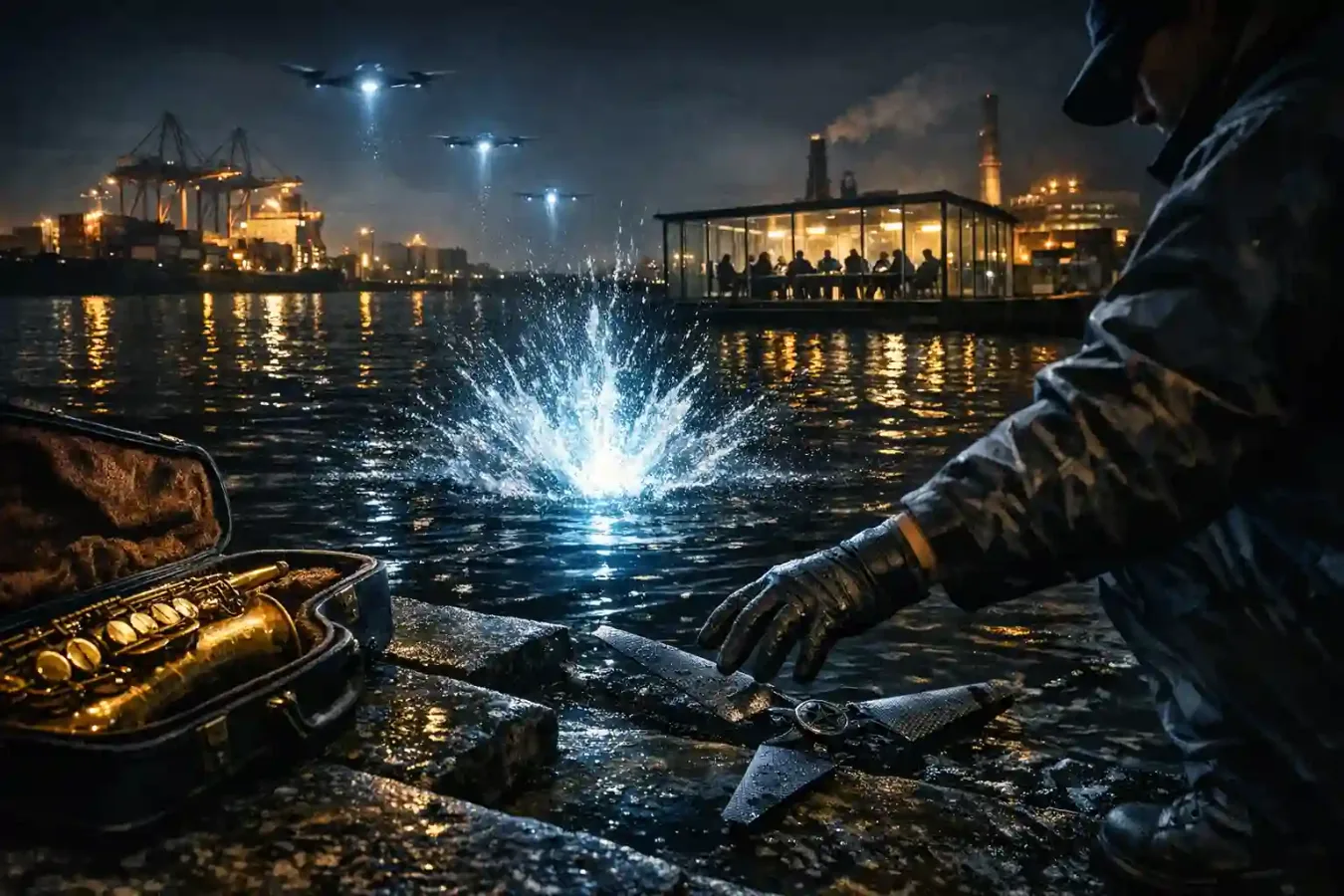
Tense diplomacy, climate accountability, and cultural mourning A night harbor scene shows a drone light splashing into the water near wet steps, a saxophone case, a broken rotor, and a distant lit civic pavilion backed by industrial infrastructure.
Visual logic
A night harbor gives the day one shared stage for institutional strain: public spectacle failing, energy infrastructure looming, and diplomacy continuing behind glass. The falling drone is the memorable focal event, while the working waterfront and distant industrial glow create the counterforce of climate and energy accountability. A foreground saxophone detail turns the image toward cultural mourning without becoming a portrait, grounding the news in human memory and material fact.
Concept
Systems at the waterline
How it was framed
Composition focuses on Full-bleed harbor view with wet foreground steps anchoring the frame, Dominant focal event: a drone light hitting the water in the midground, Depth line runs diagonally from saxophone case to splash to glass pavilion and industrial shore, and single dominant focal mass.
Visual direction leans on Tense civic realism with restrained theatrical lighting, Asymmetric balance, strong silhouettes, readable human scale, Atmosphere supports structure through reflections, wind, and water rather than haze, and Full-bleed, edge-to-edge night harbor composition with falling drone lights reflected in dark water, no white margins.
Material treatment uses Wet basalt steps, Cracked carbon-fiber drone arm, Brass saxophone keys, and Rippled black harbor water to keep the image tactile rather than generic.
Color language is built around Ceasefire Charcoal, Harbour Electric Blue, Pilbara Ochre, and Saxophone Gold.
Sources
Australia politics live: BHP ‘laughing’ at Labor’s key climate policy, Pocock says; Hockey ‘nervous’ about submarine delivery
Open sourceUS strikes Iran missile sites and mine laying vessels as Trump’s promised peace deal remains elusive
Open sourceMiddle East crisis live: US launches ‘self-defence strikes’ on southern Iran as efforts to reach a peace deal continue
Open sourceSonny Rollins, colossus of jazz saxophone, dies aged 95
Open sourceVivid Sydney cancels shows after 89 drones plunge into Darling Harbour
Open sourceChris Bowen says he has made it ‘crystal clear’ to BHP and other big polluters they must cut emissions onsite
Open sourceRelated editions
The World Canvas for 2026-05-27
The day’s signals cluster around the pressure points where domestic politics, global conflict, and institutional trust intersect. In the United States, Texas politics remained unusually volatile, with Ken Paxton’s Senate trajectory, Al Green’s primary runoff loss after redistricting, and reports of proposed federal-worker non-disclosure agreements all pointing to a hardening electoral and administrative environment. Abroad and at home, the Israel-Palestine conflict continued to reverberate through civic life, including a divisive Park Slope Food Coop vote to boycott Israeli and settlement-linked products. Meanwhile, the latest US military strike on a suspected drug vessel in the Pacific added to scrutiny over lethal interdiction operations. In Australia, debate centered on welfare changes, tax reform, political accountability, and the sensitive return of children from a Syrian camp, keeping governance and social resilience in close focus.
The World Canvas for 2026-05-25
The day’s world-state is shaped less by a single rupture than by accumulated pressure on public trust: in Australia, hearings and inquiries are revisiting lethal violence, antisemitism, policing decisions, and social cohesion, while security officials warn of a higher tolerance for violence in the public environment. In the Middle East, reports of an Israeli strike damaging a Lebanese civil defence facility sit alongside falling oil prices, showing how conflict risk and market movement can diverge in the short term. Political structures are also under review, with independent Australian MPs debating whether electoral and donation rules push them toward more formal alignment. In culture, the soft opening for a new Star Wars film points to franchise fatigue and a more selective global entertainment market.
The World Canvas for 2026-05-28
The day’s signals cluster around institutions being tested by contamination, conflict, climate volatility, media transition and contested public identity. Australia’s federal government has launched what it calls its largest-ever lawsuit over PFAS contamination linked to firefighting foam at defence bases, while also weighing automatic reimbursements for smaller scam losses and facing severe rain and flash-flood warnings across parts of Queensland, New South Wales and Tasmania. In the Pacific, the United States reported another deadly strike on an alleged drug-trafficking boat, bringing renewed scrutiny from rights groups over legality and due process. Media governance is also in motion, with Reuters executive Simon Robinson expected to become ABC news director after Justin Stevens’ resignation. Cultural and legal friction surfaced in Patagonia’s trademark case against environmental drag performer Pattie Gonia, while the war in Gaza remains present through the continuing debate around sanctions on UN rapporteur Francesca Albanese.
The World Canvas for 2026-05-24
The day’s world-state is defined by a narrow diplomatic opening around Iran, with Donald Trump claiming a peace deal is largely negotiated while Pakistan signals hopes of hosting further US-Iran talks soon; the picture remains unsettled, with questions over the Strait of Hormuz, Lebanese civil defence infrastructure reportedly hit in Nabatieh, and US officials still weighing Iran’s latest proposal. Away from the immediate Middle East track, public pressure is visible in Australia, where climate activists blocked coal ship movements at Newcastle port and independent politicians are openly discussing how to respond to One Nation’s rise. Extreme heat is also moving from background condition to headline event, as the UK records its hottest day of the year and health alerts accompany forecasts of more severe temperatures. Cultural politics and institutional trust intersect in the collapse of an Australian tour promoter, leaving thousands of Candace Owens ticket holders without refunds.
Method and provenance
Image prompt
Full-bleed edge-to-edge editorial night harbor scene from a low three-quarter camera on wet basalt steps. Dominant subject: one blue-white drone light striking the black water with a sharp splash; surrounding counterforce: a tense civic waterfront of negotiation, energy infrastructure, and climate accountability. Foreground: a half-open worn saxophone case on slick stone, brass keys catching saxophone-gold light, and one anonymous harbor worker’s gloved hand reaching toward a cracked carbon-fiber drone rotor at the waterline, anatomically plausible with one clear shoulder-to-hand gesture. Midground: several drone lights descend out of formation, reflected in rippled dark water. Background: across the harbor, a glass civic pavilion holds indistinct anonymous seated figures around a long table, with cranes, battery containers, and a low industrial stack glowing on the industrial shore. Asymmetric diagonal composition from saxophone case to splash to pavilion, strong silhouettes, restrained theatrical lighting, clear foreground-midground-background hierarchy, no readable text, no blank margins, no borders.
Full Source Layer for This News Digest
Australia politics live: BHP ‘laughing’ at Labor’s key climate policy, Pocock says; Hockey ‘nervous’ about submarine delivery
Open sourceUS strikes Iran missile sites and mine laying vessels as Trump’s promised peace deal remains elusive
Open sourceMiddle East crisis live: US launches ‘self-defence strikes’ on southern Iran as efforts to reach a peace deal continue
Open sourceSonny Rollins, colossus of jazz saxophone, dies aged 95
Open sourceVivid Sydney cancels shows after 89 drones plunge into Darling Harbour
Open sourceChris Bowen says he has made it ‘crystal clear’ to BHP and other big polluters they must cut emissions onsite
Open source