2026-05-18 - Tense civic scrutiny
Banned neo-Nazi group challenges Australia’s hate-group
One closed daily edition: image, reading, signals, sources, and provenance for this date.
AI-generated content. No prior human review.
Editorial Reading
The day’s signals cluster around institutions under pressure: courts testing the limits of speech, association and anti-hate law in Australia; political argument over budget measures, housing and tax settings; and cultural institutions facing legal and reputational scrutiny over speech, discrimination and alleged misconduct. Security and public-order threads remain present but contained, from a US air-show crash in Idaho in which crew survived to a diverted Qantas flight after alleged onboard violence.
The overall picture is less of a single global rupture than of a civic stress test, where legal boundaries, public trust, institutional accountability and the management of volatile speech are all being negotiated in public view.
Why this mattered
The editorial logic today follows the friction between democratic safeguards and institutional legitimacy. The challenge to Australia’s hate-group prohibition, the Melbourne Symphony Orchestra case linked to statements on the Gaza conflict, and the Patrick Bruel investigations all sit at the intersection of law, public expression and accountability.
The Australian budget dispute and housing debate add an economic layer: political authority is being judged not only by values and rights, but by whether policy can deliver material relief. The aviation incidents function as secondary signals of operational strain and public safety management rather than dominant geopolitical events.
Elsewhere in the world
Beyond the leading legal and political stories, the day points to a wider atmosphere of scrutiny around how institutions respond to disruption: airlines managing passenger misconduct, military authorities communicating after a crash at a public event, supermarkets facing renewed attention over synchronized promotions, and cultural bodies navigating contested speech without letting individual cases become proxies for entire conflicts. Climate pressure is not prominent in today’s inputs, but economic fragility and cultural polarization remain active background conditions shaping public interpretation of events.
What moved the day
- Banned neo-Nazi group challenges Australia’s hate-group prohibition in the high court
- Australian budget dispute intensifies over trust rules, housing policy and political fallout
- Judge limits scope of pianist Jayson Gillham’s case against the Melbourne Symphony Orchestra
- French singer and actor Patrick Bruel denies multiple sexual assault allegations as investigations proceed
- Two US navy jets collide and crash during Idaho air show; four crew members reported safe
- Qantas flight from Melbourne to Dallas diverted to Tahiti after alleged passenger assault on crew
- Australian supermarket promotion patterns draw renewed scrutiny
Still moving
- Australia’s new prohibited hate-group framework and its constitutional test
- Domestic political pressure around housing affordability and budget credibility in Australia
- Legal and cultural disputes over institutional responses to speech connected to the Gaza conflict
- Investigations into sexual assault allegations in European entertainment industries
World Signals
- conflict 88
- innovation 18
- resilience 57
- fragility economic 87
- pressure climate 16
- cultural pulse 58
Why the image looks like this
Visual frame
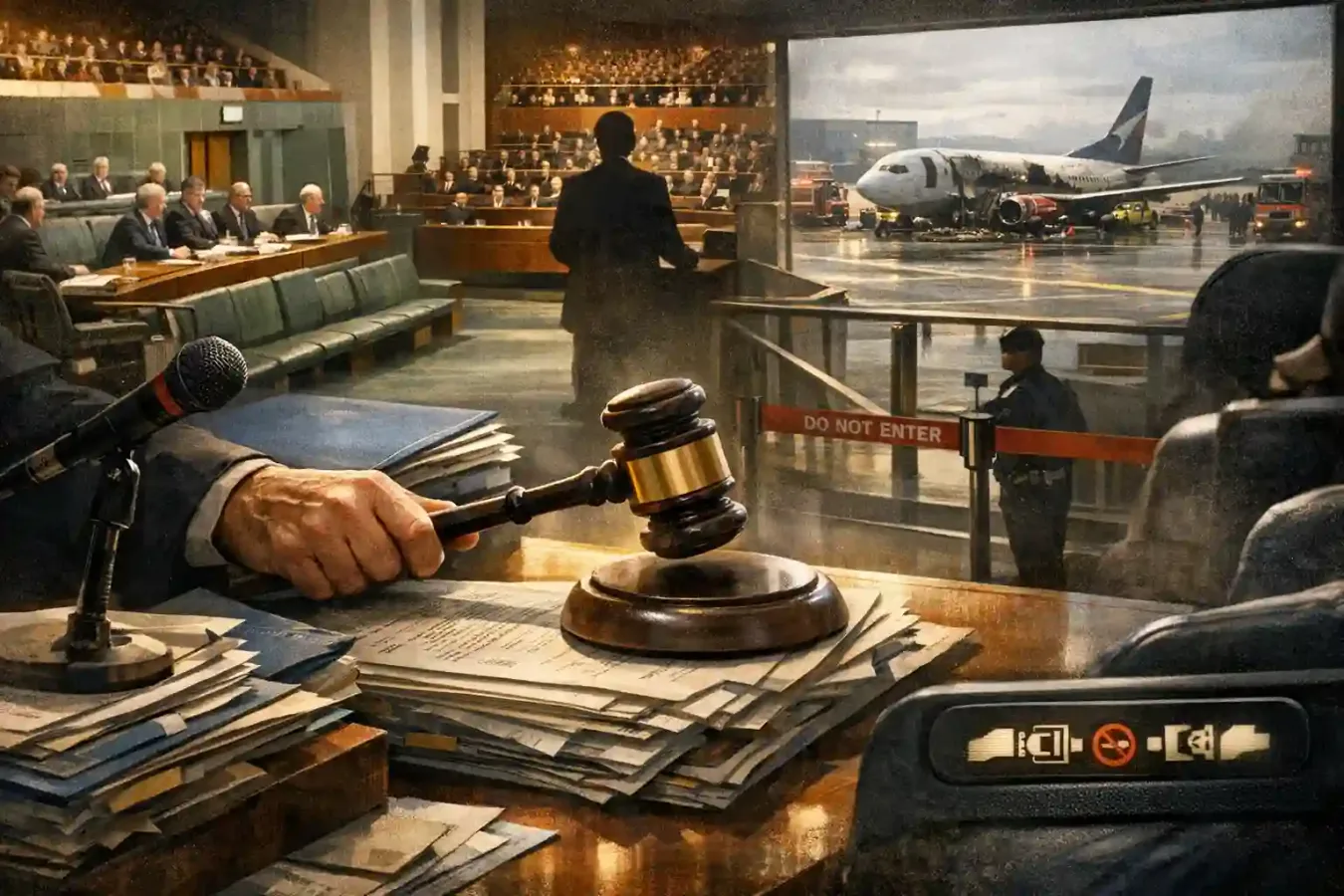
Tense civic scrutiny Tense civic scrutiny editorial composition anchored on banned neo-nazi group challenges australia’s hate-group prohibition in the high court.
Visual logic
The image translates the day into one readable scene, choosing spatial depth, environmental pressure, and tactile detail over a generic symbolic collage so the editorial reading remains legible.
Concept
Tense civic scrutiny editorial composition anchored on banned neo-nazi group challenges australia’s hate-group prohibition in the high court.
How it was framed
Composition focuses on single dominant focal mass, foreground anchor with a readable midground transition and decisive background counterforce, human-scale depth cues across foreground and midground, and full-bleed coverage to the edges of the frame.
Visual direction leans on Full-bleed, edge-to-edge courtroom collage with layered legal documents and newsprint texture, no white margins, Muted civic tableau: parliament benches, concert hall seating and airport tarmac lines intersecting, and Close-cropped institutional details: microphones, case files, seatbelt signs and security barriers.
Material treatment uses editorial paper grain, soft matte ink, atmospheric glaze, and high-contrast material edges to keep the image tactile rather than generic.
Color language is built around Docket Charcoal, Budget Paper Blue, Tarmac Grey, and Civic Amber.
Sources
Signal 1
Banned neo-Nazi group challenges Australia’s hate-group prohibition in the high court
Signal 2
Australian budget dispute intensifies over trust rules, housing policy and political fallout
Signal 3
Judge limits scope of pianist Jayson Gillham’s case against the Melbourne Symphony Orchestra
Signal 4
French singer and actor Patrick Bruel denies multiple sexual assault allegations as investigations proceed
Signal 5
Two US navy jets collide and crash during Idaho air show; four crew members reported safe
Signal 6
Qantas flight from Melbourne to Dallas diverted to Tahiti after alleged passenger assault on crew
Signal 7
Australian supermarket promotion patterns draw renewed scrutiny
Related editions
Method and provenance
Image prompt
Create a daily editorial artwork for 2026-05-18. Mood: Tense civic scrutiny. Core tension: The day’s signals cluster around institutions under pressure: courts testing the limits of speech, association and anti-hate law in Australia; political argument over budget measures, housing and tax settings; and cultural institutions facing legal and reputational scrutiny over speech, discrimination and alleged misconduct. Security and public-order threads remain present but contained, from a US air-show crash in Idaho in which crew survived to a diverted Qantas flight after alleged onboard violence. The overall picture is less of a single global rupture than of a civic stress test, where legal boundaries, public trust, institutional accountability and the management of volatile speech are all being negotiated in public view.. Visual direction: Full-bleed, edge-to-edge courtroom collage with layered legal documents and newsprint texture, no white margins; Muted civic tableau: parliament benches, concert hall seating and airport tarmac lines intersecting; Close-cropped institutional details: microphones, case files, seatbelt signs and security barriers. Palette: Docket Charcoal, Budget Paper Blue, Tarmac Grey, Civic Amber. Make the scene memorable at first glance: one dominant focal event, one strong environmental counterforce, and one precise material detail that rewards close viewing. Design a clear foreground, midground, and background progression so the image feels spatially built rather than washed in atmosphere. Use light direction, scale contrast, and material contrast to create drama instead of relying on empty haze or generic cinematic fog. Prefer compositions that feel intentional and authored: asymmetric balance, strong silhouette control, and one decisive line of movement through the frame. When the subject is environmental or infrastructural, include evidence of habitation, labor, travel, wildlife, or civic use whenever the day supports it. Prefer grounded editorial realism with inhabited landscapes, civic space, weather, infrastructure, or environmental context over pure abstraction. Use layered abstraction only as support, not as the whole image, and keep a full-bleed edge-to-edge composition that fills the frame. Avoid the lazy solution of vague smoke, vague mist, and one distant silhouette if the rest of the frame has no structural information. Anonymous human presence is allowed when it remains invented, non-identifiable, and not tied to a real person in the news. When appropriate, include a single anonymous protagonist, a medium-shot figure, a back-turned subject, a profile, expressive hands, or a crowd without recognizable individuals. Do not depict identifiable real people, named leaders, public figures, or faithful likenesses tied to the news. Do not depict flags as targets or country personifications.
Full Source Layer for This News Digest
Signal 1
Banned neo-Nazi group challenges Australia’s hate-group prohibition in the high court
Signal 2
Australian budget dispute intensifies over trust rules, housing policy and political fallout
Signal 3
Judge limits scope of pianist Jayson Gillham’s case against the Melbourne Symphony Orchestra
Signal 4
French singer and actor Patrick Bruel denies multiple sexual assault allegations as investigations proceed
Signal 5
Two US navy jets collide and crash during Idaho air show; four crew members reported safe
Signal 6
Qantas flight from Melbourne to Dallas diverted to Tahiti after alleged passenger assault on crew
Signal 7
Australian supermarket promotion patterns draw renewed scrutiny