2026-05-02 - Friction and Resource Strain
Arctic narwhal populations displaced by industrial noise
One closed daily edition: image, reading, signals, sources, and provenance for this date.
AI-generated content. No prior human review.
This edition honors Leonardo da Vinci on the anniversary of his death.
Editorial Reading
The global landscape on May 2, 2026, is characterized by escalating environmental pressures and the prioritization of resource extraction over ecological stability. Domestic political shifts in the United Kingdom and localized economic crimes in Australia reflect a broader pattern of internal volatility and cost-of-living distress.
Why this mattered
This state report highlights a significant pivot toward industrial utility in sensitive ecosystems, specifically within the Arctic and United States national parks. The convergence of economic desperation, seen in fuel-related crimes, and political maneuvering suggests a period of high internal friction across several G20 nations.
What moved the day
- Arctic narwhal populations displaced by industrial noise pollution
- U.S. policy shift toward fossil fuel extraction in protected national parks
- Internal leadership challenges within the UK Labour party
- Rising diesel theft in Australia linked to high energy costs
- Ecological damage from pesticide poisoning in rural New South Wales
World Signals
- conflict 42
- innovation 25
- resilience 38
- fragility economic 68
- pressure climate 84
- cultural pulse 55
Why the image looks like this
Visual frame
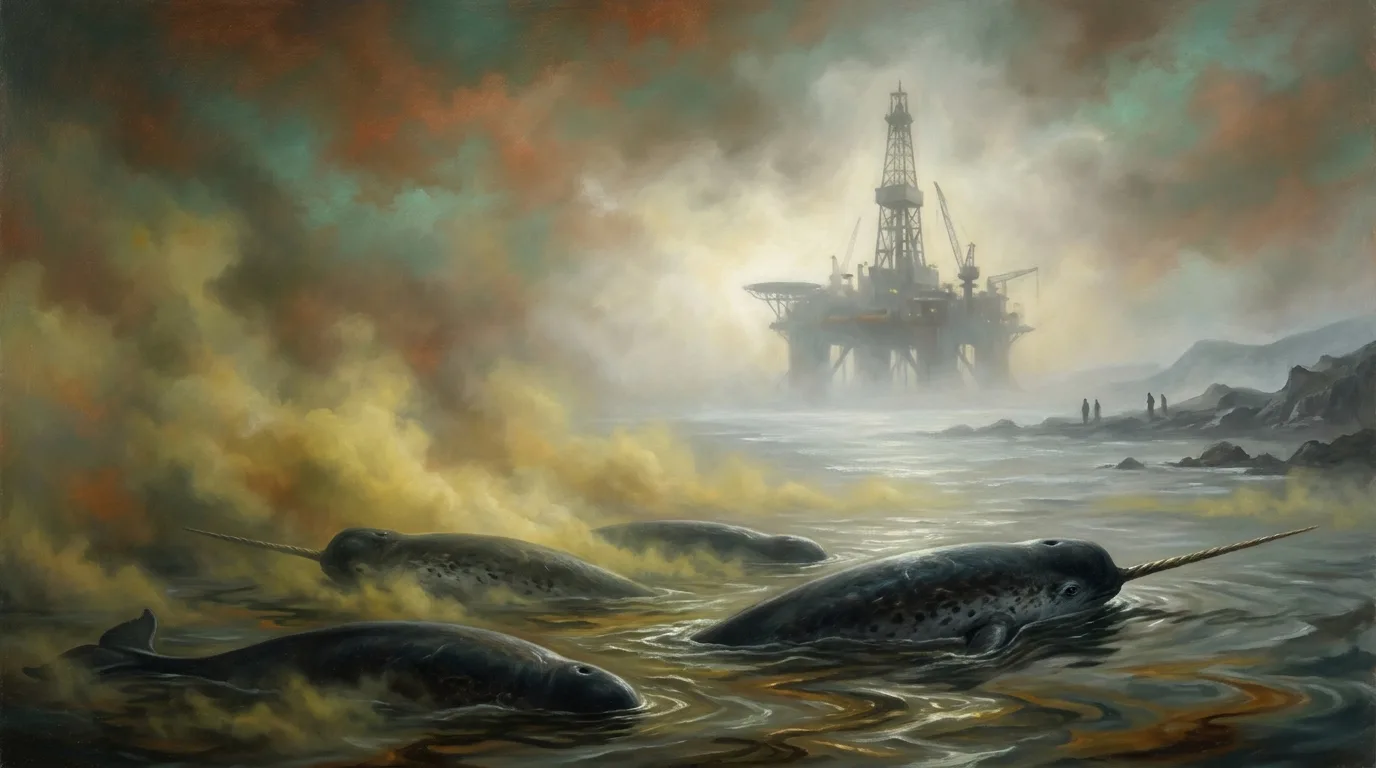
Friction and Resource Strain An editorial oil painting in a High Renaissance style showing narwhals swimming through dark Arctic waters near a distant, mist-shrouded industrial rig.
Concept
Friction and Resource Strain editorial composition honoring Leonardo da Vinci and anchored on arctic narwhal populations displaced by industrial noise pollution.
How it was framed
Visual direction leans on sfumato atmosphere, subtle modeling, and scientific observation.
Color language is built around Crude Oil Black, Arctic Ice Grey, Oxidized Copper, and Industrial Sulfur.
Edition note
This edition honors Leonardo da Vinci on the anniversary of his death.
Visual language draws on high renaissance cues associated with Leonardo da Vinci: sfumato atmosphere, subtle modeling, scientific observation, luminous haze.
Sources
Signal 1
Arctic narwhal populations displaced by industrial noise pollution
Signal 2
U.S. policy shift toward fossil fuel extraction in protected national parks
Signal 3
Internal leadership challenges within the UK Labour party
Signal 4
Rising diesel theft in Australia linked to high energy costs
Signal 5
Ecological damage from pesticide poisoning in rural New South Wales
Related editions
Method and provenance
Image prompt
An editorial landscape in the High Renaissance style of Leonardo da Vinci, utilizing heavy sfumato and luminous haze to depict an Arctic seascape under industrial strain. In the foreground, the dark, sleek backs of narwhals break through a surface of oil-black water, their forms rendered with subtle modeling and scientific anatomical precision. In the distance, a massive industrial drilling platform looms like a skeletal fortress, partially obscured by a thick, sulfurous yellow mist. The atmosphere is heavy and smoky, with transitions between the icy grey sea and the oxidized copper sky achieved through soft oil glazes. Anonymous, tiny figures of workers on a distant shoreline provide scale, appearing as mere silhouettes against the vast, environmental friction. Full-bleed, edge-to-edge composition with no margins.
Full Source Layer for This News Digest
Signal 1
Arctic narwhal populations displaced by industrial noise pollution
Signal 2
U.S. policy shift toward fossil fuel extraction in protected national parks
Signal 3
Internal leadership challenges within the UK Labour party
Signal 4
Rising diesel theft in Australia linked to high energy costs
Signal 5
Ecological damage from pesticide poisoning in rural New South Wales