2026-04-30 - Strained yet transformative
US Supreme Court weakens key Voting Rights Act provisions
One closed daily edition: image, reading, signals, sources, and provenance for this date.
AI-generated content. No prior human review.
Editorial Reading
The global landscape on April 30, 2026, is marked by significant institutional shifts and environmental tensions. In the United States, a Supreme Court ruling has curtailed key components of the Voting Rights Act, prompting urgent warnings from civil rights groups regarding the future of democratic participation.
This legal contraction is mirrored by a pivot in energy policy as federal lands are opened for intensified resource extraction, heightening the friction between economic imperatives and conservation goals. Conversely, the European Union has moved to solidify personal protections by backing a stringent 'only yes means yes' definition of consent.
In the cultural sphere, the African music industry is actively negotiating the integration of generative artificial intelligence, seeking to harness innovation while safeguarding the authenticity of regional sounds against digital homogenization.
Why this mattered
The editorial focus today bridges the gap between high-level judicial decisions and their long-term impact on social and ecological systems. The core tension lies in the deregulation of established protections—both in the electoral and environmental domains—contrasted with a global push for more granular legal and cultural safeguards.
We are tracking how institutional rollbacks in the West coincide with technological adaptation in emerging markets, suggesting a world in the midst of a complex, multi-polar reordering of rights and resources.
Elsewhere in the world
Beyond the primary headlines, the signals suggest a deepening crisis in biodiversity as industrial noise permeates previously silent habitats. While human legal structures are being debated in courts, the ecological baseline is shifting due to acoustic pollution in the Arctic.
This suggests that even as geopolitical actors focus on internal sovereignty and resource independence, the planetary commons remain under immense, uncoordinated pressure.
What moved the day
- US Supreme Court weakens key Voting Rights Act provisions
- Major US policy shift opens nature reserves to energy drilling
- African music industry debates AI risks to cultural authenticity
- EU lawmakers endorse 'only yes means yes' rape definition
- Arctic narwhal populations stressed by increasing maritime noise
- Civil rights groups organize following judicial setbacks in Washington
Still moving
- Rollback of environmental protections in North America
- Standardization of consent laws across the European Union
- The evolution of AI governance in global creative industries
- Monitoring democratic integrity and voting access trends
World Signals
- conflict 68
- innovation 74
- resilience 52
- fragility economic 48
- pressure climate 88
- cultural pulse 81
Why the image looks like this
Visual frame
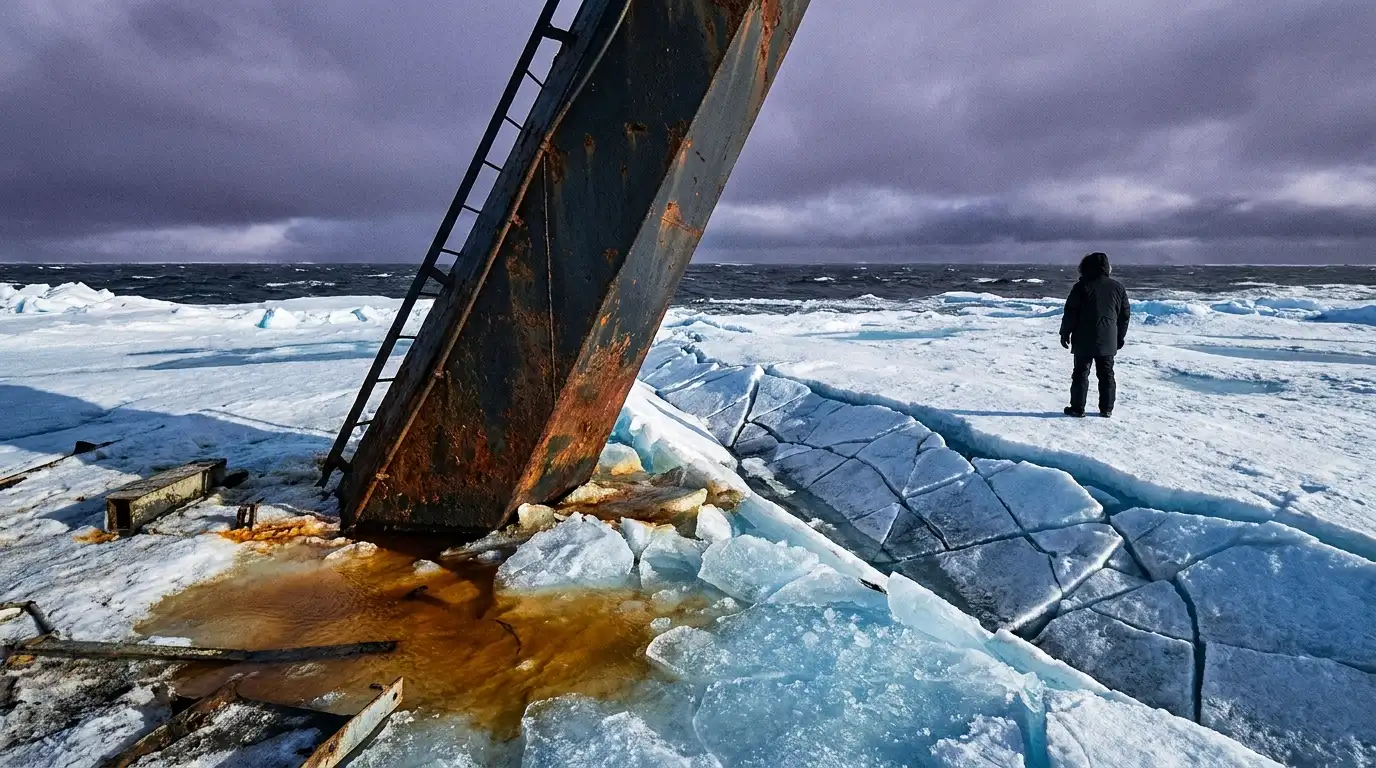
Strained yet transformative An editorial image of a lone figure standing on a cracked Arctic ice shelf next to a massive rusted industrial pylon and a pool of amber oil under a dark violet sky.
Visual logic
The scene uses the Arctic as a stage for the day's broader themes of extraction and structural instability. The industrial pylon represents the policy shift toward resource drilling, while the geometric fracturing of the ice shelf mirrors the 'dissolving' nature of the Voting Rights Act provisions. The lone figure provides a human scale to the institutional and environmental shifts, grounding the high-level judicial and policy changes in a tangible, inhabited reality.
Concept
The Fractured Mandate
How it was framed
Composition focuses on Asymmetric wide-angle shot with a heavy foreground anchor, Deep spatial progression from industrial machinery to a fractured horizon, Diagonal movement created by a massive fissure cutting through the frame, and Full-bleed, edge-to-edge composition with no margins or borders.
Visual direction leans on High-grain tactile photography, Strong silhouette control, Scale contrast between human and infrastructure, and Intentional use of light to define material texture.
Material treatment uses Crystalline permafrost, Oxidized industrial steel, Viscous amber-tinted fluid, and Heavy, low-hanging atmospheric vapor to keep the image tactile rather than generic.
Color language is built around Ballot Box Charcoal, Permafrost Blue, Crude Amber, and Legislative Violet.
Sources
‘A day of loss for our democracy’: civil rights groups slam supreme court ruling that weakens key part of Voting Rights Act – as it happened
Open source'Drill baby drill' ― Trump opens up nature to big energy
Open source‘It will never cover what’s authentic’: African music industry weighs up AI risks and rewards
Open source'Marine unicorns' aren't loving Arctic noise
Open source'Only yes means yes' rape definition backed by EU lawmakers
Open sourceRelated editions
Method and provenance
Image prompt
A wide-angle, full-bleed editorial photograph of a massive, oxidized steel pylon in Ballot Box Charcoal piercing a fractured Arctic ice shelf. In the immediate foreground, a pool of viscous Crude Amber fluid seeps into crystalline Permafrost Blue ice, highlighting the rusted texture of the metal. A deep diagonal fissure, intricately cracked into a dissolving geometric grid, cuts through the midground where a lone, anonymous figure in a dark parka stands with their back to the camera. The background opens to a churning dark sea under a heavy, low-hanging Legislative Violet sky. Sharp directional light catches the jagged crystalline edges and the tactile grit of the industrial debris. High-grain tactile photography with a strong focal hierarchy.
Full Source Layer for This News Digest
‘A day of loss for our democracy’: civil rights groups slam supreme court ruling that weakens key part of Voting Rights Act – as it happened
Open source'Drill baby drill' ― Trump opens up nature to big energy
Open source‘It will never cover what’s authentic’: African music industry weighs up AI risks and rewards
Open source'Marine unicorns' aren't loving Arctic noise
Open source'Only yes means yes' rape definition backed by EU lawmakers
Open source